Physicists from CERN in Switzerland have made another scientific breakthrough that could answer an age-old cosmological question: how did our universe come to be?
While you may be familiar with the term antimatter from science-fiction shows like Star Trek, it’s actually a real thing. Scientists know it exists — small amounts of it rain down on us all the time — but capturing it and actually seeing it has been tricky.
The theory is that when the universe was created in a violent explosion — the Big Bang — equal amounts of antimatter and matter were created. When antimatter and matter come together, they should annihilate one another, leaving nothing but energy behind. However, we live in a world where matter far outweighs antimatter, something that has stumped physicists.
In a study published in the journal Nature on Monday, CERN’s physicists used a laser to precisely measure the optical properties, or spectroscopy, of antihydrogen contained in an antimatter “trap.” Scientists found that hydrogen and antihydrogen contained the same properties, something that Einstein’s theory of general relativity had previously concluded.
Canadian researchers, part of the Antihydrogen Laser Physics Apparatus (ALPHA) team at CERN, participated in the successful experiment.

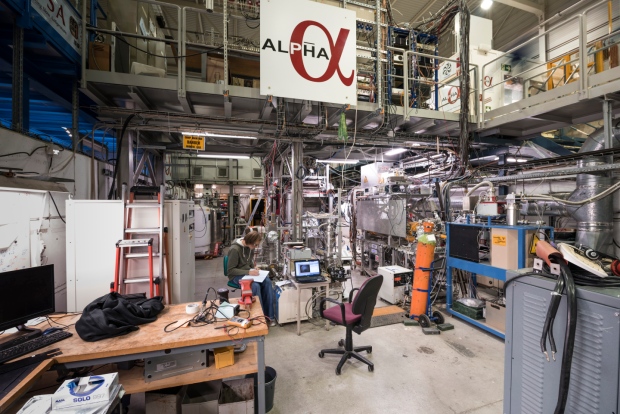
The ALPHA laboratory at CERN in Geneva, Switzerland. (2016 CERN)
Makoto Fujiwara, a research scientist who leads the ALPHA-Canada group, explained why the discovery was so important.
“According to laws of physics, the basic properties of matter and antimatter have to be exactly the same. If you see any difference, not ony would physics be in trouble, the whole universe would be in trouble.”
The researchers have specifically focused on studying antihydrogen for two reasons: one, it is the most abundant in our universe, and two, because it is also the most precisely measured, up to 15 decimal places.
‘It’s one of those kind of mysteries that only keeps a physicist awake at night.’ – Scott Menary, York University
This experiment measured antihydrogen to within 10 decimal places.
The researchers didn’t really expect to see a difference, something that Scott Menary, from Toronto’s York University and part of ALPHA-Canada said was a bit disappointing, since it doesn’t solve the puzzle as to why matter triumphed over antimatter.
“A difference would at least give us an entry way of an explanation of what happened,” he told CBC News. “At the moment, nobody knows where to look.
“It’s one of those kind of mysteries that only keeps a physicist awake at night.”
What’s next
The concept of antimatter was first put forth by British physicist Paul Dirac who surmised that, just like the mathematical equation x²=2 has two possible solutions (x=2 or x=-2) so should the universe — one with a positive solution and one with a negative.
Antimatter atoms were first created in 1995, but were fleeting. After decades of trying to capture it, scientists were finally successful in 2010.
And while physicists have been able to create and capture antimatter like antihydrogen, the idea of using it to power spaceships isn’t something that’s even on the horizon: the amount that has been created since the 1950s would only be powerful enough to light a match.
The next phase of the group’s experiment, ALPHA-G, will study gravitational forces on antihydrogen, and is expected to take place at the end of 2017. Specifically, the researchers want to see if antihydrogen will “fall up,” suggesting that the two repel each other. If it does— which Menary is somewhat skeptical about — it could mean that half the galaxies we see are antimatter galaxies.
The physicists hope that eventually their experiments will provide scientists with yet another piece in the puzzle as to how our universe came to be.