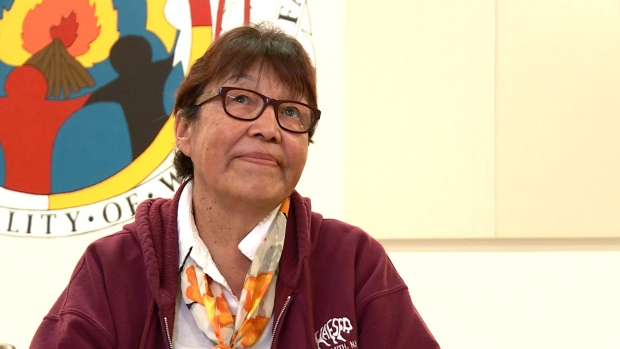
Not everyone in Fort Chipewyan is convinced a UNESCO tour of the Wood Buffalo National park and the connecting inland delta will make a difference to its fragile eco-system which the community said is, “drying out.”
“Will it go anywhere. I hope so. Do I believe that it will go anywhere? No,” Alice Rigney said.
“I hope they prove me wrong because I will be the happiest woman.”

Alice Rigney is a hunter, owns a cabin on the land and is a member of the Athabasca Chipewyan Nation. (David Thurton/ CBC News)
Two UNESCO monitors are on a mission to determine whether the United Nation’s body should place the World Heritage Site under the status, “in danger.”
For years Cree, Dene and Metis have been saying the park and the connecting Peace River Athabasca Delta is disappearing. They say B.C.’s Bennett Dam and upstream oilsands contaminants have harmed the area’s fragile eco-system.
Land users have said they weren’t able to hunt or fish in traditional areas because low water levels have meant they couldn’t access traditional lakes.
“We can’t get to the lakes where the birds are. We can’t get to the lakes where the moose are,” Rigney said.
‘A big deal’
Canadian’s and the government should be taking the UNESCO monitoring mission seriously, said Alison Woodley who directs Canadian Parks and Wilderness Society’s park program.
“It is a big deal to have a reactive monitoring mission sent to a world heritage site,” Woodley said.
Worldwide, UNESCO considers 55 World Heritage sites to be in danger. Woodley said when Canada accepts the responsibility of a World Heritage Site it must protect it otherwise it could lose the title.

Fort Chipewyan sits on Lake Athabasca and the edge of Wood Buffalo National Park. The community is at the forefront of calling for park to be designated ‘in danger.’ (David Thurton/ CBC News)
The government of Canada acknowledges that if UNESCO lists Wood Buffalo National Park as an “in danger” site it wouldn’t reflect well on Canada’s environmental image as a developed nation.
“The optics of having the danger listing are not ideal,” said George Green, who is Vice-President of Parks Canada’s Indigenous Affairs and Cultural Heritage Directorate.
Green represents Canada at UNESCO when it comes to World Heritage Sites and was in Fort Chipewyan while the monitors were on their tour.
Not legally binding
Green said despite the unfavourable public relations spin from a danger listing UNESCO’s decision wouldn’t force the federal government to change it’s actions when it comes to managing the park and the surrounding area.
“The decision and how we react is solely in Canada’s control,” Green said.
“The world heritage committee cannot impose any legislative or regulatory restrictions on a sovereign nation such as Canada.”

Parks Canada’s George Green represents Canada at UNESCO when it comes to World Heritage Sites. (David Thurton/ CBC News)
Green said the Canadian government supports the UNESCO mission into the park, which will issue a list of recommendations in July.
‘The world heritage committee cannot impose any legislative or regulatory restrictions on a sovereign nation such as Canada.’ – George Green
“It’s too early to prejudge the outcome of this exercise,” Green said, “The mission report will come out and Canada will have an opportunity to figure out how it will respond.”
He said Parks Canada also welcomes the monitoring mission.
Regardless of the result, Green said, Parks Canada will receive recommendations that could help it better manage Wood Buffalo National Park.
“It’s not meant to be a punishment. Obviously the way its worded has a negative connotation,” Green said.
“But it was meant originally to focus attention efforts that need to be brought to bear to protect the site.”
‘It’s a start’
Fisherman, hunter and Mikisew Cree band member, David Campbell, understands the danger designation won’t necessarily mean a change overnight for his community and park.
But he’s open to the process and its outcomes.

Low water levels are a constant concern for residents of Fort Chipewyan who fear the lakes, rivers and channels that feed into Lake Athabasca will soon dry up. (Mikisew Cree First Nation/ Submitted)
“I wish UNESCO had more influence in there. Yeah, that’s for sure,” Campbell said.
“It’s a start. We have to start somewhere and work our way up the system.”
The berries, fish, muskrats and moose are too precious, Campbell said, for him and other First Nations communities to not explore every avenue.
Follow David Thurton, CBC’s Fort McMurray correspondent, on Facebook, Twitter and via email.