First Nations on B.C.’s Central Coast are worried about environmental damage after a tug boat and empty fuel barge ran aground early this morning near Bella Bella.
The Nathan E. Stewart and the fuel barge DBL 55 crashed on Edge Reef, in Seaforth Channel near Athlone Island, just after 1 a.m. PT. The tug was southbound from Alaska and while the fuel barge was empty, the tug was leaking diesel.
“It’s a tug so it won’t have as much as a vessel, but it will have a good few thousand litres on board,” said Kevin Obermeyer, CEO for Pacific Pilotage Authority.
“Any kind of a spill is significant. None of us want to see any kind of a spill on this coast whether it’s diesel, gasoline, crude oil.”

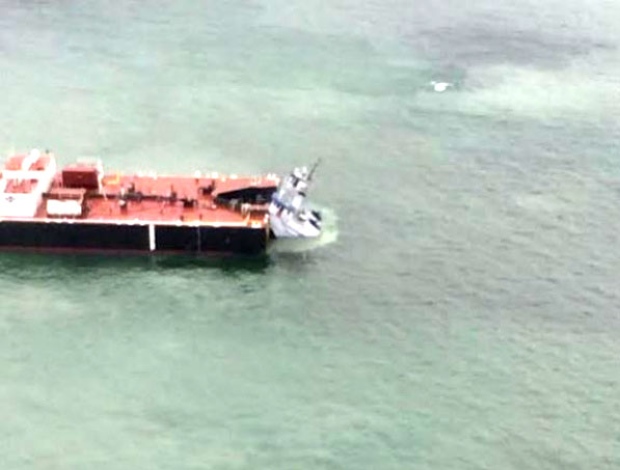
An aerial photo of the sinking tug boat. (Elizabeth Harris)
Members of the Heiltsuk Nation responded to the scene, along with the Canadian Coast Guard, and are monitoring the environmental effects of the spill.
They report that three fuel tanks on the tug were compromised and that vessel has now sunk.
“Things don’t sound promising from the chatter we are hearing on the radio,” said Heiltsuk tribal councillor Jess Housty.
The Coast Guard confirmed the tug sank but said it is still connected to the barge, which is stable.
“The tug is submerged and leaking some diesel, which is expected to dissipate and break-up,” said Coast Guard spokesperson Michelle Imbeau in an email.

The sheen of diesel can be seen on the water near where the tug boat sank after running around. (Ingmar Lee)
But the spill threatens dozens of species that are harvested in the area, including manila clam beds that provide income of up to $150,000 per year for the community, according to the Heiltsuk.
“It’s a significant part of our local winter economy. That clam fishery was due to open in about three weeks,” said Marilyn Slett, chief councillor for the Heiltsuk Tribal Council.
Slett said the nearby Gitga’at Nation is still unable to harvest seaweed and clams because of pollution from the sinking of the Queen of the North ferry a decade ago.
Vessel had pilotage exemption
Seven people were onboard the tug at the time of the grounding. No injuries were reported, said Michelle Imbeau, a spokesperson for the Canadian Coast Guard.
Weather conditions provided for visibility of eight miles when the tug and barge ran aground, and the wind was blowing at nine knots, she said.
The tug and barge are owned by the U.S. company Kirby Offshore Marine. It said the Western Canada Marine Response Corporation has deployed vessels and crew from a base in Prince Rupert several hundred kilometres away.
“A mobile skimming vessel, boom skiff, work boat, and tug, along with a total of 2,500 feet of boom, have been deployed to the scene,” Jim Guidry, Kirby’s incident commander, said in a statement.
“Owners and managers of the Nathan E. Stewart regret that this incident has occurred and are working to respond and mitigate the impact.”

The Heiltsuk Nation is worried diesel that escaped from the damaged tug boat will contaminate the environmentally sensitive harvesting area. (Elizabeth Brown)
The incident shows the need for improved spill response for the area, the Heiltsuk Nation said, adding it could take up to 24 hours for spill response ships to arrive from Prince Rupert.
U.S. vessels that are under 10,000 gross tonnage, such as the Nathan E. Stewart, are often allowed to operate without a local pilot on the West Coast of Canada, if the crew meets a minimum standard of experience and licensing, Obermeyer said.
“We’ve removed the waiver pending [the] result of [the] investigation,” he said.
With files from Ash Kelly, George Baker, Andrew Kurjata