Walking back to the car
after a recent screening of “Miss Peregrine’s Home for Peculiar Children,” my
movie-savvy, nearly-seven-year-old son took my hand and asked me sweetly: “Mommy,
what was that about?”
Um … er … well …
The short answer (which
probably wasn’t terribly helpful to him) was: It’s “X-Men” meets “Groundhog
Day.” The real answer, which required a lot of stumbling and bumbling and
twists and turns, was far more lengthy (and probably not terribly helpful, either).
Because even though I’d just seen the exact same movie my son had, I wasn’t
sure I completely understood it, either.
The latest adventure
from Tim Burton would seem tailor-made for his tastes but it’s a convoluted
slog, dense in mythology and explanatory dialogue but woefully lacking in
thrills. It’s been a matter of diminishing returns with Burton for the past
several years now between “Alice in Wonderland,” “Dark Shadows” and “Big Eyes”
(although the animated “Frankenweenie” found the director in peak retro form).
“Miss Peregrine’s Home for Peculiar Children” allows him to show only brief glimmers of the gleefully
twisted greatness of his early work such as “Pee-wee’s Big Adventure” and
“Beetlejuice.” The characters here are supposed to be delightful—or at least
interesting—simply because they’re superficially odd, and it just isn’t
enough anymore. Too often, it feels like we’ve seen this movie before—and
seen it done better.
Although the film (based
on the novel by Ransom Riggs) is populated by an assortment of peculiars, as
they’re known—kids born with unusual abilities that make it difficult for
them to live in the outside world—precious few of them feel like actual human
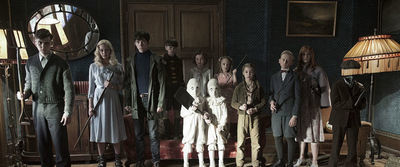
beings whose lonely plight might carry some emotional resonance. There’s Emma
(Ella Purnell), the pretty blonde who has to wear lead shoes so she doesn’t fly
away. There’s Olive (Lauren McCrostie), the redhead who has to wear gloves so
she doesn’t accidentally set things on fire. There’s the girl with a ravenous
maw hidden on the back of her head. The invisible boy who likes to play tricks.
The girl who can make things grow super fast. The boy who can project images
through his eyeball. The creepy, masked twins. They flit in and out, do the
thing they do, and ta da! Then they’re gone without leaving much impact.
Their leader is the
stylish and formidable Miss Alma LeFay Peregrine, played by Eva Green, who nearly saves
the day simply by showing up with that vampy, riveting screen presence of hers.
With a shocking swoop of midnight-blue hair and an array of gorgeous gowns
from frequent Burton costume designer Colleen Atwood, she has the ability to
manipulate time (and turn into a bird, which seems unrelated). But that isn’t
enough. She also has to be extra quirky by smoking a pipe.
And the seemingly
regular kid who stumbles upon all these freaks and geeks is the incredibly
boring Jake, played by “Hugo” star Asa Butterfield. He’s our wide-eyed conduit,
so of course he has to function as the straight man in such a wildly fanciful
world. But there’s just nothing to him, and the young British actor’s American
accent seems to flatten him further.
You may have noticed I
haven’t tried to describe the plot yet. Yes, I am procrastinating.
Shy, teenage Jake lives
in a bland tract house in suburban Florida (on the same street as Edward
Scissorhands, possibly). He dreams of being an explorer, he says, but he would
seem to lack the requisite get-up-and-go. All his life, he’s heard his beloved
grandfather (Terence Stamp, who departs far too quickly) tell him outlandish stories
about his own youth on an island off the coast of Wales, where he grew up at an
orphanage for misfits with magical powers.
After Grandpa dies under
mysterious circumstances, Jake convinces his parents (Chris O’Dowd and a
frustratingly underused Kim Dickens), with the help of his grief counselor
(Allison Janney), that he should visit the island and try to find this
mysterious home in hopes of achieving closure. Dad tags along to take
photographs of birds and drink beer at the pub full of crotchety locals.
(Cinematographer Bruno Delbonnel, whose work includes the Coen brothers’
luscious, black-and-white “Inside Llewyn Davis,” does make the foggy Welsh
setting look severe and dramatic.)
When Jake finally does
find the stately, gothic home his grandfather had told him about, he discovers
it’s in ruins, the result of a bombing decades earlier during World War II. But
once he steps inside and begins investigating, the inhabitants dare to pop
their heads out and the place comes colorfully to life. Seems they’re stuck in
a time loop, doomed to repeat the same day in September 1943 right up until the
moment the Nazi bomb fell on them. The time-conscious Miss Peregrine explains
that she winds the clock back 24 hours at the end of each night, just before the
moment of destruction, allowing everyone to relive that day all over again.
Doesn’t that sound fun?
Are you still paying attention?
Anyway, for some reason,
all the kids want Jake to stick around, ostensibly because they haven’t seen a
fresh face in about 70 years, and his will do. But they’re all in danger, you
see, because just as there are good mutants in the “X-Men” world, there are
also bad ones. Here, they’re the peculiars who use their powers to take over
other time loops, or something. And they way the stay alive is by eating
people’s eyeballs, or something. Their leader is the courtly yet menacing Mr.
Barron, whom Samuel L. Jackson plays with the kind of scenery chewing he could
do in his sleep. But what they want is never clear, so they’re never truly
frightening.
The supposedly epic collision between good and
evil results in exactly one exciting action set piece. It involves stop-motion
animated skeletons battling an army of long-limbed, eye-gouging mercenary
giants at a boardwalk amusement park, and it’s the only scene that vividly
recalls the kind of artistry and absurd humor that long have been Burton’s
trademarks. And the peculiar who makes it all happen has the most useful—and
the most ethically intriguing—ability of all. Enoch (Finlay MacMillan) can
bring things back to life—a person, a creepy doll—by inserting a beating
heart into it. Unfortunately, though, he ends up being just another cog in the
particularly dull machinery.