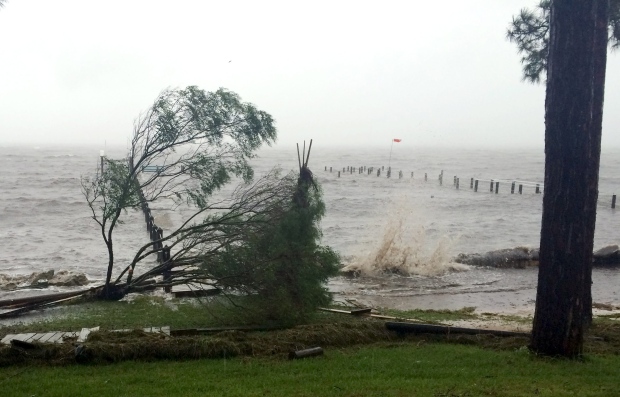
Hurricane Hermine gained new strength Thursday evening and roared ever closer to Florida’s Gulf Coast, where rough surf began smashing against docks and boathouses and people braced for the first direct hit on the state from a hurricane in over a decade.
The U.S. National Hurricane Center said the storm’s winds rose from 120 kilometres per hour in the afternoon to 129 kilometres per hour by evening as the former tropical storm gained new fury.

In this image made from a video, rough surf smashes the shore as Hurricane Hermine nears the coast in Carabelle, Fla. (Joshua Replogle/Associated Press)
Hermine was expected to blow ashore late Thursday or early Friday along the state’s Big Bend — the mostly rural and lightly populated corner where the Florida peninsula meets the Panhandle — then drop back down to a tropical storm and push into Georgia, the Carolinas and up the East Coast with the potential for drenching rain and deadly flooding.
Florida Gov. Rick Scott warned of the danger of strong storm surge, high winds, downed trees and power outages, and urged people to move to inland shelters if necessary and make sure they have enough food, water and medicine.
“This is a life-threatening situation,” Scott said. “It’s going to be a lot of risk. Right now, I want everybody to be safe.”
There goes the power plant… #HurricaneHermine pic.twitter.com/yT4I7bPCPW
Courtney Chason in Carabelle along the coast watched with his girlfriend Thursday evening as storm surge began smashing into docks and boathouses, covering some in angry surf that slowly tore at the structures. Water also was crashing into yards near the shore.
“I’ve never seen it this high, it’s pretty damn crazy,” said Chason. “I hope it doesn’t get any higher, we need lots of prayers.
Georgia, North Carolina brace for aftermath
Scott added that 6,000 National Guardsmen in Florida are ready to mobilize after the storm passes. The governors of Georgia and North Carolina declared states of emergency.
As of 8 p.m. ET, Hermine was in the Gulf of Mexico, centreed about 73 kilometres south-southeast of Apalachicola, Fl., and was moving north-northeast at about 22 kilometres per hour. Forecasters said it would still strengthen slightly some more before blowing ashore but would still be only a Category 1 hurricane.
Projected rainfall ranged up to 25 centimetres in parts of northern Florida and southern Georgia, with 10 to 25 centimetres possible along the coasts of Georgia and the Carolinas by Sunday. Lesser amounts were forecast farther up the Atlantic Coast, because the storm was expected to veer out to sea.
Residents on some islands and other low-lying, flood-prone areas in Florida were urged to clear out. Flooding was expected across a wide swath of the Big Bend, which has a marshy coastline and is made up of mostly rural communities and small towns, where fishing, hunting and camping are mainstays of life.

Andre Anton has been gathering his family’s belongings as the rain pours inside of his home after a large tree crashed through the roof Wednesday in Tampa, Fla. (Octavio Jones/Tampa Bay Times via AP)

Jerry Boyd, left, and Tommy Neal unload sandbags that will be used to shore up doorways at a restaurant as they prepare for Hermine on Wednesday in Cedar Key, Fla. (John Raoux/Associated Press)
Spyridon Aibejeris, 36, crouched in the mud, the seashore just a few feet away, helping some campers earlier in the day to change flat tires on a trailer so that it could be evacuated from the Keaton Beach campground he and his family manage.
“We already moved about 40 of them as fast as we could,” he said. He sent his wife and daughter into the nearby town of Perry. “I’ve heard 80 mph winds (128 km/h) are coming. It could rip siding off my house.”
Florida’s governor ordered many state government offices to close at noon, including those in the state capital of Tallahassee, home to tens of thousands of state employees. The city, roughly 56 kilometres from the coast, has not had a direct hit from a hurricane in 30 years.

Hurricane Hermine is shown over the Gulf of Mexico in this GOES East satellite image captured on Thursday. (NASA via Reuters)
The last hurricane to strike Florida was Wilma, a powerful Category 3 storm that arrived on Oct. 24, 2005. It swept across the Everglades and struck heavily populated south Florida, causing five deaths in the state and an estimated $23 billion US in damage.
On Thursday, residents were out in force preparing for the storm, and stores began running low on bottled water and flashlights. City crews struggled to keep up with demand for sand for filling sandbags.
‘Bring it on, Hermine’
On Cedar Key, a small island along the Big Bend, about a dozen people went from storefront to storefront, putting up shutters and nailing pieces of plywood to protect businesses from the wind.
One of them, Joe Allen, spray-painted on plywood in large black letters: “Bring it on, Hermine.” Despite the bravado, he said, “I’m worried. You can never fully protect yourself from nature.”

Ariel Callahan, 5, left, and her grandmother, Kelly Smith, navigate rain water Wednesday at Anona Elementary School in Largo, Fla. (Douglas R. Clifford/Tampa Bay Times via AP)
Chris Greaves and family members stopped in Tallahassee to pick up sandbags for his garage and the church they attend. Greaves said he lived in South Florida when Hurricane Andrew devastated the area in 1992. While he said he doesn’t expect the same kind of widespread damage, he warned that tropical weather is “nothing to mess with.”
In South Carolina, Friday night high school football games in many areas were moved up to Thursday night because Hermine was expected to bring heavy rain on Friday.
The storm is expected to flood streets in the Charleston area, which can see flooding at high tide even on sunny days.
Meanwhile, Hurricane Lester continues to track toward Hawaii. A hurricane watch has been issued for Maui County and Hawaii County.