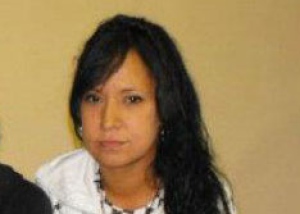
There was anger from coast to coast last year when an Edmonton jury found Ontario truck driver Bradley Barton not guilty in the death of Cindy Gladue.
Support rallies were staged and more than 4,500 people signed a petition asking Alberta’s justice minister to appeal the jury’s verdict.
On Tuesday morning, Alberta’s highest court will hear that appeal.
‘Difficult to fathom’ how jury acquitted
Cindy Gladue’s friends and family describe the 36-year-old as a kind, caring and funny mother of three.
During Barton’s first-degree murder trial, the jury was told she was a prostitute who lost her life after agreeing to have sex with the accused in exchange for $60.

Cindy Gladue, 36, was found dead in the bathtub of a west end motel room in 2011. (Facebook)
In June, 2011, Gladue’s naked body was found in the bathtub of a west Edmonton motel room. Medical examiner Dr Graeme Dowling described her fatal wound as a “a large, gaping hole in the vaginal wall, about 11 centimetres or 4 inches long, going almost the full length of the vagina.”
Barton, now 48, admitted during the trial he had rough sex with Gladue that night, but insisted her death was an accident, that he never meant to hurt her. He testified he was shocked when he discovered Gladue’s body in the bathtub the next morning.
In a factum filed with the Court of Appeal, the Crown states “Given the horrific nature of the injury and the respondent’s admission to having caused the injury that led to Ms. Gladue’s death, it is difficult to fathom how the jury could have acquitted.”
Crown blames trial judge for improper jury instructions
The Crown describes the judge’s instructions to the jury as “misleading, confusing and grossly deficient,” arguing that if the members of the jury had been given the proper instructions, they could have reasonably convicted Barton of manslaughter.
In response, Barton’s lawyer Dino Bottos argues the judge’s instructions to the jury were fair and were agreed to at trial by the Crown. Bottos writes that calling the judge’s charge misleading, confusing and grossly deficient “is both incorrect and unfair to the trial judge.”
The Crown lists four errors of law it believes the judge made during the trial. It asks the appeal court to set aside the acquittal and order a new trial on the charge of first-degree murder.
Interveners also voice concerns
In March of this year, the Court of Appeal granted permission to two groups representing women to make written submissions on the Barton case.
The Women’s Legal Education and Action Fund Inc. and the Institute for the Advancement of Aboriginal Women prepared a 20-page factum that was filed with the court four months ago.
The joint interveners complain the victim was repeatedly referred to during the trial as “the Native woman”, “the Native girl,” and as a prostitute. They believe the jury was given “irrelevant and prejudicial” information about the victim that perpetuated “racist and sexist myths and stereotypes about Indigenous women, particularly Indigenous women who engage in sexual activity for payment.”
The interveners add: “These characterizations also risked giving rise to the sentiments of prejudice or hostility towards Ms. Gladue among the jury.”
Controversial trial exhibit
Apart from the controversial verdict, another reason the trial created such a national furor was due to a decision by the medical examiner to preserve the victim’s vagina, and another decision by the trial judge to allow the specimen to be admitted into evidence.
A central issue at trial was what caused the wound — whether it was from a sharp object such as a box cutter, or from blunt trauma caused by manual penetration.
The interveners describe the admission of Gladue’s body part as evidence as the “dehumanization” of the victim, “in complete disregard for Indigenous customary practices in caring for the dead.”
They also argue, along with the Crown, that the trial judge made an error in law when he allowed evidence of the victim’s past sexual history to be put before the jury without an admissibility hearing.
“In every case,” the interveners write, “trial judges, Crowns and defence counsel must ensure that a woman is not considered to have consented to the sexual activity at issue because of her sexual history.”
They argue the central issue in the case is whether the victim consented to every sexual act that occurred with Barton, including “the use of any conceivable degree of force during sexual touching.”
Defence argues acquittal should stand
Barton’s lawyer asks for the Crown’s appeal to be dismissed. He suggests some of the appeal arguments made by the Crown contradict the position taken by the prosecution at trial.
Dino Bottos also suggests that “the evidence reveals that the Crown experts were ill-equipped and the Crown at trial unprepared” to rebut expert evidence from the defence.
In his 49-page factum, Bottos sharply criticizes the interveners, suggesting they “far overstepped the boundaries of what they were allowed to comment on and as such should not be considered by this honourable court.”
Bottos adds that “the joint interveners’ argument also seems to misunderstand who bears the burden of proof in a criminal trial.”
He argues the failure to hold an admissibility hearing about the victim’s past sexual history “had no material bearing on the acquittal as the evidence would inevitably have been admitted.”
Bottos argues none of the Crown’s four grounds of appeal “withstand close scrutiny or provide a compelling reason to order a new trial.”
He says that even if the Court of Appeal finds there was an error of law made during the trial, it could only have affected Barton’s potential liability for manslaughter, so “the jury acquittal on the first-degree murder charge should remain intact.”
Barton, who still lives in Ontario, will not attend Tuesday morning’s hearing.