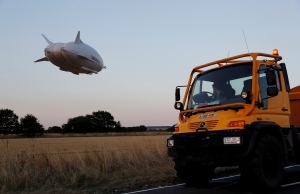

A man watches from a lorry as the Airlander 10 hybrid airship makes its maiden flight at Cardington Airfield in Britain, August 17, 2016. The airship was damaged during a crash landing today during its second test flight. (Darren Staples/Reuters)
[embedded content]
The world’s longest aircraft, the Airlander 10 airship, has crash-landed after a test flight in Bedfordshire, central England, its British manufacturer Hybrid Air Vehicles said on Wednesday.
The airship, which is bigger than the size of six double-decker buses, sustained damage on landing from its second
test flight, Hybrid Air Vehicles said, adding that all crew were safe and well following the incident.
We’re debriefing following the second test flight this morning. All crew are safe and well and there are no injuries.
Privately owned Hybrid Air Vehicles denied a report on the BBC that the airship had hit a telegraph pole.
“No damage was sustained mid-air,” the company said on Twitter. Hybrid Air Vehicles was not immediately reachable by
telephone.
Airlander sustained damage on landing during today’s flight. No damage was sustained mid-air or as a result of a telegraph pole as reported.
The 92-metre Airlander 10 made its first test flight earlier this month and the company had posted photographs of it up in the air before Wednesday’s incident.
Once the concept is proven, Hybrid Air Vehicles hopes the helium-filled giant will be able to stay airborne for up to two
weeks, and that potential customers might want to use it to carry cargo or deliver aid, for surveillance, communications or leisure purposes. It can carry 48 passengers.
Photos courtesy of Angela Hatwell of the Airlander 10 crash at Cardington airfield in Bedfordshire pic.twitter.com/j87XaDEfqv
— @PA
The Airlander can take off and land vertically meaning it does not need a tarmac runway. It can also operate from open
fields, deserts, ice or water.
Airships have a long history stretching back to the 19th century, although their popularity dipped in the face of
competition from aeroplanes in the 20th century and high-profile accidents such as the Hindenburg disaster in 1937.
Hybrid Air Vehicles told Reuters in March that it aimed to be building 12 airships a year by 2018.