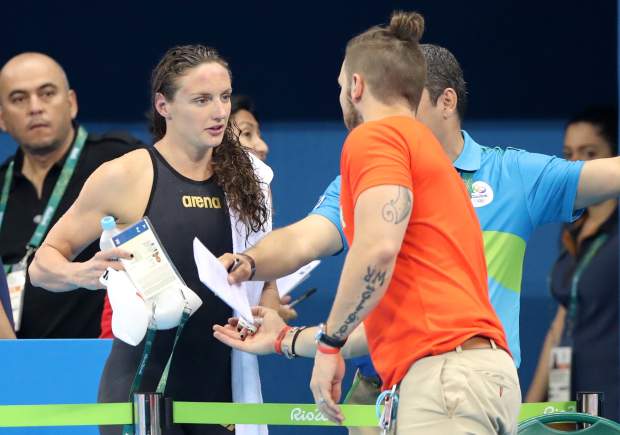
RIO DE JANEIRO — The most puzzling part of CBC broadcaster Byron MacDonald’s on-air gaffe on Wednesday night remains the actual words.
In saying that a teenaged Chinese swimmer “went out like stink, died like a pig,” MacDonald may well have been the first person to ever utter those clauses in succession, let alone do so as part of a live television broadcast. “Go like stink” has been around, but the porcine-death part seems like his own flourish. Bad time to get inventive.
That it made it to air — the CBC says he didn’t realize he was live at the time — isn’t that surprising, since the hot microphone has tripped up many a broadcaster over the years. And besides, with Rio 2016 still just a few days old, there have already been several phrases uttered on-air by broadcast professionals that have either been followed by apologies, or clarifications, or some combination of the two. And these were from people who knew they were on-air.
NBC has made a cottage industry of the gaffe, calling gymnast Simone Biles’ adoptive parents “her grandfather and his wife,” referring to a lesbian athlete’s wife as “her husband” and describing a medallist swimmer’s coach (and husband) as “the man responsible” for her swift rise in performance.
It has been an excellent reminder that broadcasting live television, and particularly sports, when there is no script for the action to follow, has no safety net. Despite the advent of high-definition broadcasts and spider cams and super-slo-motion and pitch trackers and all manner of such technological goodies, it’s still just someone speaking into a live microphone with no filter and no delete button.

Non-broadcasters have had to learn this lesson first-hand in the past decade, as social media has given everyone the opportunity to say something off the cuff that they might later regret. Journalists, who use social-media sites like Twitter and Facebook in their professional lives a lot, and who formerly had to run their work, and words, through an editor before it was deemed fit to publish, have now had that filter removed, and often with problematic consequences. In one of the more well-known examples, a Sportsnet broadcaster was fired after he tweeted against gay marriage.
Years ago, for a piece on the fifth anniversary of Twitter, I interviewed a media critic who described the social-media site as a “loaded gun” for those in the sports world who weren’t used to having their private thoughts widely shared. Athletes who once said something dumb and off-the-cuff in a locker room could plead for mercy from a reporter before those words were published, even if the reporter might not concede with the request. But social-media allows those thoughts to be instantly shared, like the pull of trigger. Even if you quickly delete the sentiment, someone will have thought to take a picture of the offending tweet, ensuring it lives forever in infamy.

Live TV, though, is the original loaded gun. Sometimes it’s a hot mic and a strange phrase, as was the case with MacDonald. With others, the misstep exposes a bias, and makes public a privately held belief. Few people knew until this week that certain NBC commentators don’t think adoptive parents should be referred to as “parents.” Or that the another commentator believes the proper term for a lesbian wife — even while the actual wife is being shown on air, so it is clear she is a woman — is “a husband.”
In one instant, the words are in the throat, and in the next they are out, with no way to reclaim them. Broadcasts have vast numbers of people working behind the scenes, producers, editors, technical staff, but none of them can turn back time.
Bang. Off goes the gun again.