RIO DE JANEIRO – This is just the beginning, but also, this is the end.
The last time for Usain Bolt with a flag around him, circling the Olympic Stadium. The last wave to a world wide audience. The last chance, in the grandest stage of all, to say goodbye.
He didn’t want to leave. He was smiling and waving, waving and smiling. One last encore without music on the world stage.
Bolt wound up nine for nine in Olympic finals. Three 100 metre hundred gold medals. Three 200 metre gold medals. Three 4X100 relay gold medals.
Nine gold medals. Nine for nine. Will never happen again. And, hey, thanks for the memories.
“What can you say,” said Mike Rogers, the American sprinter. “Really, what can you say?”
Justin Gatlin wasn’t as certain that this is the end. For him, anyhow. That wasn’t how he wanted to end his Olympic career. He won a medal, it would have been his sixth as an Olympian, and then he didn’t. Just like that. The pass from Rogers to Gatlin was messed up – spotted on film by a member of the Canadian entourage – costing the U.S. the bronze medal they thought they deserved.
Rogers thought the pass was okay. The U.S. winners, of 15 gold medals in the 100 metre relay over history, instead wound up without one on Friday night.
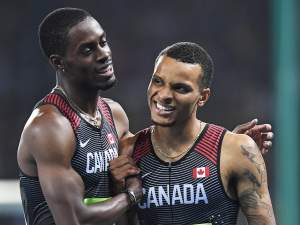
That was the end. For a great and the greatest ever. And it was beginning, another one, for Andre De Grasse, the sensation from Markham, who ran the anchor leg for Canada and seemed to come up an inch or so short. In doing so, the Canadian relay team set the national record, the fastest any Canadians have ever run. Faster than the legendary gold medal team of Donovan Bailey, Glenroy Gilberty, Bruny Surin and Robert Esmie ran in Atlanta 20 years ago in shocking the world. Not ironically, Gilbert coaches the Canadian relay team, Surin was here last night broadcasting for CBC-French and Bailey was part of the relay broadcast in English for CBC.
“It’s about time somebody broke this,” said Gilbert with a smile. “Twenty years is a long time. We’ve had our day.”
They won gold in Atlanta. The Canadians were the protect winners of bronze. And it seemed as though turnabout was fair play for the Canadian sprinters, none of whom were party of the team that apparently won bronze in London four years ago only to succumb to disqualification for stepping on a line.
This time a rule worked in their favour: Last time not so much. That happens in this Yogi Berra sport of relay racing: It really ain’t over ‘til it’s over.
The win by the relay team was the 21st medal of these Olympics – its sixth in athletics. Earlier in the day, Canada thought it had its 21st medal in the person of race walker Evan Dunfee. But he was fourth, then third after protect, then fourth again after further protect.
One protest went against Canada in the afternoon. One protest went their way at night. The six medals in athletics are more than the previous five Olympic Games combined, which is indication enough that the turnaround in the program is nothing short of astounding.
Bolt says goodbye, Gatlin is almost certainly leaving and De Grasse says hello and it’s time to get to know me. That’s the subtext of this week in Olympic sprinting.

Batons were passed last night but Gatlin couldn’t properly take his exchange and De Grasse, running anchor, had no one to pass the baton to. It is now his show. It was thought De Grasse had a chance, a long shot maybe, to win three Olympic medals here.
But as he leaves here after the weekend, he leaves with three medals, a breathtaking number considering the events he participates in. Bolt won three in his second Olympics at the same age, 21. He won gold, gold and gold. De Grasse ended up with silver, bronze and bronze. But say this for Bolt: When he won his first medals, he didn’t have to run against himself.
The meet was masterful for the Canadian but also for his lesser known teammates. This wasn’t like the Bailey run of 20 years ago. At that time, Bailey was known, Surin was a world class sprinter, Gilbert was known for his straight away speed.
For Akeem Haynes and Brendon Rodney and Aaron Brown, not much known for anything before Friday night, now have a medal to call their own.
What they didn’t get – and it’s rather unfortunate – was a chance to celebrate in front of the fans at Olympic Stadium. There was no flag to dance with. No lap to share with anyone. No flashing of the red and white.
“That’s too bad,” said Peter Eriksson, the national team coach. Everyone wants to take that lap.
They’ll happily take the medal too. Although, in fairness, the matter was still under appeal early this morning and it wasn’t known when a decision would be made.
The clock struck midnight and somewhere Usain Bolt still had a flag around his neck, wasn’t quite ready to walk away. He was still celebrating. The Canadians were celebrating. An end and new a beginning for sprinting on the world stage.
ssimmons@postmedia.com
twitter.com/simmonssteve