RIO DE JANEIRO — The green sign over a doorway at Rio Olympic Arena seemed pretty straightforward. “Media Entrance,” it said, in two languages.
Being in the media, and wearing a large badge that identifies me as such, I began to walk into the venue that will house the Olympic gymnastics events in the coming weeks.
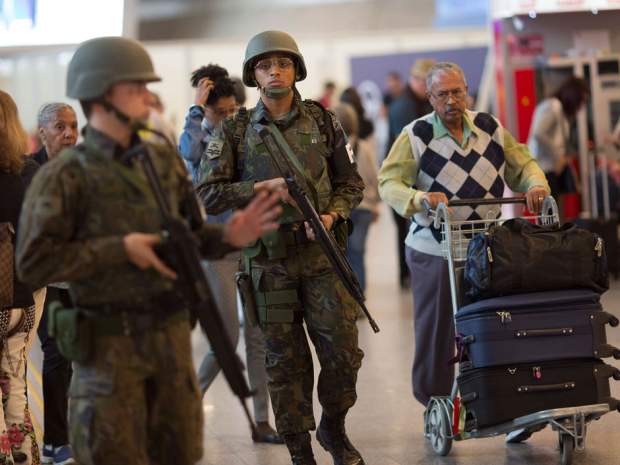
A soldier held up his hand to tell me to stop. He was wearing the burgundy beret and grey digital camouflage of Brazil’s national police force. It is an effective deterrent. I pointed to the sign and the badge — “Jornalista,” it says — and he kept shaking his head and pointing me away and eventually, between my weak Portuguese and his poor English, we came to a gentlemen’s agreement that I would not enter the building and he would not shoot me.

All of which is to say, my first-hand reporting on the state of some of the Olympic venues, with competitions beginning in less than 24 hours, is somewhat limited. From the outside, the Rio Olympic Arena looks nice. Inside? Ask the fellow with the gun.
Those who have been to these events many times insist that all the last-minute scrambling is nothing new. Things are always being painted and hammered and, especially, cleaned up, right up until the moment when an awkward musical number officially kicks off the Games. And they say that the present reluctance of organizers to let anyone into the stadiums to give them a look-over isn’t unusual, either. So, the fact that soldiers were menacing certain people away from other Olympic Park venues like the Carioca Arena and the tennis stadium wasn’t necessarily a sign that they were shielding prying eyes away from seeing anything untoward. It’s just that they aren’t quite ready to have people wandering about en masse. I did manage to get into the Olympic Velodrome — no soldiers there — and it looks exactly as you would expect it to look at this point: shiny green seats and a smooth track that is terrifyingly steep. (Honestly, who though that up: “I know, let’s race bikes, but not on the ground. On the WALLS.”)
The general sense here is that, despite all the worries in recent months about construction woes and an economic crisis and strike threats and Brazil’s antipathy toward doing anything in a hurry, the Rio 2016 organizers are more or less done. Mostly done. Done-ish. Which is kind of surprising but also not surprising. The Olympics always manage to pull themselves together in time, no matter the logistical challenges.
There have been, to be sure, more than a few problems as the Games have drawn near. The Athletes Village has been the most recent flashpoint, with first the Australians refusing to move into their apartment building because of electrical and plumbing problems and then, on the weekend, the same team fleeing the building because of a fire in the basement. The fire failed to trigger an alarm, which was rather disconcerting, and the Australians had to rely on word-of-mouth to alert their colleagues to the danger. Very old school.
From the outside it is like a jewel, but inside it is like a construction site
That was followed by the head of the delegation from Greece complaining that the problems in the huge apartment complex that will be home to the more than 11,000 athletes and 6,000 coaches and staff in Rio for the Games are unprecedented in recent memory. Water leaks, gas leaks, unfinished rooms, and reports that labourers have no plans to finish them because they haven’t been paid on time. “The situation is tragic,” the chef de mission told an Athens radio station, which if nothing else gave plenty of opportunity for Greek Tragedy headlines.
“From the outside it is like a jewel, but inside it is like a construction site,” Isidoros Kouvelos said.
He could just as well have been speaking for the whole city. The Olympic transportation system that has been the focus of much consternation in advance of the Games is still not exactly up and running. Some lines haven’t opened yet and the schedule is only vaguely connected to reality. Meanwhile, the brand-new Rapid Transit line has been largely empty in the early days, probably because no one actually expected it to open on time.

Other delays and problems seem to be largely overcome. Venues like the beach volleyball arena on scenic Copacabana Beach, which was hilariously unfinished just last month, looked almost ready to welcome its scantily-clad competitors by Tuesday morning. Workers were completing the reconstruction of an elevated bicycle-and-jogging path that runs along the Atlantic coastline, a chunk of which was swept into the ocean in April, killing two and adding quite the taint to the Olympic legacy project. Today, only the presence of the men finishing the paint on the railings gives an indication of where heavy waves destroyed the path three months ago.
The path is a decent metaphor for the Games as a whole at this point. There were cost concerns, and then major problems, and no one is entirely sure if, after the end, there will be much point to all the effort in the first place. But, it should at least be done. Barely.