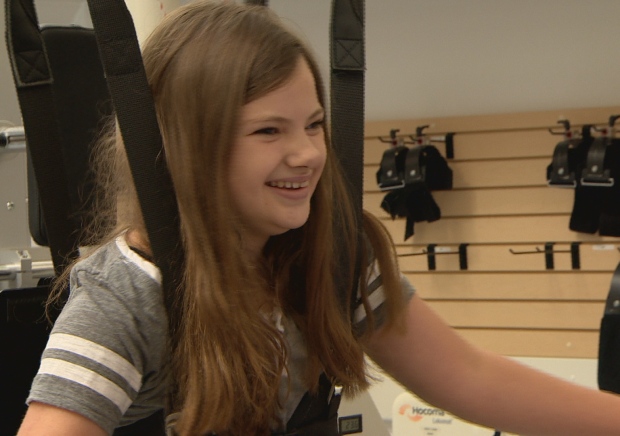
When it’s 12-year-old Maggie Slessor’s turn on the Lokomat, she’s pretty excited.
“I think it is fun and distracts you, but you are working.” Maggie says.

Maggie Slessor hooked up to the Lokomat as part of a University of Alberta study. (Richard Marion / Radio-Canada)
Maggie has a form of cerebral palsy called spastic diplegia.
Going to the Glenrose Rehabilitation Hospital for treatment is not a new thing for Maggie.
But now, she’s not the only one benefiting from the steps she takes on the Lokomat, a robotic gait-training device.

Maggie Slessor walks with assistance from the Lokomat at the Glenrose Rehabilitation Hospital. (Richard Marion / Radio-Canada)
She is the first Edmonton participant in a new study that is a partnership between the University of Alberta and the Bloorview Research Institute in Toronto.
“What we are really interested in is how the therapy contributes to attaining goals that the families have identified,” said Lesley Wiart, an assistant professor of physical therapy at the U of A.

Lesley Wiart is an assistant professor of physical therapy at the Faculty of Rehabilitation Medicine at the University of Alberta. (Richard Marion / Radio-Canada)
The Glenrose is one of three sites with a Lokomat that will take part in the study. The others are in Toronto and Chicago.
Researchers are also interested in learning more about families who have children with cerebral palsy, a neurological disorder that can affect motor function.
“We really want to understand what the kids’ perspectives are and then also what the parents’ perspective are, so when we are offering therapy interventions they really meet the families’ needs,” said U of A researcher Shanon Phelan.

U of A researcher Shanon Phelan is also interested in the quantitative data from the five-year study. (Richard Marion / Radio-Canada)
Maggie’s mother Doreen is happy that her family could take part in the study.
“We have been with the Lokomat since the first day that it has been here, and we have always known that it was a beneficial therapy for Maggie,” Doreen said. “So I am always of the mind that there have been families that have come before us who have paved the way for us, and we should come behind and plant flowers.”

Doreen Slessor looks on as her daughter Maggie uses the Lokomat robotic gait training program. (Richard Marion / Radio-Canada)
For Maggie, who normally uses crutches or a walker, she will keep putting one foot in front of the other.
“It’s like your legs are walking like normal, so that is really cool.”
The U of A researchers are looking for other kids to take part in the study over the next five years.The study is recruiting children and youth with cerebral palsy ages five to 18 who walk with or without handheld walkers. For more information contact lokomatstudy@ualberta.ca