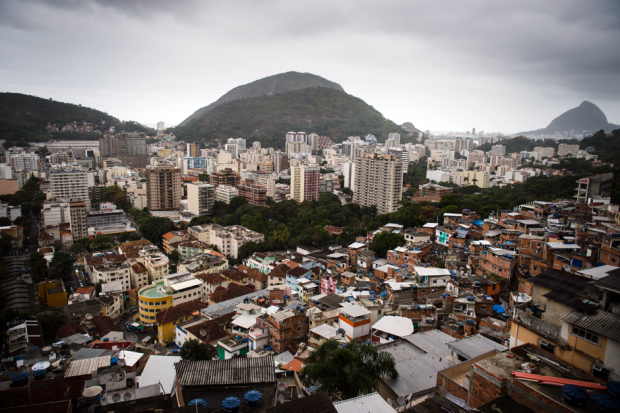
RIO DE JANEIRO, Brazil — Hundreds of police officers raided one of Brazil’s notorious slums Wednesday only days before the official opening of the Olympic Games.
Two people were reported killed and one officer wounded during firefights after police launched an airborne dawn assault on Complexo do Alemao — a group of hilltop favelas known for crime and drug trafficking.
A cable car worker said that the shooting had started in a maze of alleyways and staircases in the sprawling, impoverished enclave as soon as police helicopters appeared in the sky.
Mario Araujo, who earns his living taking people up and down the hilltop favelas on his motorcycle taxi, said, “Everybody knows that some very bad criminals live up there.”
Three hundred civil police and 150 military police took part in the raid, according to the Brazilian daily O Globo. Ten suspects were detained.
The complex was also the target of an operation during the Pan-Am Games in 2007 when the area was almost put under siege by police in order to suppress drug dealing.

As happened in many of Rio’s other favelas, violent crime had dropped in the 22 slums that comprise the Complexo do Alemao beginning in 2009. That was the year Rio was awarded the Olympics in return for a solemn pledge to eradicate violence in large parts of the city that at that time were controlled by gangs and were no-go areas for police.
A calm of sorts was subsequently enforced using a strategy Brazilians call “pacification” — a robust and aggressive posture by heavily armed Pacification Units who were given almost carte blanche to subdue the most dangerous favelas. They sometimes used their authority to be judge, jury and executioner in the communities to which they were assigned.
“Complexo do Alemao is really complex because it has many communities and each one has a different reality ,” said filmmaker Luis Lomenha, who was born and raised there and has been part of a series of prize-winning films about police violence in the slums.
“We have a difficult moment now because the community has no control over events. There are big economic problems. The people have no connection to the Olympics because they have no money to see them. Their concern is simply to survive.”

Violent crime dropped for several years as police took back control of many favelas and the economy boomed. But the crime rate began spiking late last year just as public support for the police dropped because a growing number of civilians were getting killed in the crossfire. This coincided with a catastrophic drop in oil and gas prices and a billion-dollar political scandal that centred around corruption at the state-owned Petrobras energy conglomerate.
In the first six months of 2016, as Rio was making final preparations for the Olympic Games, nearly 2,500 people were murdered in the city — up by 900 from the same time last year.
A planned visit to Complexo do Alemao Wednesday — preceded with stern lectures about risk as well as discussions about secure entrance and exit scenarios — was cancelled because of the raids.
During a trip instead to Santa Marta, considered one of the safest of Rio’s more than 100 favelas, fear of drug traffickers and police still persist.

A middle-aged woman pleaded that her name not be published because the drug lords might kill her. Moments later a pair of men sitting in the shadows at the back of a dark of alley with bandanas obscuring their faces sternly warned that their pictures should not be taken.
“We don’t talk to the police and they don’t talk to us,” said a mother of a four-year-old boy who would only give her name as Marina. “Talking with the police or talking to you could get me killed.”
Near a mural of a man crying were written the Portuguese words: “Don’t join a gang. Christ cries for you.”
Speaking from her stoop as she laid out her laundry to dry, 70-year-old Maria Martins said she welcomed the Rio Olympics because it meant there might be foreign visitors whose presence might bring some calm to the favelas.
“All I want is to think about beautiful things and that there is no fighting and everyone is happy,” she said.
