RIO DE JANEIRO — The Portuguese-English translator, via the headphones through which the world’s media listened to Rafaela Silva recount the story of her childhood, repeatedly used the term “local community.”
Intentional or not, he avoided the word “favela” which is not so much local community as ghetto.
But that is where Silva was born, and where she was on the cusp of losing hope as a little girl: in the godforsaken Cidade de Deus favela, the City of God.
“I had no dream, no objective in life. The only thing I wanted was to have a bicycle … and cool clothes. My family had no money to get me these things,” she said Wednesday, when the Rio 2016 organizing committee and the IOC brought her to the daily press briefing, as a warm-up act for the inquisition about rocks thrown at a media bus and algae turning blue water to green sludge in the Olympic diving tank.
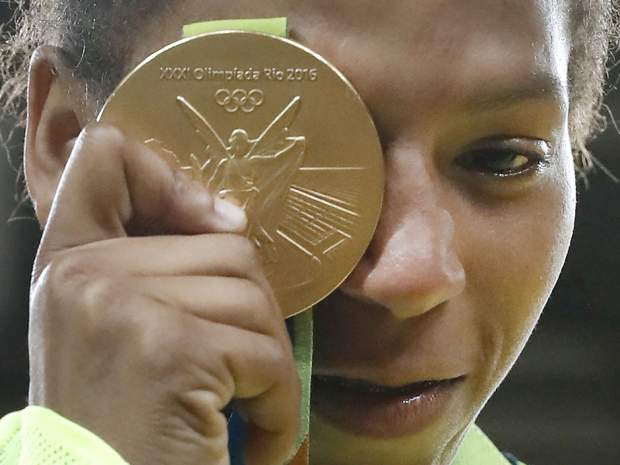
On Monday night, this 26-year-old product of one of Rio de Janeiro’s poorest slums had won Brazil’s first gold medal — first medal of any colour — of their home Olympics, and the poets had all rushed to this irresistible story of inspiration and joy, as if it might change the world.
After all, the symbolism was perfect. The director of the Rio Olympics opening ceremony, Fernando Meirelles, had famously used the favela as a backdrop for his Academy Award-nominated City of God film in 2002.
Now here was this once angry little girl whose parents sought to channel her aggression — and at the same time keep her out of the streets — winning her gold medal, fittingly enough, in a combat sport: judo.
Fighting her way out of poverty. Cue the music.
“I was a child, I was five years of age. I wanted to play in the streets, and I couldn’t stay in the streets, not even at three o’clock in the afternoon because shooting started in that city, we saw bandits fleeing from the police and raiding our house. We couldn’t even play in the streets like any child could,” she said.

Her salvation was moving to a different neighbourhood where the Dwellers’ Association in the City of God had a sports club.
“There was soccer, but they only had the male team, and dance, and judo. I couldn’t do soccer so I went to judo. I made a good choice, I believe,” she said.
“So I have to acknowledge my parents for their initiative in taking me out of the streets, because some of my friends, my sister, they also started to train judo because they saw me training.” And some who didn’t, she said, “got pregnant, and others followed the drug trafficking life, and so if I were still in the (favela) this could have been my future, and of my sister.”
It was a riveting account and yet, to the cynic’s ears, sounded like so many of the stories of inspiration that abound at an Olympics: a recital of a liberally-exploited tale, like that of the Refugee Olympic Team’s most voluble player, Syrian swimmer Yusra Mardini.
As Mardini retells her story of going overboard from a dinghy in the sea, between Turkey and the Greek Island of Lesbos, helping her sister Sarah swim the sinking boat and its refugee passengers to shore, one can’t help but conjure up the image of the little three-year-old Syrian boy, Alan Kurdi, lying dead on the beach — no future Olympic swimmer there to save his life.
So Mardini’s story, and Silva’s, only sound rehearsed because they are Olympic touchstones and everyone wants to hear them. They are exactly what Olympism is supposed to be about: striving, never giving up.
I still have family and relatives that live in the City of God and I intend to go back there
Maybe in the affluent West — where sacrifice equates to parents getting up at 5 a.m. to drive their kids to the pool or the rink, and young athletes eschewing parties and boyfriends/girlfriends and later regular paying jobs to pursue their Olympic dreams — it’s impossible to imagine the spectre of death hanging over a teenage girl, or another from a population of millions of the disenfranchised poor rising above circumstances that could have destroyed someone with a lesser will.
At the London Olympics four years ago, Silva was disqualified and faced an appalling barrage of abuse through the social media.
“They said judo was not for me, that I was a cheat, and that monkeys should be staying behind bars not in the Olympic Games,” she said. “I was already suffering because I had lost my chance to achieve my Olympic dreams and now I thought of stopping judo because that hurt me a lot. I didn’t want to have that feeling any more.”
But the stories of greatness achieved through unimaginable dedication are the reason athletes save the Olympics from itself, every time. She didn’t quit. Monday, she became the first Brazilian judoka ever to be both a world and Olympic champion.
“And so if my medal could touch people’s emotions who still do not understand the spirit of the Olympics, I believe this is what I can convey winning the gold medal,” she said.
“I still have family and relatives that live in the City of God and I intend to go back there. There’s always small kids that ask at my aunt’s house when I am coming back. Not long ago I visited the Dwellers’ Association where I started to train judo.

“We have some local athletes that recognize me and I want to go back to my (favela) and be received in the way that I am being received now in the streets of the Olympic Park.
“If that can serve a purpose to inspire the children of the City of God so they can start to develop in sports, but not only in sports but to go to school, to a university, this is the main objective for me.”
Go ahead. Find fault with that.
ccole@postmedia.com