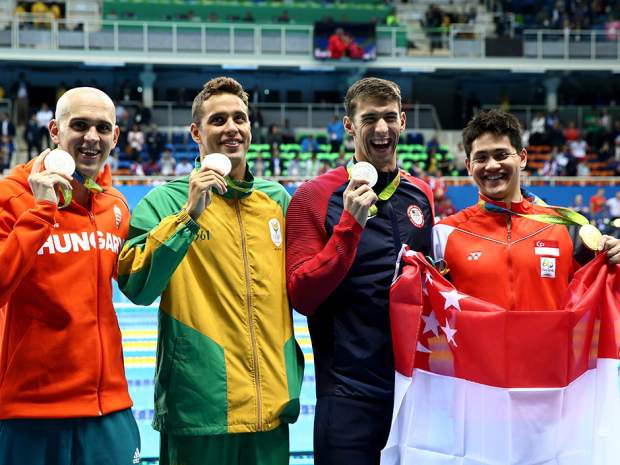
RIO DE JANEIRO — When Michael Phelps was just a 19-year-old kid swimming in the Athens Olympics, he marvelled at the man who had just beaten him — and everyone else — in the 200-metre freestyle final.
He had come to Athens advertising that he would like to break Mark Spitz’s record of seven gold medals at a single Olympic meet, and that was quickly put to rest in a relay in which the Americans finished third.
Now he had finished third to the great Aussie, Ian Thorpe, and his Dutch rival, Pieter van den Hoogenband.
“Ian Thorpe is probably one of the, if not the, greatest middle-distance freestyle swimmer of all time. He’s got, I think, a perfect stroke. Just watching him swim, it’s just so fluid, it’s perfect, really,” Phelps said.
“And, boy, does he make big waves.”
It was a lesson, and Phelps was a quick learner.
He left Greece with six gold and two bronze medals, and ever since, the only waves that have buffeted him have been outside the pool, when he collided with real life.
But Friday night, in what he has called the last individual race of his life, the 100-metre butterfly, the greatest swimmer in the history of the sport — greatest Olympian, by the only standard that matters — finally hit some turbulence he couldn’t overcome.
Out in Lane 2 after posting a mediocre qualifying time, Phelps was out of touch with the fastest qualifier, Singapore’s Joseph Schooling, who’s ten years younger, and couldn’t find that extra gear that had always bailed him out of every jam.
Schooling won in an Olympic record 50.39 seconds. That had been Phelps’s record. The legend was three-quarters of a second behind, in a three-way dead heat for the silver with old rivals Chad Le Clos of South Africa and Laszlo Cseh of Hungary.
Asked what Phelps had said to him afterwards, Schooling said: “He just said you swam a great race. I told him he should go four more years. He said no way. I hope he changes his mind.”

He entered these Rio Olympics with 18 gold medals, 22 overall (it’s 22 and 27 now), and something to prove — not to anyone else, but to himself.
After a DUI, and rehab, a famous photo of him puffing dope from a bong, and a phase of his life before and after the London Olympics that painted a picture of a conflicted, possibly even disinterested one-sport superstar trying to figure out who he was, the old Phelps turned up here with the sculpted body of his youth. He also came with a wife and young son, Bo, and a twinkle in his eye and a set to his jaw that said: “I’m back loving this game again.”
To say that there will never be another one like him is dangerous, because athletes are getting bigger and stronger, and it’s always possible someone might come along with that rare combination of talent, drive, a wingspan like a pterosaur, zero body fat, double-jointed ankles and elbows, a dolphin kick that would make Flipper jealous, a genius coach, a singular focus over five Olympic quadrennials, and an ego big enough to want it all — and then some.
So now that you mention it, no, there probably will never be another one like him.
Phelps’ resounding victory over Ryan Lochte , his half-friendly rival and relay teammate of four Olympics, in Thursday’s late-night 200m individual medley was yet one more demonstration of an athletic freak re-dedicated to his craft. But not as fast as ever in the shorter distance.
“I don’t know if I’m in better shape than I was in 2008. That hurt a lot,” he said early Friday morning.

“My body is in pain, and my legs are hurting. I’m tired … I kind of knew when I first started coming back that it wasn’t going to be an easy process and I was going to force myself to go through pain I didn’t really want to go through. But if I wanted the end result, I had to. I felt like a kid again. I felt like I did when I was 18.”
He doesn’t feel that way today. It has been a long meet for a 31-year-old racing against kids, some of them, like Schooling, a decade younger.
“I think the biggest thing for me through the meet so far, I’ve been able to kind of finish how I’ve wanted to,” he said.
Finish? Yes, that’s what he says, though it wasn’t Phelps’ last race. Presumably, he’ll swim on the U.S. 4×100 medley relay team Saturday night.
There will always be American swim stars, because it’s a nation that produces them like widgets off an assembly line.
The U.S. already has another superstar in Katie Ledecky, who at age 15 won the 800m freestyle in the second-fastest time in history and, now all of 19, won it again Friday night for her fourth gold of the Rio meet.
Phelps swam in the Sydney Olympics as a 15-year-old, too, but didn’t win a medal.
There is a charming photo of a 9-year-old Ledecky grinning giddily as she gets an autograph from Phelps in 2006, in between Olympics in which the then 21-year-old would win 14 gold medals.
Ledecky didn’t waste any time growing up to be a logical successor to her hero. She holds the freestyle world records in the 400, 800 and 1,500 — an absurd combination of speed and endurance — and Friday, she not only annihilated the 800 field, but shaved a couple of seconds off her world record with a time of 8:04.79, eight seconds under her Olympic record and nearly 12 seconds ahead of British silver medalist Jazz Carlin.
The torch hasn’t been passed just yet. But any day now …
ccole@postmedia.com