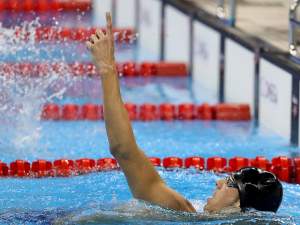
Rio de Janeiro — “He is just a normal person,” Russian Alexander Sukhorukov said back in 2008, trying to put Michael Phelps into historical perspective.
“But he is maybe from a different planet. A planet from a different galaxy.”
Tuesday night at the Rio Olympic pool, he wasn’t that Michael Phelps, not the Phelps of Beijing, where he was an eight-gold-medal machine.
But he was 23 then. In winning the 20th gold medal of his absurdly wonderful swim career, the 200-metre butterfly, despite crashing the wall on the final turn, he proved that there is still some magic left in his 31-year-old body.
And then he proved it again, an hour later, in the relay, for No. 21.
The butterfly gold was his sixth, and if he had to grind all the way to the wall to barely out-touch Masato Sakai by 4-100ths of a second.
Well, he had to grind in Beijing, too. And in London. And that’s another part of his greatness.
He is the oldest individual gold medalist in Olympic history, so he’s allowed to win a close one now and then.
The only man to top him at butterfly since his rampage through the Olympics began, South Africa’s Chad Le Clos, seven years his junior, who won this race in 2012, was a well-beaten fourth, behind Tuesday’s fastest semifinalist, Hungary’s Tamas Kenderesi.
Phelps’ winning time of 153.36 was a long way off his seven-year-old world record, but he enjoyed looking up at the clock, seeing his name at the top, and in that moment, he raised both arms, beckoned with his fingers for applause — and one more thing: he raised an index finger and wagged it, which seems to have become the international symbol for: “Take that, cheaters.”

He already had more gold medals than all but two entire countries — the United States and Australia — had ever won in the history of men’s Olympic swimming.
Somehow, it didn’t seem likely he was going to stop at a round number, and he didn’t.
Sixty minutes, give or take a few tics, after he touched the wall in the 200 fly — with a lengthy medals ceremony in between — he swam the anchor leg for the U.S. 4x200m freestyle relay team, and the Americans did what they usually do in the relay they had already won for three Olympics in a row, and 16 times overall.
Staked to a 2-1/2-second lead by the time he left the blocks, Phelps couldn’t get the Americans a world record but was plenty good enough to nail down the victory by the same margin Ryan Lochte had given him, finishing what Conor Dwyer, Townley Haas, and Lochte started.
In fact, he finished it wearing Dwyer’s swim cap, because he had broken his own while getting set to climb onto the block. Great Britain was second, and Japan third.
It was just another golden evening for the U.S., with an earlier win by the peerless Katie Ledecky in the women’s 200 free, though she looked gassed in the middle of a tough race with Sweden’s Sarah Sjostrom and said afterward: “That hurt pretty bad. It’s the closest I’ve ever come to throwing up at the end of a race.”
Phelps still has plenty of time, and two more events, in this meet to do more damage to the record books, but his 14th individual medal — the other 11 are in relays — put him No. 1 among all Olympians in that category, too.
The medal that lifted him over Germany (East and West) and into third place on the countries list came on Day 2 in his first race, the 4×100 freestyle relay, where he swam his fastest-ever 100 split to hand the Americans the lead.

That was enough to announce that he was back.
What transpired Tuesday night merely added to the lore.
Meanwhile, among the mortals, Canada’s Santo Condorelli — he of the middle finger salute to his dad before races — finished second in his 100m freestyle semifinal and tied for third overall to qualify for Wednesday’s final. Calgary’s Yuri Kisil was sixth in the same semi, and didn’t qualify.
Sydney Pickrem, the 19-year-old dual citizen from Dunedin, Fla., was a respectable sixth in the final of women’s 200 IM, won by Hungary’s Katinka Hosszu in an Olympic-record 2:06.58.
ccole@postmedia.com