John Krasinski calls getting the role of Jim Halpert on “The
Office” a “lottery ticket.” Even after shooting the pilot, he was still working
as a waiter. Since the show premiered, he hasn’t turned back, still cashing in
on that ticket with his second effort as a director, “The Hollars,” opening
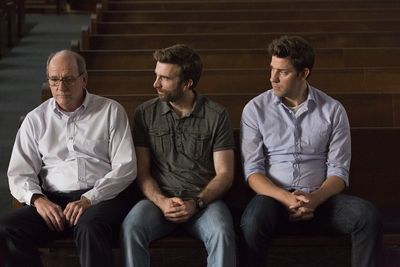
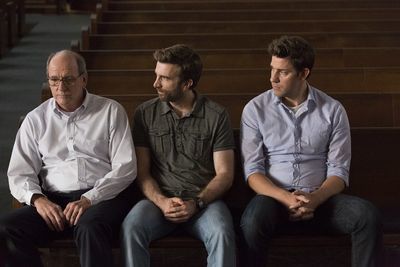
this week. In the film, written by Jim Strouse (“Grace is Gone”), Krasinski
plays John Hollar, a NYC artist who returns home after his mother Sally (Margo
Martindale) is diagnosed with a brain tumor. The trip brings issues of his
dysfunctional family—including father Don (Richard Jenkins) and brother Ron (Sharlto
Copley)—while also forcing him to deal with the fear entrenched in pending
fatherhood with his girlfriend Rebecca (Anna Kendrick). The incredibly likable Krasinski
recently swept through Chicago, and we got a chance to talk to him about his
own family, “The Office,” “Away We Go,” the stunning talent of Margo
Martindale, and much more.
I’ve been thinking
about major life decisions and how they change the way we look at the world, so
I want to start with a kind of deep one: How does fatherhood make you a different
director?
The clichéd version is the truth, which is “in every single
way.” I signed on to this as an actor six or seven years, pre-having kids—actually,
I had just met Emily [Blunt, his
wife], so I wasn’t even married yet—so by the time I was directing, to say that
my understanding of this movie had changed 180 degrees would be the biggest
understatement in the world. It was a whole different world. Yes, my daughter
was 4.5 months old when we went to shoot, so, yes, I understood the guy who was
on the doorstep of fatherhood.
More importantly, what I felt was this huge existential pull
to my family. I understood my parents better. I understood my brothers better.
I weirdly started thinking about things like lineage and coming from a family
name. Yes, it’s cool that you asked a heavy, deep one, because that’s what this
movie tries to lead you to have those conversations. I had one guy say, “Man, I
wish I was closer to my mom because I really wanted to give her a call after this.”
And my response was, “You still can.” No one says family is easy. But it’s
still there. And I really feel there’s an existential pull that’s connecting
you to them. They’re gonna be closer to you whether you like it or not than any
other person we ever met. And I think there’s something super-beautiful about
that as the world gets a little bit more chaotic.
And I think the way
we perceive that going back changes when we have it going forward.
Exactly. Exactly. I’m gonna steal that from now on. When you
read it in other interviews…
When you’re a kid,
you don’t really comprehend…
No. You see pictures of your grandfather and your
grandmother, and they look cool, and did they get Lucky Charms for when I come
and visit their house? And then you start realizing…The struggle of parenthood
is a daily struggle because of whether or not you’re going to feed them before
they go play to am I the person that I want to be? That, to me, was the biggest
question. And, let’s be honest, I have a completely blessed life. I live in a
fantasy camp. This is not real life. And yet, I still, before my daughter was
born, had these huge questions. A big mirror was held up: Are you the guy you
want to be for the arrival of this person? And it’s huge. It’s heavy. I think
that everybody goes through it no matter what you’re doing in your life. It’s
really powerful, but also something you need to listen to about that.

So, fatherhood
changed you as an artist. On a very practical level, I’m curious how your TV
experience changes the way you direct and the way you look at art?
Wow. So, “The Office” experience was transformative in every
single way. It was a lottery ticket. I couldn’t have planned for it. It just
happened. I was a waiter. After the pilot, I went back to waiting tables. I
wasn’t even sure it would get picked up. So, my life changed completely. But,
then, getting there, there was something very special about that experience
because none of us were hugely famous. Yes, Steve [Carell] had done “The Daily
Show,” and, more importantly for me, those FedEx commercials. I
used to love those. So we came in feeling more like a rep company than a “TV
show cast.” So, everything we did felt special. Then, beyond that, I was
spending a lot of my time in the writer’s room, watching how an idea comes from
someone’s head, gets tossed in the air and thrown around. It either goes on the
board or it falls on the floor. On top of that, I got to watch all these
directors. So, what I’m saying is that I got a film school education every
single day. I could hear my dad’s voice telling me to take this opportunity.
So, you concentrated
on elements other than your role.
100%.
And it must have
taught you about ensemble, which is essential to this.
It taught me everything about ensemble. This movie was the
closest I’ve had to “The Office” experience. We became a family on day one. I
hadn’t met Richard Jenkins. My first acting role ever was as an extra in a
Marshall’s commercial, and that was with Margo.
Really?
Yeah, Margo Martindale was in this Marshall’s commercial and
I was upgraded to feature extra, so we were thrown together in the universe.
Is that online
anywhere? I’d love to find it.
I know! We’ve got to find it! It was 17 years ago. [Ed. Note – I tried. No luck.]
Sharlto I had met briefly. I was writing “Promised Land”
with Matt Damon and he was shooting “Elysium.” So I met Sharlto, and that’s
where I saw he could play this part. Once you meet him, he’s like this adorably
sweet puppy dog of a person. I knew he could crush this. We became that thing
that I remember on “The Office.” There were no notes. This wasn’t one of those
directing gigs where you give people notes. What it was was creating an environment
where these people could work, which was exactly
what we did on “The Office.” And the smart directors and our crew knew that and
wouldn’t interfere.

Real short question:
Why Margo?
I think she’s doing work that very few people do. The only other
person that I can think of that does emotional U-turns and has comedies and
understanding and eloquence is maybe Meryl Streep. I put them on the same
level. I’m sure Meryl would too. It’s not that she hasn’t been acknowledged,
but this is her time to be acknowledged as one of the best actors we have.
How do you take
actors like her—she’s bringing a lot of talent and so does a lot herself—but as
a director, to relatively dark places? Fearing for their lives?
Like you said, she did a lot of that on her own, but I would
say it wasn’t the direction as much as the conversations we would have. In
between takes, at dinners and stuff, we would talk a lot about family. We’d
talk about our upbringing. We talked about her dad, her brother, her experiences.
I remember when she was going to do emotional stuff, she would always ask me if
I was there. I would say “Yes,” and the thing I love about her is that she’s
such a bold, confident person that she would be like “Don’t lie to me.”
There’s the scene with the chandelier—that’s actually a
scene I rewrote based on my dad. My dad was at Catholic University in
Washington, D.C., and every night after basketball, he would go to the Library
of Congress, lean back, and just look up at the ceiling for about 20-30 minutes
before he went and did work. Once I told her that story, she was laser-focused—“What
does that mean emotionally?” She used it. It was more about sharing each other’s
past, and, also, I will say that Margo and I cry at anything. So there was a
connection in that the moment in a scene when it started getting emotional and
it worked, I was a very bold and confident sounding board. The most emotional
scene in the movie, not only was it all her, but even people like Richard Jenkins,
one of the greatest actors in the world, wasn’t prepared for what she did. What
she did there was not acting. She went to a place that was so unbelievably real.
It was almost like she completely unplugged from having her faculties about
her. That take you see in the movie was the first and only take I did of that.
I cut a wide shot and a close-up shot and she blew it out of the water. You can
see all the actors legitimately not know what to do. That’s nothing I could
direct. That’s just pure power.
She taps into something
grounded. It’s not showy.
Yes. Yes. And let’s be honest. We’ve all seen a lot of
family movies. People will see this trailer and be like
“I’m not going to this. I’ve seen a lot of family movies.” I don’t want to make
a movie that people have seen before. The reason I made this is because of
scenes like that. Performances. You’re going to connect not because it’s a
music swell to make you cry but because it’s real. I think this movie can be
hugely therapeutic because you can connect to some version of your own experience.
And I think, as a
critic, that there should still be space for “performance pieces.” Not
everything needs to be “Inception.” There should be space for things that aren’t
high concept. Although I’m worried they’re all going to TV. It’s all MCU and
Netflix.
“You’ll see The Hollars on ABC this Fall!”

Well, then let’s talk
a little bit about expectations for a movie like this. What do you hope for in
this new market?
I don’t think I’ve ever talked about this. I had this
experience on “Away We Go”—the week before it came out, and, again, I had no
way to navigate nor plan for these event, but my representation about a week
before, the machine picked up. “Oh my God, you’re gonna be in an Oscar-nominated
film. Best Picture nominee.” I didn’t want to believe the hype. I come from
Boston. There’s that thing where you don’t believe the good stuff. Just do your
job and that’s all you can do. And I can remember vividly that I got caught up.
“Oh my God, this is gonna be HUGE.” And then the night before, Sam Mendes
called me and he said, “It’s not gonna be what we thought. A lot of it is
because of me and whatever people feel about me—it might be personal. But the
other part of it is people aren’t wanting to have this mirror held up to them.”
I thought it was really interesting. And, sure enough, the next day, that exact
thing happened. It was split, which is whatever. But that day, I remember
hearing a snap in my head and I’ve never thought about it since. And I’m not
trying to say I’m above it all. I definitely get emotionally connected. What I’m
saying is when we finally got to the place where we edited this the way we
wanted to, my only fear was “Could I capture what Jim wrote? And, we all went
down and had the time of our lives, could I capture that on film?” My biggest
fear was that Richard Jenkins, Margo, Anna, Charlie [Day]—all these people
would see it and be like “That’s not what we did.” These smaller movies with
much more intimate performances don’t work sometimes and you can feel it. I
couldn’t let that happen. So, what do I hope for the movie? My job is done
because they’re happy and that’s all I care about. And I’m trying to say that
as genuinely as possible. At the same time, I think that there’s a weird part
of me that hopes that people see it because it means that people still go see
movies like this. I want to see the next one somebody else makes. If nobody
goes and sees this movie, it will make me sad as the director but more as the
film fan. I might not be able to see a lot of these because nobody’s gonna make
em.
You mentioned
including the story about your father and I’m curious how much of your family
is in this film?
I come from an extremely loving, well-connected family. We
see each other all the time. We could not be more different than this family.
And yet, at the end of the script, I was crying harder than I ever have reading
a script. That is my family. I didn’t understand how Jim did that. It’s so easy
to disconnect—the dysfunction, the comedy, the slap fight, and all that—but somewhere
in there were the nuggets of truth of why I love my mom; why I love my father.
Why my father is my hero. There’s that scene on the truck where the father is
trying to say he’s sorry for not being there and my character says “That doesn’t
matter to me.” It’s a scripted line for anyone who says that. No one doesn’t
care what their parents think—it’s just how they interpreted it. For me, there’s
a whole lot of my family in here. The specifics are completely different, but
the pull and the connections are all totally true. I’m just lucky enough to
have open channels where these people do not. I think the best thing about this
movie is the channels can still be open.
Do you know what’s
next other than “Jack Ryan”? Congratulations, by the way. I love Carlton
[Cuse].
Thanks! He’s awesome. “Jack Ryan” for acting is definitely the
next thing. They also made me a producer on that so Carlton is letting me into “the
tent” to talk, which is great. And I just want to learn from him. For me, I’ve
been writing a lot more. Again, “The Office” sort of afforded me this
opportunity to take chances. So, my favorite thing right now is my production company,
Sunday Night. This script was around for ten years—so being able to bring it to
life is really fun. And I will say that doing “Promised Land” and something
like this is opening up relationships that I always had as friends but now I
get to work with people.