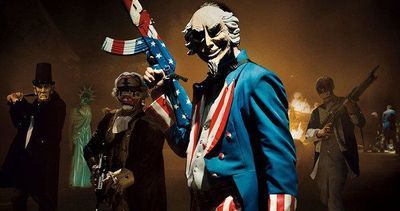

Writer/director James DeMonaco’s three Purge films have been an exercise in futility: violent
features about anti-violence, and gun-driven action movies about the horror of an
NRA-dominated society. With “The Purge” franchise, he has a hell of a hook that doesn’t rely on reoccurring characters, but a holiday, in which all
crime, including and especially murder, is legal for 12 hours. Appealing to
America’s taste for violence and
our short attention span with the tragedies caused by it, he has created one of
the most popular and profitable horror series, but one that dubiously claims
that its trigger finger is actually on the pulse of society.
The idea started with a remark that his wife made after a road rage
incident (“Wouldn’t it be great if we all
had one free one a year?”), enhanced by DeMonaco reflecting upon America’s relationship with guns compared to other countries. From a
writer/director who openly speaks about his fear of firearms, “The
Purge” is meant to reflect our violence-obsessed news cycle through
genre entertainment, and comment upon killing by presenting it more absurdly.
That satire of gun nut extremism even becomes marketing with posters featuring
American flags made of weapons (“The Purge: Anarchy”) or
using the winking tagline “Keep America Great” (this past weekend’s “The Purge: Election Year“). Frustratingly, the films
themselves prove to be thoroughly hypocritical about gun ownership and a
violent, desensitized America, with the two issues providing the series’ bloody bread and
butter.
DeMonaco’s franchise hasn’t always been so misguided. The peak sequence of the series (so
far) is in the opening credits to 2013’s “The
Purge,” which presented savage violence from previous purge nights in surveillance footage, accompanied by a striking inclusion of Debussy’s greatest hit “Clair de Lune.” It’s a moment that captures what DeMonaco was initially horrified
by—that violence is a widespread tragedy in a nation that adores
weapons as a means of protection, and that answers to fear with hatred, not
compassion. As a family tries to protect themselves in their home throughout
this film, the dystopia of “The Purge” is vivid, showing that the holiday does not work for the greater
good of society, despite statistics being shared in voiceover about crime being
lowered, or that scientists agree that purging is healthy.
Even by the second half of the first movie, DeMonaco’s entire intent falls apart, as his overriding interest to make “a thrill ride” leads to speaking in a
dull slasher film language. Campy villains with masks become the face of a
human being’s decision to kill, and
violence is presented in slow motion with gushy money-shots, like Michael
Haneke’s home invasion story “Funny
Games” but American-ized with more shotgun blasts. When I attended a
preview screening of the first film, a dissonance had already started;
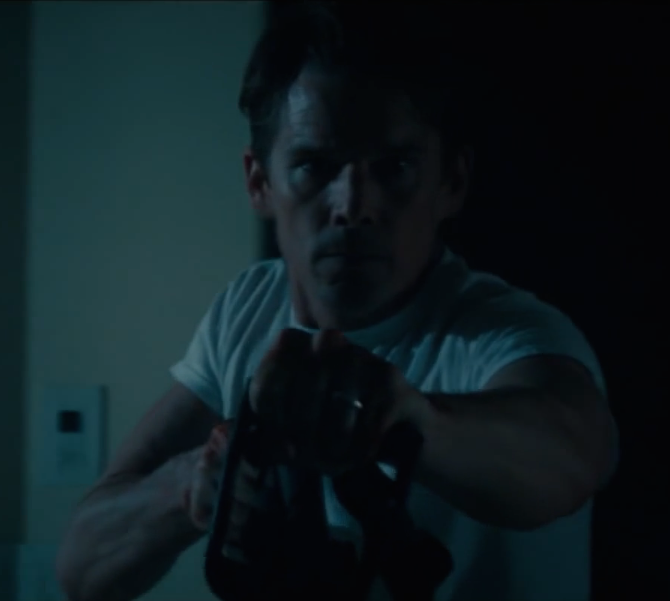
Ethan Hawke’s face was traumatized
after killing numerous purgers inside his home, but the audience accompanied
his reaction with uproarious applause, having been wound up by DeMonaco’s beats to expect the melee they were just rewarded. By the film’s conclusion, violence is recognized foremost as an outlet for
cool kills, and guns an instrument for action that the film relies upon as much
as the characters.

This disturbing dissonance between initial intent and execution
by no means hindered “The Purge’”s
success, with two sequels and a Universal Studios Fright Night attraction proving that the satire of his
concept isn’t what turned DeMonaco’s idea into a franchise. It is bad enough that the idea of “The
Purge” is engineered to advocate why people must have firearms in their
house—because if this dystopia isn’t that far off, then no security system will protect us. Yet if
we’re afraid of fellow Americans
that want to be cowboys—clinging to their
weapons in public and eager to become a hero—“Anarchy” and “Election Year” fulfill their fantasies of a new Wild West with lawless groups
of armed wackos (nudging towards the pithy mental illness argument that guns
don’t purge people, people
purge people); “Anarchy” also introduced a lead character who DeMonaco says himself was
based on Clint Eastwood’s
title gunslinger in “The Outlaw Josey Wales.” For whatever intention
DeMonaco originally had with avenging, strapped-up killer Leo Barnes, the
character’s lead status helps
fortify the franchise’s hypocritical
normalization of gun ownership, making the gun the vital sidekick of any purge.
2014’s “The
Purge: Anarchy” and 2016’s “The
Purge: Election Year” provide a wider scope of terror, while further desensitizing the
franchise’s purpose in favor of an
amusement park-friendly presentation of chaos. Lives mean less and less. “Anarchy” takes
shape as a pro-gun narrative about Barnes saving the lives of others (a mother
and daughter and a divorcing husband and wife) by showing them the value of the
weapon—they’re people who do not
want to purge, as this franchise always takes the moral high-ground with its
holiday, but embrace weapons as necessary protection. In the end, everyone has
a gun, the commentary not speaking to the horror of everyone needing one, but
its satisfying relief that they do.

Though the NRA are called out with dinky cheap-shots in
voiceovers that comment on how gun sales profit from purging, the films have a
bizarre repression when it comes to firearms. In one of DeMonaco’s largest failures for a political statement, the anti-Purge
rebellion leader in “Anarchy” played by Michael K. Williams directly says to the camera that “We
worship at the altar of Smith & Wesson,” but then reasons that
the solution is to “take up arms,” which leads to one of “Anarchy”’s many O.K. Corral shootouts. The end credits of “Anarchy” then
prominently features documentary footage of guns at firing ranges, which along
with weapons that are called out by name in the film (Mauser Elite SSX Double
Barrel, and an “MP-9 silver-tipped Auto Magnum”) might as well be an endorsement. “Election
Year,” in turn, doesn’t
even feign commentary as its narrative follows characters trying to protect a
senator who wants to end the purge; everyone is merely armed from the beginning
and ready to protect or assume heroism.
Never one to refuse a close-up of a body exploding from bullets,
the franchise savors how loud guns and heightened violence combine to make good
guy vs. bad guy set-pieces, which create straight-forward, crowd-pleasing
climaxes. A highlight for my screening audience of “Election
Year” was one continual take, which showed one character walking out
of a truck and over to a woman she had just run over, then shooting her point
blank in the face with a shotgun; the audience roared with approval, and
DeMonaco continued to prove nothing with his cheap pulp franchise but a
symbiotic bloodlust. It’s a hypocritical
sensation matched by other franchise moments of bullet-riddled bodies being
ripped up in slow motion in war-like sequences, a common visual coda for
DeMonaco’s prominently gratuitous
filmmaking.

“Anarchy” features a revealing passage in which a psychotic purger boasts
that she is the virus of violence incarnate, recalling how Steve James’ 2011 documentary “The
Interrupters” diagnosed daily violence as a disease. The fascinating, frightening
psychology about what makes a human able to kill is the least of the franchise’s priorities, despite the series’desire for subversive
relevance in an era of daily mass shootings among other headline-topping acts
of violence. Through its fleeting acts of horror carnage and action movie
shootouts, “The Purge” films desensitize instead of heightening awareness of the
complicated motivations behind violence. It presents a human story of revenge
in Barnes’ arc
(who, in “Anarchy,” initially wants to purge the man who killed his son in an
accident) but shrugs off the immediate issues about why people would embrace
killing, reducing a complicated phenomenon to what a throwaway character in “Election
Year” calls “Halloween for adults.” “The Purge” recognizes
that America is sick with boiling aggression and hatred for the other, but it
sorely lacks the narrative imagination, let alone audaciousness, to challenge
its viewers.
DeMonaco’s idea of satire is
defined by a thoroughly juvenile perspective. Along with wagging its middle
finger at easy, generic targets like stuffy white male politicians and
religious extremism, “The Purge”’s
witless presentation of guns and violence doesn’t have an ideological eloquence beyond the notion of “everything
is totally fucked, dude.” While audiences proceed to show an interest in DeMonaco’s spoof of our national bloodlust ($30.8 this past weekend,
guaranteeing a third sequel), the franchise continues to be complicit in toxic
American fantasies of harming others.