Spaniards headed to the polls Sunday for an unprecedented repeat election that aimed to break six months of political deadlock after a December ballot left the country without an elected government.
Public anger at high unemployment, cuts in government spending on cherished services such as welfare and education and unrelenting political corruption scandals have shaped the two-week election campaign.
Opinion polls in recent weeks have unanimously predicted that the new ballot will also fail to deliver enough votes for any one party to take power alone. That would likely consign Spain to more protracted political negotiations – and possibly even another election.

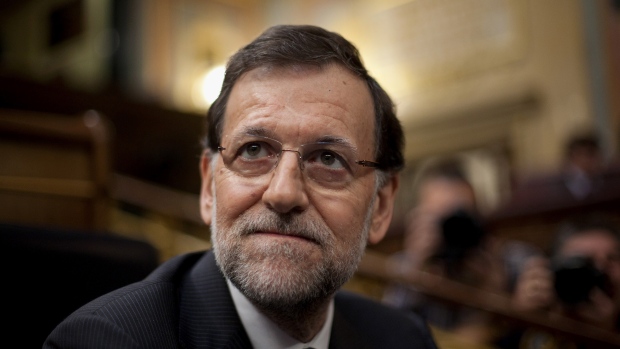
Popular Party leader Mariano Rajoy is hoping to be re-elected as prime minister. (Pablo Blazquez Dominguez/Getty Images)
The most recent polls suggest the conservative Popular Party will win most votes Sunday but will again fall short of the parliamentary majority it had from 2011 to 2015. Popular Party leader Mariano Rajoy is hoping to be re-elected as prime minister.
According to the Spanish Constitution, a government must win a vote of confidence in Parliament with more than 50 per cent of the possible 350 votes before taking office. If it misses that, in a second vote 48 hours later it must get 50 per cent of only the votes that are cast, a lower bar that allows parties to abstain and let another party into power in return for concessions.
A new round of political negotiations could be complicated by support for a new far-left alliance called Unidos Podemos (United We Can). That group, which includes radical leftist party Podemos along with the communists and the Greens, is expected to finish second. That would push the centre-left Socialist Party, which has traditionally alternated in power with the Popular Party, into third place. The business-friendly Ciudadanos (Citizens) party is expected to come fourth.

Pablo Iglesias, leader and candidate of Unidos Podemos, casts his vote in Madrid. His left wing alliance party is expected to finish second in the Spanish general election. (Pablo Blazquez Dominguez/Getty Images)
The election in Spain comes four days after the U.K. voted in a referendum to leave the 28-nation European Union. But Antonio Barroso, a London-based analyst with the Teneo Intelligence political risk consultancy, said it’s “unlikely” the Brexit decision would have much of an influence on the Spanish election.
Polls were to close at 8 p.m. (1800 GMT) for Spain’s roughly 36.5 million voters. Exit polls with projections are expected within minutes after that and most votes are expected to be counted Sunday night.
As of 6:30 p.m. Sunday, turnout stood at about 51.2 per cent, a significant seven-point decrease from the 58.2 December number during that time period.
‘I’m voting for change’
Outside a Madrid polling station, many voters said they wanted Sunday’s election to bring a break with the past.
“I’m voting for change, so that our politicians understand that we don’t agree with what they’ve been doing,” said Maria Jesus Genovar, a 47-year-old teacher who was supporting Unidos Podemos.
Unidos Podemos wants to improve job security, increase the minimum wage and strengthen the welfare state and other public services.

Outside a Madrid polling station, many voters said they wanted Sunday’s election to bring a break with the past. (Pablo Blazquez Dominguez/Getty Images)
But Maria Jose Escos, a 59-year-old government worker, said she had no appetite for the new parties that upended Spain’s traditional two-party system in December.
“I’d like everything to be like it was before,” she said, adding she would back the Socialists.
After the December election, Rajoy couldn’t get enough support from rival parties to form either a minority government or a coalition. The negotiations between the parties dragged on for months as Pedro Sanchez, leader of the second-placed Socialists, also failed to clinch a deal that would let him govern.
Part of the difficulty is that Spain has never had a coalition government.

Spanish politics has been dominated by tensions over Catalonia, high unemployment rates and an unrelenting stream of corruption scandals. (Cristina Quicler/AFP/Getty Images)
Pablo Iglesias, the college professor who leads Unidos Podemos, has repeatedly said he wants a pact with the Socialists in order to oust Rajoy. But a major sticking point is Iglesias’s insistence on letting the powerful northeastern region of Catalonia stage an independence referendum – a possibility that has been rejected outright by all other main political parties.
Ciudadanos is willing to talk to both the Popular Party and the Socialists but want no deal with Unidos Podemos.
Besides tensions over Catalonia, Spanish politics has been dominated by a national unemployment rate of more than 20 per cent for nearly seven years – the second-highest in the EU after Greece – and an unrelenting stream of corruption scandals, mostly involving the Popular Party and the Socialists.