Chilling video has emerged from inside the Pulse nightclub — filmed during Omar Mateen’s deadly rampage in Orlando, Fla., by one of a handful of patrons as they hid in a bathroom.
The dark and blurry footage, shot by survivor Miguel Leiva, shows roughly half a dozen young men and women, crammed into what appears to be a bathroom stall. Many are crying, while others urge them to be quiet.
“We had to be quiet because … any noise [Mateen] heard he was going in that direction and shooting people and killing them,” Leiva said.
“I thought I was going to die and I thought someone has to know what really happened.” The fate of the other people in the video was not immediately clear.
GRAPHIC WARNING: Terrifying moments of clubgoers hiding from Orlando shooter0:49
The video surfaced as other details about Mateen’s life come were discovered.
School records say he struggled academically in the elementary grades because of behavioural problems and an inability to concentrate, and talked about violence at an early age.
Teachers found dealing with Mateen difficult as early as third grade, according to St. Lucie County school records. One teacher wrote that he was “very active … constantly moving, verbally abusive, rude, aggressive.”
In a 1999 letter to Mateen’s father, one of his middle school teachers wrote that the boy’s “attitude and inability to show self-control in the classroom create distractions.”
Separately, a bartender says Mateen stalked her nearly a decade ago when he started coming into her Florida bar.
Heather LaSalla of Fort Pierce, Fla., told The Associated Press that Mateen sent her so many uncomfortable messages on Facebook that she blocked him.
She says she ran into him again at a park in November while she was with her young son and Mateen was with his. She says he talked about his son’s soccer league, but he still had a weird vibe about him.
She was a bartender in Port St. Lucie at the time and says she never filed a criminal complaint over his behaviour.

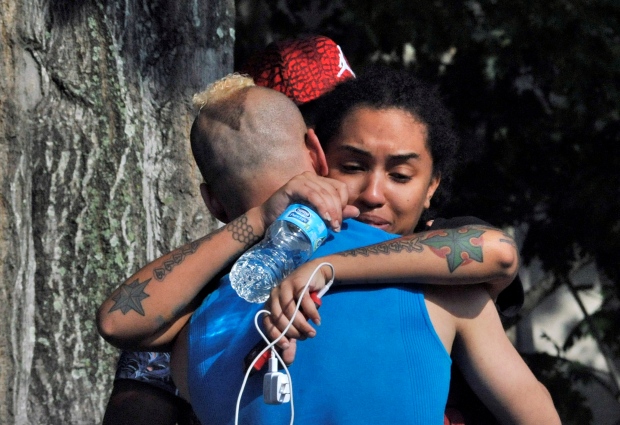
Friends and family members embrace outside the Orlando police headquarters on June 12, following the deadly rampage at Pulse nightclub. A gay rights group says it will distribute $5 million raised online to victims of the shooting. (Steve Nesius/Reuters)
$5M for victims, families
Meanwhile, an advocacy group for crime victims will oversee the payout of some of the millions of dollars in donations raised for victims of the shooting in an effort to deliver aid as quickly as possible.
As of Thursday afternoon, $5 million had been raised online for the victims by Equality Florida, a gay rights group that has decided to distribute the money through the National Compassion Fund, a unit of the nonprofit National Center for Victims of Crime.
There are other private fundraising campaigns for the victims of the massacre, including campaigns to benefit specific individuals, but so far only Equality Florida has sought the Washington-based centre’s help in managing the money.
The victim centre’s executive director Mai Fernandez said the fund planned to disburse emergency money after the authorities confirm an official list of those present during Sunday’s massacre at Orlando’s Pulse night club where a gunman killed 49 people and injured 53 others.
Distributing money to the victims of mass shootings, terrorism and other major crimes can be a fraught process, raising thorny questions about the value of human life, how applications will be verified, who should be making the decisions and how quickly aid can reach those in need.
While countries such as France, Italy and Spain have government-run funds that provide benefits to victims of acts of terrorism, the United States largely relies on a patchwork of state-level aid for crime victims and private fundraising efforts.
The National Compassion Fund was set up in 2014 to help speed up and streamline the flow of private funds and co-ordinate efforts on a national level. The Orlando massacre is the fourth shooting for which the fund is collecting contributions.
Victims and survivors could also be eligible for compensation from public funds.

Gunshot survivor Angel Colon is surrounded by family as he listens to remarks at a news conference at the Orlando Regional Medical Centre on Tuesday. (Jim Young/Reuters)
Dozens of claims
The U.S. federal government helps states pay for crime-related expenses including funeral and burial services, medical treatment and mental health counselling. The Florida Attorney General’s Office is processing dozens of claims through its victim compensation fund, a spokesman for the office said.
The state could also receive money through a $50 million Antiterrorism Emergency Assistance Program, administered by the Office for Victims of Crime, which is part of the U.S. Department of Justice.
According to Florida law, state-distributed victim compensation that reimburses losses is capped at $25,000 or double that sum in case of a “catastrophic injury.”
It is too early to say how much in private aid the Orlando victims could receive in total, Fernandez said in a phone interview. “What we disperse is whatever the public gives us.”
The fund aims to disperse money within nine months and gives 100 per cent of what it receives to victims minus fees charged for electronic donations, with administrative costs covered by separate fundraising, Fernandez said.

Patience Carter, a victim in the Pulse nightclub shooting from Philadelphia, becomes emotional after giving her story during a news conference at Florida Hospital in Orlando. (Phelan M. Ebenhack/Associated Press)
No central fund
For an attack last year in which a gunman fatally shot four U.S. Marines and a Navy sailor in Chattanooga, Tenn., the fund says it received $467,335 from 556 donors. The bulk, $331,490, was paid to the estates of the five people killed, with smaller amounts going to those who were physically injured or psychologically traumatized, the fund says.
The fund also collected donations for a 2014 shooting in Fort Hood, Tex., and the movie theatre shooting in Aurora, Colo., even though that attack took place in 2012, before the fund was created.
The fund does not consider variable factors such as lost future income, so, for example, each person severely injured receives the same amount.
Merging funds with similar missions is a good idea, said Kenneth Feinberg, the lawyer who oversaw compensation funds for the Sept. 11 attacks and the 2010 Gulf of Mexico oil spill. Feinberg is helping to advise the National Compassion Fund.
“Having competing funds is a big mistake. The money gets distributed too widely. You don’t have a centralized, single fund to maximize distributions,” Feinberg said.
The victims centre approached Equality Florida, which found the offer of help attractive because the center does not charge for its services and provides one-on-one contact with victims, Ida Eskamani, Equality Florida’s development officer, told Reuters.
“It’s sad that there is a need for such an organization.”