A Calgary-based team’s perilous mission to fly in and rescue two people needing medical attention at a research facility in the Antarctic continues.
The crew left the Amundsen-Scott South Pole Station and was en route back to the British Antarctic Survey’s Rothera Station Wednesday, according to the U.S. National Science Foundation.
After leaving Calgary June 14, the crew arrived at the South Pole on Tuesday afternoon and rested for 10 hours before beginning their return journey.
The small Twin Otter plane operated by Calgary’s Kenn Borek Air made the 2,400-kilometre, nine-hour trip on Tuesday through dark and cold from the British base on the Antarctic peninsula.
Two of the 48 people at the South Pole station are ill, and at least one of them needs medical care off the continent.
Officials were still determining whether the second patient needed to be brought out as well, but had not given any details on the person or condition. There was no word on whether one or two patients were to be flown out of the station.
It’s midwinter in Antarctica, and the foundation said flights in and out of the station are usually not planned between February and October due to the extreme cold and darkness.

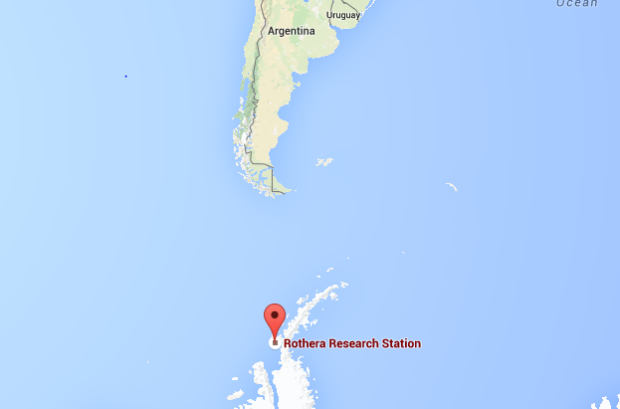
Two twin otter planes from Calgary-based Kenn Borek Air headed to the Rothera Research Station and the Amundsen-Scott Research station at the South Pole to evacuate a Lockheed Martin seasonal employee. (Google Maps)
The foundation said the planes that Kenn Borek Air flies are able to operate in extremely low temperatures and can land on skis. Because there is no tarmac runway at the South Pole, it said the aircraft must land in total darkness on compacted snow.
Kenn Borek provides contractual logistical support to the Antarctic Program, according to the foundation, and conducted similar evacuations in 2001 and 2003 — the only other times a winter rescue flight has been attempted in the 60-year history of the station.
At Rothera, the aircrews prepared the planes, including equipping them with skis for a landing on snow and ice at the pole.
One plane flew to the pole for the medical mission, while the other remained at Rothera to provide search-and-rescue capability, if needed.