Canadian lawmakers who have encouraged consumers to buy compact fluorescent lights (CFLs) for years, will soon set out rules for how to dispose of them.
CFLs last longer than traditional incandescent bulbs and use less electricity. But, inside each twisty tube is toxic mercury powder that can pollute a huge quantity of water.
Mercury is so potent, that the amount found in a household medical thermometer — 0.5 grams — could contaminate more than seven Olympic-sized swimming pools, containing a total of 22.5 million litres of water.

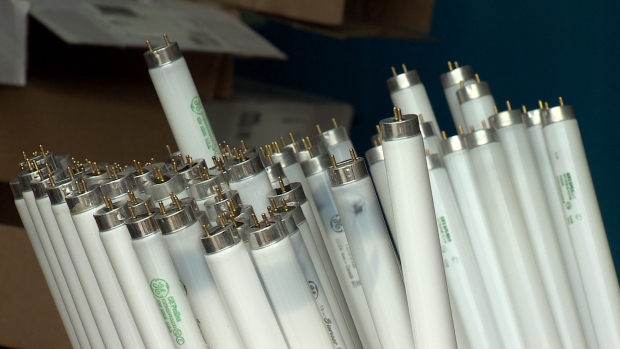
Fluorescent tubes can contain up to 12 milligrams of toxic powdered mercury. (Brett Ruskin / CBC News)
CFLs each contain three to five milligrams of mercury powder; fluorescent tubes contain up to 12 mg.
‘What we’re doing right now just isn’t working’
“I think everyone can agree that what we’re doing right now just isn’t working,” said Darren Fisher, member of Parliament for Dartmouth-Cole Harbour.

MP Darren Fisher (Dartmouth – Cole Harbour) (Brett Ruskin / CBC News)
“All of these light bulbs are currently going in the garbage,” he said.
He said the CFLs end up in landfills, shatter and release mercury into the ecosystem.
Fisher has introduced a private member’s bill in the House of Commons, to create a national strategy for the safe disposal of CFLs.
Until now, any rules for diverting the mercury-filled lights from landfills have come from a patchwork of municipal bylaws and provincial directives.
British Columbia and Nova Scotia are leading the way with provincial programs. Fisher says B.C. has increased its rate of bulb recycling from 10 per cent to 75 per cent. A program coordinated by Efficiency Nova Scotia offers free CFL bulb disposal for consumers, funded by the provincial power corporation.
But those programs only cover a fraction of the bulbs that end up in Canadian landfills annually.
“All of these light bulbs are currently going in the garbage.” – MP Darren Fisher (Dartmouth – Cole Harbour)
“Our waterways don’t respect provincial boundaries,” Fisher said.
“Trace amounts of mercury can poison hundreds of tons of fresh water. So this is something that we need to look at in a national way. It’s not something that we need to continue looking at individually in a provincial way,” he said.
Fisher’s bill had its second reading in the House of Commons last month, and has received support from all parties.
“I look forward to the discussion,” said Ed Fast, Conservative Party member for Abbostford, during House of Commons debates last month.
“The member and I are going to work very closely to make sure this is done in a way that is respectful of taxpayers and also addresses the very real concerns of mercury within our environment,” he said.
Fisher said he was excited to have support from every federal party, meaning his bill will likely pass.
“It’s very hard to pass a private-members bill in the first place,” he said. “The support has been massive.”
Too early to know about light bulb fees
Fisher says adding regulations won’t necessarily add costs for consumers.
“This bill speaks to starting the conversation, it doesn’t presuppose an outcome, he said.
Many items already have responsible recycling strategies. Not all of them include fees passed on to the consumer.
Nationally, there currently is a:
- Battery Recycling Program (no fees to consumers)
- Mercury Switch Recovery Program (funded by steel & automotive industries)
- Mobile Device Recycling Program (no fees to consumers)
- Obsolete Pesticide Collection Program (fees paid by manufacturers)
- Pesticide Container Recycling Program (fees paid by manufacturers)
- Refrigerants Management — ozone depleting substances (environmental levy charged to consumers)
Fisher’s bill has now gone through second reading in the House of Commons.
He says it will go to third reading in the fall, and will then be sent for Senate approval.