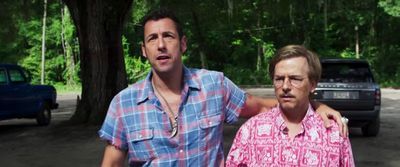
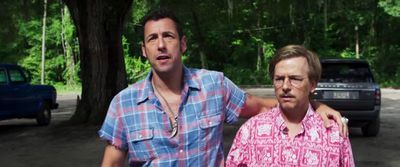
Steven Brill’s “The Do-Over,” the latest in a multi-picture
deal between Netflix and Adam Sandler, starts like a real movie. At first,
there’s a sense that it’s something at least greater than the half-star abomination
that was last year’s “The Ridiculous Six.” This feeling doesn’t last long. By
the time this unfunny, sexist, homophobic, stupid movie has reached the hour
point, any goodwill created by the set-up is long gone. At one point, I checked
the time code on Netflix and saw that the movie had over forty minutes to go. I
visibly winced.
The set-up is OK (at least when compared to the
increasing laziness of Sandler’s recent output). Sandler plays Max, a
smooth-talking guy who runs into an old friend named Charlie (David Spade) at a
reunion. Charlie’s life is a mess. His wife Nikki (Natasha Leggero) is sleeping
around (with Sean Astin), his kids hate him, and he’s just generally
miserable. Reuniting with Max turns him into a goofy teenager again, having fun
and avoiding his depressing reality. When Max decides to fake their deaths so
they can start over in Puerto Rico, Charlie doesn’t object for long. Of course,
they can’t party it up in their new identities for long without the need for a
convoluted Happy Madison plot, and that’s when armed men show up and they get
involved with the widow (Paula Patton) of one of the men whose identities they
stole. Narratively, it’s a film that gets markedly dumber with every passing
minute.
“The Do-Over” is the kind of film in which two essentially
50-year-old men (Spade is 52 and Sandler is 49) are riding around on a yacht
when they spot a few bikini-clad ladies on another vessel. If you’re playing
Sandler Mad Libs at home, you instantly know that Adam is going to ask the
women to flash them. They oblige, but then ask Spade’s character to return the
favor by dropping his trousers, after which they laugh at his dick. Sandler
then shoots the women with a flare gun. And the cherry on this Bad Scene Sundae
comes with the following in voiceover, “I couldn’t believe it. I was having the
best time of my adult life.” It’s one of only about three times I laughed out
loud while watching “The Do-Over,” but not for the reasons Sandler wanted.
I use this example not just to point out the incredibly low
level of humor in “The Do-Over,” but to note how structurally, tonally
disastrous the whole thing is. Like that scene, almost every moment has multiple
punchlines. Charlie and Max decide they have to get tattoos and piercings to
match the dead guys. Charlie finds a stud, thinks it’s for his ear, and then
learns it’s for his tongue. That’s the joke. Then we get a wide-eyed shot of it
going in. Then we get the swollen tongue the next day. Then we get a scene of
him eating a popsicle, unable to talk. Imagine a stand-up comedian who just
piles on to one lame joke after another, repeating the punchline with a few
words changed. The rhythm isn’t there. It feels desperate, almost as if the
deal that Sandler worked out with Netflix required that he be paid by the
minute. How else to explain the fact that this film is 108 minutes long? (And
it feels twice as long as that.)
There are really brief spots that work, most of them
courtesy of the fearless Kathryn Hahn, who shows up as Max’s crazy ex. Hahn has
the comic timing to make nearly anything work, even this disaster. I wish I could
have followed her into a better movie. Although her arrival is right around
when most people will realize how sexist this whole thing is. Almost every
female character is there to be screwed or to screw the guys over. Or both.
This is how Sandler’s brand has always portrayed their female characters, but
it’s just increasingly depressing. When the climax of the film features a
catfight set to Madonna’s “Crazy For You,” in slow motion, I shouldn’t be
surprised, but that doesn’t make it any more forgivable.
For years now, Adam Sandler has been making movies to
bankroll his vacations. That’s why most of “Just Go With It” takes place in
Hawaii. “Blended” actually shot in South Africa. Sandler gets his buddies
together, finds a studio to pay for them all to take a vacation, and loosely “writes”
a movie set in his chosen destination (screenwriting credit goes to Kevin Barnett and Chris Pappas). This time it was Puerto Rico, and
Sandler puts in the same degree of effort as his disastrous theatrical “Vacation
Comedies.” You’d think by now that someone would figure this out. Maybe the
studios did and that’s why Sandler ran to the remarkably open checkbook of
Netflix. Maybe one day, they’ll read the script before they book the plane
tickets. Or at least make sure he’s got one.