Louise Osmond’s “Dark Horse,” an account of impecunious
Welsh villagers who team up to sponsor a race horse that surprises everyone by
turning out a winner, has all the elements of crowd-pleasing Britflicks such as
“The Full Monty,” “Billy Elliott” and “Pride.” It almost cries out to be a Mike
Leigh film starring Jim Broadbent and other members of the director’s stock
company.
Even with Leigh at the helm, though, it would be hard for
any fictional treatment to beat the pleasures of Osmond’s genial, enthralling
documentary. The story is one of those real-life, against-all-odds sagas that
almost defies belief, yet the most important elements here are the characters.
While the film (not to be confused, incidentally, with the recent New Zealand
drama “The Dark Horse”) has an abundance of quirky, colorful British types, two
stand out in particular—one human, one equine.
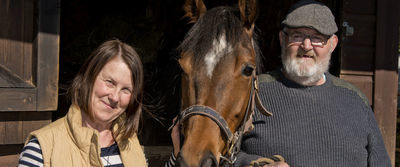
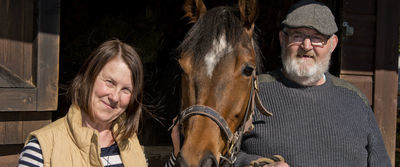
The biped is a twinkly-eyed, middle-aged woman named Jan
Vokes who works as both a barmaid and a supermarket cleaning woman in the
depressed Welsh village of Cefn Fforest. Tending bar one night, she hears a tax
lawyer named Howard Davis discoursing on the ins and outs of raising race
horses. Horse racing, of course, is a sport that’s belonged to the aristocracy
and the well-heeled for centuries, but Jan has a idea. The expenses are more
than she could afford, obviously, but what if a group of friends shared them?
She quickly assembles a team of allies, who each pledge £10 per week to the
venture. Some of her backers are unemployed, and all know that the odds against
any kind of success going up against such well-funded, experienced and tony
competitors are high indeed. And Jan isn’t proposing to buy a horse, mind you.
She’s starting from square one. A mare must be found, a stud fee paid
(naturally, they can’t afford the pricier candidates), and birth awaited.
The colt that results, initially all eyes and
spindly legs, looks like it might not even be suitable for racing. But Jan
proceeds with her plans undaunted. A trainer is engaged and does his work. The
horse, named Dream Alliance (Dream for short), eventually gets entered in a
race and astonishes his backers by coming in fourth. But very soon, the real
astonishment arrives: Dream wins a high-profile race.
In this doc, as in any fictional treatment of
this narrative, that first victory serves as the climax of act one. Act two also
climaxes with a big event, which won’t be revealed here. Suffice it to say,
though, that the horse’s unexpected success entails problems. Yet those don’t
include any divisions or fractiousness among his backers. One of the film’s
most resonant pleasures is the friendship and solidarity these unostentatious
Welsh folk share; they remain warm-spirited and loyal to each other through
thick and thin. And their loyalty extends to their four-legged prodigy as well.
When Dream needs some expensive help late in the story, they are ready to put
up their winnings, because, they say, the money really belongs to the horse
anyway.
As noted, the human brigade has a charismatic
leader. In a film comprised mainly of retrospective interviews and news footage
chronicling various races and the activities around them, Jan Vokes’
recollections stand out, because the woman herself does. She’s usually filmed
leaning slightly to one side, her straight auburn hair swaying as it frames her
recurrent smiles; it gives her a merry, mischievous look. Her
irrepressible sense of fun—which encompasses realizing her whole enterprise’s
absurd improbability—sets the film’s light-hearted, engaging tone.
The film’s equine star, Dream, also seems to
harbor reserves of wit and playfulness. As happens with many favored animals,
he develops a relationship with the humans around him that leaves many thinking
he is communicating with them intentionally via certain
looks and actions. Seeing the footage of him, it’s hard not to share that
belief. Dream does seem to have a certain self-consciousness, as if his
extraordinary, unexpected career on the track was driven by an understanding of
those who invested so many hopes in him. He’s certainly a star, and easily
one of the most memorable characters you’re likely to see in a movie this year.