Alberta’s oilsands industry is one of the biggest sources in North America of harmful air pollutants called secondary organic aerosols (SOAs), a new Environment Canada study has found.
SOAs are formed when volatile organic compounds (VOCs) emitted directly by the oilsands are exposed to sunlight and react with oxygen and other compounds in the atmosphere. VOCs emitted by cars, other industrial processes, and plants can also generate SOAs.
Because SOAs are relatively heavy, they form particles and become a significant component of pollution known as “particulate matter,” or PM.
According to the World Health Organization, particulate matter is linked to respiratory problems such as asthma, along with increased deaths from cardiovascular disease and lung cancer.
The new study reports Alberta’s oilsands generate 45 to 84 tonnes of SOAs a day, comparable to daily output of the Greater Toronto Area, the largest metropolis in Canada – even though the oilsands take up a relatively small area, geographically.

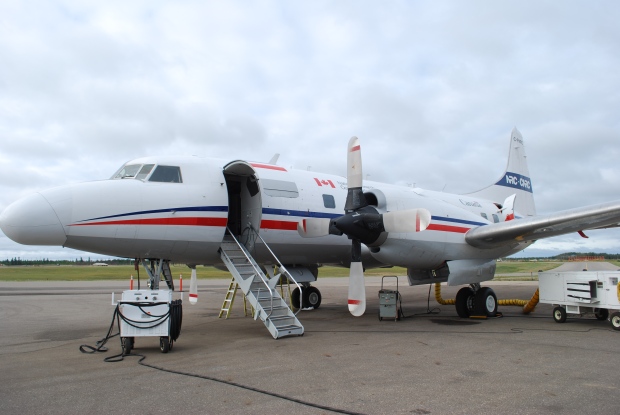
In August and September of 2013, the research team took more than 20 four-hour flights over the oilsands aboard a National Research Council aircraft. (Environment and Climate Change Canada)
That would make Alberta’s oilsands either the largest or second largest source of SOAs in Canada, and one of the top 10 in all of North America, says Environment and Climate Change Canada research scientist John Liggio, lead author of the report published today in the journal Nature.
Shao-Meng Li, another Environment Canada research scientist and principal investigator for the project, said the researchers knew that the oilsands were producing SOAs. “What surprised us, I think to an extent, was the magnitude.”
It appears that the oilsands are unusually efficient at making SOAs compared to other sources.
Once airborne, the pollutants can be blown as far away as Ontario before being deposited in soil and water, although most probably remains in Alberta. The highest concentrations of oilsands SOAs are likely to end up in Edmonton, and the levels from the oilsands may be higher than the levels produced by the city itself, Liggio said.
Environmental impact assessment
It’s the first time scientists have measured pollutants produced indirectly from oilsands emissions.
“Such production should be considered when assessing the environmental impacts of current and planned bitumen and heavy oil extraction projects globally,” the researchers wrote.

The aircraft was loaded with sophisticated scientific instruments designed to measure air pollutants. (Environment and Climate Change Canada)
The study was part of a joint Canada-Alberta oilsands environmental monitoring project launched in 2012 that looked at impacts on biodiversity, water and air quality.
Liggio and Li were looking at air quality, including what and how much pollution were being emitted.
“As air quality scientists, we know that everything that’s emitted reacts in the atmosphere to form something else,” Liggio said. “It’s that something else we were interested in, and it’s that something else that perhaps wasn’t really considered in the past.”

The researchers followed plumes of pollution from the oilsands as they headed downwind, watching the chemicals transform into SOAs along the way. (Environment and Climate Change Canada)
In August and September of 2013, the team took more than 20 four-hour flights aboard a National Research Council aircraft loaded with sophisticated scientific instruments designed to measure air pollutants. They followed plumes of pollution from the oilsands as they headed downwind, watching the chemicals transform into SOAs along the way.
SOAs begin forming almost immediately, and continue forming as long as the raw ingredients are still around – and they can “hang around for a week or more,” Liggio said.
The measurements showed that the types of heavy petroleum products emitted by the oilsands react unusually quickly and produce far more SOAs than similar quantities of lighter petroleum products, such as gasoline.
No easy fix
Cutting those SOA emissions may not be easy.
“You can’t stop the chemistry happening in the atmosphere,” Liggio said. The only approach that could work is to reduce the emissions of chemicals that react to form SOAs, but even that is tricky because many of them are thought to originate from open pit mines, where they would be difficult to contain.
However, Li said the researchers are interested to know more about where the emissions come from, as they may be more easily controlled from facilities such as plants where the bitumen is processed.

The study was led by John Liggio and Shao-Meng Li as part of a joint Canada-Alberta oilsands environmental monitoring project launched in 2012 that looked at impacts on biodiversity, water and air quality. (Courtesy John Liggio and Shao-Meng Li)
According to the paper, SOAs make up more than half of the particulate matter less than 2.5 microns in size in many locations in the northern hemisphere.
The World Health organization says particles of that size are small enough to be inhaled deep into the lungs, where they cause chronic inflammation. Long-term exposure significantly boosts the risk of dying of cardiopulmonary illnesses, and there is no evidence of a safe level of exposure.
As for environmental effects, Liggio says scientists are still trying to figure out how SOAs deposited in soil and water affect ecosystems.