Categories
Sports

Toronto Blue Jays, Josh Donaldson reportedly agree to two-year contract

Josh Donaldson and the Toronto Blue Jays have reportedly bridged the massive gap between their arbitration filings and agreed to a two-year contract, Sportsnet reported Monday night.

Donaldson’s arbitration hearing was scheduled for Feb. 15 and the two sides had submitted amounts that were laughingly just $450,000 apart. Donaldson, last season’s American League MVP in his initial season with the Jays, sought $11.8 million; the Jays submitted $11.35 million. An arbitrator would have heard arguments from both sides and chosen one amount.

Instead, Donaldson can skip next week’s hearing and skip the whole process next winter. Sportsnet’s Shi Davidi reports the two-year deal is worth $29 million.

Last season, the Blue Jays made the playoffs for the first time since 1993 on the strength of Donaldson’s season. Donaldson, 30, hit .297 with a .939 OPS, slugged 41 home runs with a league-leading 123 RBIs. He also scored a league-leading 122 runs hitting second in the American League’s most potent offence.

Spring training for the Blue Jays begins Feb. 22 when pitchers and catchers are scheduled to report. The first day for the full squad is Feb. 25.

Source:: http://www.canada.com/sports/baseball/toronto+blue+jays+josh+donaldson+reportedly+agree+year/11706344/story.html


Categories
Sports

Toronto Blue Jays, Josh Donaldson reportedly agree to two-year contract

Josh Donaldson and the Toronto Blue Jays have reportedly bridged the massive gap between their arbitration filings and agreed to a two-year contract, Sportsnet reported Monday night.

Donaldson’s arbitration hearing was scheduled for Feb. 15 and the two sides had submitted amounts that were laughingly just $450,000 apart. Donaldson, last season’s American League MVP in his initial season with the Jays, sought $11.8 million; the Jays submitted $11.35 million. An arbitrator would have heard arguments from both sides and chosen one amount.

Instead, Donaldson can skip next week’s hearing and skip the whole process next winter. Sportsnet’s Shi Davidi reports the two-year deal is worth $29 million.

Last season, the Blue Jays made the playoffs for the first time since 1993 on the strength of Donaldson’s season. Donaldson, 30, hit .297 with a .939 OPS, slugged 41 home runs with a league-leading 123 RBIs. He also scored a league-leading 122 runs hitting second in the American League’s most potent offence.

Spring training for the Blue Jays begins Feb. 22 when pitchers and catchers are scheduled to report. The first day for the full squad is Feb. 25.

Source:: http://www.canada.com/sports/baseball/toronto+blue+jays+josh+donaldson+reportedly+agree+year/11706344/story.html


Categories
TV & Movies

From the nostalgia file: “Taxi Driver”

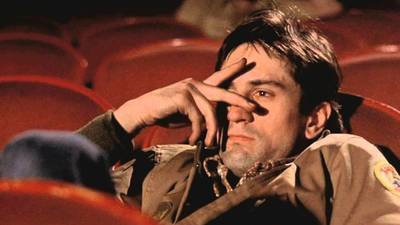
Thumb_maxresdefault

[Editor’s note: This is one in an occasional series of pieces reprinted from outlets that are now defunct or that contractually allow me to reprint things in different venues. It originally appeared in a slightly different form on Salon.com as a part of a slide show ranking Martin Scorsese’s best work. You can read the whole thing here.—Matt Zoller Seitz]

Martin Scorsese is a perfectionist, but he isn’t a control freak; his movies breathe, their performances are often dependent on improvisation, and no matter how much planning went into a shot or sequence, there’s often an unpredictability and seeming randomness to the individual moments, a sense that the story could go anywhere and that the characters could do anything. But that’s decidedly not the case with “Taxi Driver,” arguably the peak of Scorsese’s three-way collaboration with screenwriter Paul Schrader and star Robert DeNiro (who also teamed for “Raging Bull” and “The Last Temptation of Christ,” which was originally a DeNiro star vehicle). From the first moment that you see New York cabbie Travis Bickle, you know he’s headed for a bad end, and that — to borrow the title of a film made 31 years later by a Scorsese obsessive — there will be blood. That sense of inevitability, tragic and horrific, gives “Taxi Driver” much of its power, and might account for the crystalline perfection of the storytelling. The movie knows where it’s going because there is no other possible outcome for Travis.

The film is a slow Sunday drive into the maw of hell. It is largely a hell of Travis’ own perceptions, though. A few critics at the time questioned the credibility of the film’s portrait of New York as one big open sore; National Review critic John Simon even mocked Travis’ voice-over assertion that every night when he brings the cab back to the cabstand, he has to clean ejaculate and blood off the back seat, seemingly missing the brazen subjectivity of the film’s direction. Travis doesn’t just happen to run into pimps, prostitutes, petty hoodlums and the like, he seeks them out. Not every part of the city looks like a Francis Bacon painting but with platform shoes and wide lapels, just the parts that Travis can’t seem to stop visiting—more so at night, the insomniac cabbie’s time, than when the sun is up.

This is probably the Scorsese film I’ve seen the most times — with
“Goodfellas” slowly gaining on it, just because it’s so exciting and
funny and addictive — but no matter how many times I revisit it, I keep
noticing new things.Over time, what initially seemed a despairing arty-intellectual vigilante picture acquires tragic weight. Travis’ worldview is conveyed in adolescent neo-noir terms, with Bernard Herrmann’s score conveying the cornball Raymond Chandler aspects of Travis’ mentality as well as undercurrents of depression, insecurity and motiveless rage. The hero has cast himself the role of the Last Honest Man, an urban cowboy, an avenging angel who’s going to purify a fallen world; but Scorsese and Schrader undercut his banal pomposity with merciless images, such as the God’s-eye-view shot of Travis curled up in his bed in a fetal position, or the long sequence of him watching couples dancing on “American Bandstand,” blankly scrutinizing their casual intimacy while dry-firing a laughably giant handgun. Travis just isn’t wired right. De Niro’s performance captures this in its repetitions, hesitations and faintly robotic tonal shifts. When Travis grins, the corners of his mouth seem to be drawn up by invisible wires. When he flirts with women, he’s unnervingly confident, yet not all there; it’s as if he’s reenacting his favorite scenes from some nonexistent romantic comedy. There is nothing spontaneous or natural about this man. He’s deeply damaged, maybe by the war, maybe by his childhood; we don’t know exactly what his problem is, and ultimately it doesn’t matter. What matters is the evidence of what’s on-screen — the way he talks and behaves. His whole life he’s been passing for happy, confident, functional, normal.

In a way, though, you could say that about all of the characters. The child prostitute Iris (Jodie Foster), the campaign worker Betsy (Cybill Shepherd), Travis’ hilariously non-insightful “mentor” Wizard (Peter Boyle), even Sport the pimp (Harvey Keitel) all seem to be operating at some remove from the world, lost in their own interior spaces, seeing the world as they feel it and perhaps not as it actually is.

Source:: http://www.rogerebert.com/mzs/from-the-nostalgia-file-taxi-driver


Categories
Economic Ft Mac

RMWB Council Gives Approval for Winter Road Repairs of $2.5 Million

The RMWB council has given approval for winter road repairs, authorizing $2.5 million for this task. When the council recently met on a Tuesday night they covered many different things. The council spent around an hour going over 2016 capital budget amendments and approving these changes. During this time council members also simplified the system in place for rural water and sewer program contribution collections from landowners. The meeting also included Toque Tuesday, with Mayor Blake wearing a black toque before the council meeting started to raise awareness of the special event to provide long term solutions for the homeless issues that the region has faced recently. The Centre of Hope provided the toques to the council to raise awareness of the issue.

One of the amendments approved by the RMWB council was the winter road repairs which are needed. The administration had recommended that the amendments include new funding in the amount of $2.5 million for Fort Chipewyan Winter Road infrastructure projects. This amendment as a source of questions, debate, and discussion by the council. Other amendments that were examined included downsizing a planned expansion for the recycling facility, and the project cancellation to install some new computer servers. The $2.5 million approved by the RMWB will go towards culvert repair and replacement on the winter road. Two culverts are currently in need of repairs, and one culvert will be replaced with a single span bridge. The repairs and replacements will ensure that water can pass under the roadway and keep the winter road in better condition.

Categories
TV & Movies

From the nostalgia file: “Taxi Driver”

Thumb_maxresdefault

[Editor’s note: This is one in an occasional series of pieces reprinted from outlets that are now defunct or that contractually allow me to reprint things in different venues. It originally appeared in a slightly different form on Salon.com as a part of a slide show ranking Martin Scorsese’s best work. You can read the whole thing here.—Matt Zoller Seitz]

Martin Scorsese is a perfectionist, but he isn’t a control freak; his movies breathe, their performances are often dependent on improvisation, and no matter how much planning went into a shot or sequence, there’s often an unpredictability and seeming randomness to the individual moments, a sense that the story could go anywhere and that the characters could do anything. But that’s decidedly not the case with “Taxi Driver,” arguably the peak of Scorsese’s three-way collaboration with screenwriter Paul Schrader and star Robert DeNiro (who also teamed for “Raging Bull” and “The Last Temptation of Christ,” which was originally a DeNiro star vehicle). From the first moment that you see New York cabbie Travis Bickle, you know he’s headed for a bad end, and that — to borrow the title of a film made 31 years later by a Scorsese obsessive — there will be blood. That sense of inevitability, tragic and horrific, gives “Taxi Driver” much of its power, and might account for the crystalline perfection of the storytelling. The movie knows where it’s going because there is no other possible outcome for Travis.

The film is a slow Sunday drive into the maw of hell. It is largely a hell of Travis’ own perceptions, though. A few critics at the time questioned the credibility of the film’s portrait of New York as one big open sore; National Review critic John Simon even mocked Travis’ voice-over assertion that every night when he brings the cab back to the cabstand, he has to clean ejaculate and blood off the back seat, seemingly missing the brazen subjectivity of the film’s direction. Travis doesn’t just happen to run into pimps, prostitutes, petty hoodlums and the like, he seeks them out. Not every part of the city looks like a Francis Bacon painting but with platform shoes and wide lapels, just the parts that Travis can’t seem to stop visiting—more so at night, the insomniac cabbie’s time, than when the sun is up.

This is probably the Scorsese film I’ve seen the most times — with
“Goodfellas” slowly gaining on it, just because it’s so exciting and
funny and addictive — but no matter how many times I revisit it, I keep
noticing new things.Over time, what initially seemed a despairing arty-intellectual vigilante picture acquires tragic weight. Travis’ worldview is conveyed in adolescent neo-noir terms, with Bernard Herrmann’s score conveying the cornball Raymond Chandler aspects of Travis’ mentality as well as undercurrents of depression, insecurity and motiveless rage. The hero has cast himself the role of the Last Honest Man, an urban cowboy, an avenging angel who’s going to purify a fallen world; but Scorsese and Schrader undercut his banal pomposity with merciless images, such as the God’s-eye-view shot of Travis curled up in his bed in a fetal position, or the long sequence of him watching couples dancing on “American Bandstand,” blankly scrutinizing their casual intimacy while dry-firing a laughably giant handgun. Travis just isn’t wired right. De Niro’s performance captures this in its repetitions, hesitations and faintly robotic tonal shifts. When Travis grins, the corners of his mouth seem to be drawn up by invisible wires. When he flirts with women, he’s unnervingly confident, yet not all there; it’s as if he’s reenacting his favorite scenes from some nonexistent romantic comedy. There is nothing spontaneous or natural about this man. He’s deeply damaged, maybe by the war, maybe by his childhood; we don’t know exactly what his problem is, and ultimately it doesn’t matter. What matters is the evidence of what’s on-screen — the way he talks and behaves. His whole life he’s been passing for happy, confident, functional, normal.

In a way, though, you could say that about all of the characters. The child prostitute Iris (Jodie Foster), the campaign worker Betsy (Cybill Shepherd), Travis’ hilariously non-insightful “mentor” Wizard (Peter Boyle), even Sport the pimp (Harvey Keitel) all seem to be operating at some remove from the world, lost in their own interior spaces, seeing the world as they feel it and perhaps not as it actually is.

Source:: http://www.rogerebert.com/mzs/from-the-nostalgia-file-taxi-driver


Categories
TV & Movies

From the nostalgia file: “Taxi Driver”

Thumb_maxresdefault

[Editor’s note: This is one in an occasional series of pieces reprinted from outlets that are now defunct or that contractually allow me to reprint things in different venues. It originally appeared in a slightly different form on Salon.com as a part of a slide show ranking Martin Scorsese’s best work. You can read the whole thing here.—Matt Zoller Seitz]

Martin Scorsese is a perfectionist, but he isn’t a control freak; his movies breathe, their performances are often dependent on improvisation, and no matter how much planning went into a shot or sequence, there’s often an unpredictability and seeming randomness to the individual moments, a sense that the story could go anywhere and that the characters could do anything. But that’s decidedly not the case with “Taxi Driver,” arguably the peak of Scorsese’s three-way collaboration with screenwriter Paul Schrader and star Robert DeNiro (who also teamed for “Raging Bull” and “The Last Temptation of Christ,” which was originally a DeNiro star vehicle). From the first moment that you see New York cabbie Travis Bickle, you know he’s headed for a bad end, and that — to borrow the title of a film made 31 years later by a Scorsese obsessive — there will be blood. That sense of inevitability, tragic and horrific, gives “Taxi Driver” much of its power, and might account for the crystalline perfection of the storytelling. The movie knows where it’s going because there is no other possible outcome for Travis.

The film is a slow Sunday drive into the maw of hell. It is largely a hell of Travis’ own perceptions, though. A few critics at the time questioned the credibility of the film’s portrait of New York as one big open sore; National Review critic John Simon even mocked Travis’ voice-over assertion that every night when he brings the cab back to the cabstand, he has to clean ejaculate and blood off the back seat, seemingly missing the brazen subjectivity of the film’s direction. Travis doesn’t just happen to run into pimps, prostitutes, petty hoodlums and the like, he seeks them out. Not every part of the city looks like a Francis Bacon painting but with platform shoes and wide lapels, just the parts that Travis can’t seem to stop visiting—more so at night, the insomniac cabbie’s time, than when the sun is up.

This is probably the Scorsese film I’ve seen the most times — with
“Goodfellas” slowly gaining on it, just because it’s so exciting and
funny and addictive — but no matter how many times I revisit it, I keep
noticing new things.Over time, what initially seemed a despairing arty-intellectual vigilante picture acquires tragic weight. Travis’ worldview is conveyed in adolescent neo-noir terms, with Bernard Herrmann’s score conveying the cornball Raymond Chandler aspects of Travis’ mentality as well as undercurrents of depression, insecurity and motiveless rage. The hero has cast himself the role of the Last Honest Man, an urban cowboy, an avenging angel who’s going to purify a fallen world; but Scorsese and Schrader undercut his banal pomposity with merciless images, such as the God’s-eye-view shot of Travis curled up in his bed in a fetal position, or the long sequence of him watching couples dancing on “American Bandstand,” blankly scrutinizing their casual intimacy while dry-firing a laughably giant handgun. Travis just isn’t wired right. De Niro’s performance captures this in its repetitions, hesitations and faintly robotic tonal shifts. When Travis grins, the corners of his mouth seem to be drawn up by invisible wires. When he flirts with women, he’s unnervingly confident, yet not all there; it’s as if he’s reenacting his favorite scenes from some nonexistent romantic comedy. There is nothing spontaneous or natural about this man. He’s deeply damaged, maybe by the war, maybe by his childhood; we don’t know exactly what his problem is, and ultimately it doesn’t matter. What matters is the evidence of what’s on-screen — the way he talks and behaves. His whole life he’s been passing for happy, confident, functional, normal.

In a way, though, you could say that about all of the characters. The child prostitute Iris (Jodie Foster), the campaign worker Betsy (Cybill Shepherd), Travis’ hilariously non-insightful “mentor” Wizard (Peter Boyle), even Sport the pimp (Harvey Keitel) all seem to be operating at some remove from the world, lost in their own interior spaces, seeing the world as they feel it and perhaps not as it actually is.

Source:: http://www.rogerebert.com/mzs/from-the-nostalgia-file-taxi-driver