Great film has the power to convey the unimaginable. We sit
in the comfort of a darkened theater or our living room and watch protagonists
suffer through physical and emotional pain that most of us can’t really
comprehend. Too often, these endurance tests feel manipulative or, even worse,
false. We’re smart enough to “see the strings” being pulled, and the actor and
set never fades away into the character and condition. What’s remarkable about
Alejandro Gonzalez Iñárritu’s “The Revenant” is how effectively it transports
us to another time and place, while always maintaining its worth as a piece of
visual art. You don’t just watch “The Revenant,” you experience it. You
walk out of it exhausted, impressed with the overall quality of the filmmaking
and a little more grateful for the creature comforts of your life.
Iñárritu and co-writer Mark L. Smith set their tone early,
staging a breathtaking assault on a group of fur trappers by Native Americans,
portrayed not just as “enemies” but a violent force of nature. While a few
dozen men are preparing to pack up and move on to their next stop in the great
American wilderness, a scene out of “Apocalypse Now” unfolds. Arrows pierce air
and flesh as the few surviving men flee to a nearby boat. It turns out that the
tribe is seeking a kidnapped daughter of its leader, and will kill anyone who
gets in their way. At the same time, we learn that one of the trappers, Hugh
Glass (Leonardo DiCaprio) has a half-Native American son named Hawk (Forrest
Goodluck).
Low on men and hunted, the expedition
leader Andrew Henry (Domhnall Gleeson) orders that their crew return to its
base, a fort in the middle of this snowy wilderness. John Fitzgerald (Tom
Hardy) disagrees, and the seeds of dissent are planted. He doesn’t trust Henry,
and he doesn’t like Glass. In the midst of these discussions, Glass is away
from the crew one day when he’s brutally attacked by a bear—the sequence is,
without hyperbole, one of the most stunning things I’ve seen on film in a long
time, heart-racing and terrifying. Glass barely survives the attack.
It seems highly unlikely that he’ll make it back to the base. With increasingly
dangerous conditions and a tribe of killers on their heels, they agree to split
up. Most of the men will go back first while Fitzgerald, Hawk and a young man
named Bridger (Will Poulter) will get a sizable fee to stay with Glass until he
dies, giving him as much comfort as possible in his final days and the
burial he deserves.
Of course, Fitzgerald quickly tires of having to watch a man
he doesn’t care about die. He kills Hawk in front of an immobile Glass and then
basically buries Hugh alive. As Bridger and Fitzgerald head back, Glass
essentially rises from the dead (the word revenant means “one that returns
after death or a long absence”) and begins his quest for vengeance. With broken
bones, no food, and miles to go, he pulls himself through snow and across
mountains, seeking the man who killed his son. He is practically a ghost, a man
who has come as close to death as one possibly can but is unwilling to go to
the other side until justice is done.
The bulk of “The Revenant” consists of this torturous
journey, as Glass regains his strength and gets closer to home through sheer
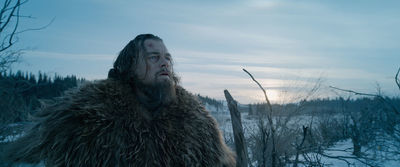
force of will. Iñárritu’s Oscar-winning cinematographer for “Birdman,” Emmanuel Lubezki (who
also took a trophy for “Gravity” the year before and could easily make it three
in a row for this work) shoots “The Revenant” in a way that conveys both the
harrowing conditions and the artistry of his vision. The sky seems to go on
forever; the horizon is neverending. He works in a color palette provided by
nature, and yet enhanced. The snow seems whiter, the sky bluer. Many of his
shots, especially in times of great danger like the opening attack and the bear
scene, are unbroken—placing us in the middle of the action.
At other times, Lubezki’s choices recall his work on “The
Tree of Life,” especially in scenes in the second half when Glass’s journey
gets more mystical. And that’s where the film falters a bit. Iñárritu doesn’t
quite have a handle on those second-half scenes and the 156-minute running time
begins to feel self-indulgent as the film loses focus. When it centers on
the conditions and the tale of a man unwilling to die, it’s mesmerizing. I just
think there’s a tighter version, especially in the mid-section, that would be
even more effective.
About that man: So much has been made of this film being DiCaprio’s
“Overdue Oscar” shot that I feel like his actual work here will be undervalued.
Make no mistake. Should he win, it will not be some “Lifetime Achievement” win
as we’ve seen in the past for actors who we all thought should have won for
another film (Paul Newman, Al Pacino, etc.). He’s completely committed in every terrifying moment, pushing himself further than he ever has
before as an actor. Even just the physical demands of this protagonist would
have been enough to break a lot of lesser actors, but it’s the way in which
DiCaprio captures his internal fortitude that’s captivating—his body may be
broken, but we believe he is unwilling to give up.
The minimal supporting cast is good, and it’s nice to see
Gleeson continue to have an incredible 2015 (also in “Brooklyn,” “Ex Machina”
and “Star Wars: Episode VII – The Force Awakens”). Tom Hardy is less effective,
often going a little too heavy on the tics (wide eyes, shot up close), but I
think that’s a fault of the direction and not one of our best actors. In the
end, this is DiCaprio’s film through and through, and he nails every
challenging beat, literally throwing himself into this character that
demands more of him physically than any other before.
What would you do for vengeance? What conditions could you
surmount to get it? Or would you just give up? Our favorite films often drop
questions like these into our lives, allowing us to appreciate the world a
little differently than before we saw them. “The Revenant” has this power. It
lingers. It hangs in the back of your mind like the best classic parables of
man vs. nature. It will stay there for quite some time.
Source:: http://www.rogerebert.com/reviews/the-revenant-2015


