
Categories
TV & Movies

Beltracchi – The Art of the Forgery

Thumb_beltracchi-2015-1

It’s too bad that Christoph Waltz and Amy Adams already co-starred as Walter and Margaret Keane in “Big Eyes,” last year’s under-appreciated art scam biopic that somehow turned a promising plotline about the contested authorship of kitschy portraits of cloying waifs into an oddly somber domestic melodrama.

They would be perfect as the leads in a big-screen depiction of smirking charlatan Wolfgang Beltracchi and his striking wife, Helene, who are the subjects of the documentary “Beltracchi: The Art of Forgery.” This free-spirited German couple made headlines in 2010 after being arrested for pulling off one of the biggest art hoaxes in modern history. They collected millions of dollars from the sale of an estimated 300 bogus paintings that they passed off as found works by great European artists—the majority Expressionists and Surrealists—from the early 20th century.

As for this subtitled documentary, primarily in German but also French and English, it is somewhat out of date since it captures the prankster and his paramour as they are about to start serving their jail time a couple years back. Theirs was a strangely lenient sentence: they were allowed to work together in a photo studio during the day—in order to pay back those they hoodwinked—and then were imprisoned nightly. Both have since been released and are now mostly free. However, Beltracchi still faces lawsuits. And, these days, he can only make money by painting under his own name, a transition that he begins to grapple with at the end of the documentary.

The much-reported saga of the so-called Bonnie and Clyde of the art world, covered on TV by “60 Minutes,” in the pages of “Vanity Fair” and in two recent memoirs by the couple, is an indisputably fascinating one. For four decades, Beltracchi—a 64-year-old, straggly-haired hippie who looks like a dashing van Dyck nobleman gone to seed— made a hugely lucrative living out of creating not reproductions but high-quality original fakes done in the style of esteemed painters such as Fernand Leger, Max Ernst, Andre Derain, Max Pechstein and Georges Braque.

They were so well done that Ernst’s widow declared Beltracchi’s “The Forest,” a counterfeit bought by French media mogul Daniel Filipacchi for $7 million in 2006, as the most beautiful Ernst piece that she had ever seen. Another false Ernst hung for months as part of a retrospective at the Museum of Modern Art in New York.

Not that any movie deal is necessarily in the works, although one senses the cash-strapped Beltracchis wouldn’t turn one down. But “The Art of Forgery’s” account of how a smugly confidant con man bamboozled seasoned connoisseurs who had a vested interest maintaining the ever-escalating price tags for fine art—auction houses Sotheby’s and Christie’s, world-class experts, gallery owners, museums and deep-pocket collectors—is certainly packed with “Catch Me If You Can” cinematic possibilities.

Actor and comedian Steve Martin is probably the most notable of Bertracchi’s victims. He was tricked into purchasing a supposed 1915 painting by Dutch-German artist Heinrich Campendonk with the title “Landscape with Horses” for about $850,000 from a Parisian gallery (he even had it authenticated by a Campendonk specialist) and later sold it through Christie’s at a hefty loss.

Like most collectors and experts who fell for Beltracchi’s chicanery, Martin understandably declined to participate in the documentary. There are rather neutral art critics and historians who pop up to provide some perspective on how and why the Beltracchis got away with their ruse for so long. Only Henrik Hanstein, the scowling owner of Cologne-based auction house Lempertz, injects some sorely needed vitriol on behalf of those who were humiliated and had their reputations sullied as he bluntly states, “I was damn angry at Mr. Beltracchi.

But too often “The Art of Forgery” turns into a how-to guide, initially interesting but ultimately belabored, with Beltracchi meticulously deconstructing the methods he employed to pass off his new art as old, from reusing period-correct frames and canvases bought at flea markets to tucking pieces of dust and dirt into the back of his paintings. It’s like watching a magician reveal his secrets, which is usually less fun than watching him pull a rabbit out of his hat.

Most galling if impressive is the fib that he and Helene concocted to ensure buyers of their legitimacy: That she inherited an art collection from her then-recently deceased grandfather who had bought these pieces from a real-life gallery owner before World War II and hid them to keep them safe from the Nazis. Given the raw emotions involved, no one thought to question the tale’s veracity.

At a certain point, however, there arrives a sense that this documentary is, in large part, a blatant act of self-mythologizing, a way to embolden Beltracchi’s outlaw genius status after being duly chastened and celebrate his knack for taking advantage of other people’s greed while feeding his own. If he has any remorse, he has probably painted over it. To him, the auction houses and dealers are no less culpable. They let him fool them because they benefited from believing. Besides, how can you not be slightly skeptical of the film’s intent after learning that “The Art of Forgery’s“ director Arne Birkenstock is the son of Beltracchi’s lawyer?

But there is one highly genuine scene that feels as if it could be an outtake from “The Grand Budapest Hotel“ that nicely underlines Birkenstock’s theme of the ephemeral nature of art when it comes authenticity and originality.

Madame and Monsieur Ommeslaghe, a prim silver-haired French couple of means, invite the camera into their tastefully appointed home. He shows off his Warhol, Renoir and Matisse before coming upon a Magritte seascape featuring a female nude in muted tones with a white dove on her shoulder. The lady of the house notes that it is “not as nice” as the phony Campendonk done by Beltracchi that once occupied the wall. She loved its bright colors and how the cow and farm homes summoned warm memories of her rural childhood. Declaring it a “poisoned gift” from her husband that they eventually returned after learning of its illegitimate origins, she no longer considers it art. Instead, it’s “a decoration.”

Yet, the painting remains beautiful, no matter how it came to be or how much it is worth. And she clearly misses it. Should the fact that it is not a Campendonk matter? If it gives you pleasure, isn’t that more important than whose signature is on the bottom? When “The Art of Forgery” considers such thought-provoking matters, that is when it feels most real.

Source:: http://www.rogerebert.com/reviews/beltracchi-the-art-of-the-forgery-2015


Categories
TV & Movies

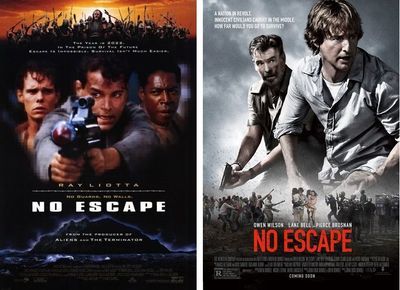
Movie Namesakes: “No Escape”

Thumb_noescapenamesakes

In terms of new releases, late August is always the cinematic doldrums. Studios are now savvier about how they parse late summer releases—“Guardians of the Galaxy” came out in August last year, and this year titles like “American Ultra” and “Hitman: Agent 47” have the potential to become sleeper hits in the wake of records set by “Straight Outta Compton”—yet the month before Labor Day is traditionally a last summer hurrah, not a chance to see another blockbuster. Besides, most critics now turn their attention to The Toronto Film Festival, which is an early harbinger of the year’s remaining prestige releases. This August is no different from summers past, yet one title caught my attention. “No Escape” looks like another middling thriller where an everyman must make difficult, sudden decisions in order to protect his family. Something about the title nagged at me, and I couldn’t quite put my finger on it until days later: there’s already a movie called “No Escape,” and I’ve seen it.

Released in April 1994, the science-fiction thriller “No Escape” drifted away from our collective cultural memory. Its trailer has less than seven thousand views on YouTube, and the packaging on its Amazon page recalls the first wave of DVD in the late 1990s. Given the film’s pedigree and box office performance, however, it’s ironic “No Escape” amounts to little more than a memory. It stars Ray Liotta, a commanding actor who had no trouble with leading roles in the wake of “GoodFellas.” The film was directed by Martin Campbell, who went on to direct “Goldeneye,” “The Mask of Zorro” and “Casino Royale,” which veer from pretty damn good to downright superb. More importantly, “No Escape” was number one at the box office the weekend it opened. How could a movie with such talent, for all intents and purposes, be forgotten? Maybe the 1994 “No Escape” deserves status as a cult classic? In any event, revisiting the movie would be an opportunity, albeit an arbitrary one, to see just how action films changed over the past twenty years.

Finding a copy of “No Escape” was not as cheap as I had hoped. It is not available on any VOD platforms, so I could either buy it from Amazon Prime for a price typically associated with a Criterion release ($25), or wait a week and get a less expensive copy from eBay. At a barbecue this summer, I mentioned this dilemma to Ramin, my good friend and neighbor, and as luck would have it he had a copy. I should have known Ramin would own this title: he hosts semi-regular movie nights where he invites a group of people to watch a campy action flick from the late eighties and nineties (past titles include “Road House,” “Shakedown” and “Demolition Man”). Before each screening, Ramin gives a brief presentation about the movie, and afterward there’s a thirty-question multiple choice quiz over the move’s minutiae. We watched “Hackers” at Ramin’s last movie night, for example, and there was heated debate over the question, “How many nipples appear in total?” In other words, he would be the perfect “No Escape” companion.

Before the opening credits finished, something was already abundantly wrong. The DVD of “No Escape” is so old that it’s a VHS transfer, and its “letterbox” formatting was meant for a cathode ray television with a 4:3 ratio. It took a few minutes of tinkering before we arrived at a zoom that took up most of the flat screen without distorting the image, yet the problems did not stop there. The premise of “No Escape” is profoundly silly. Set in 2022, Liotta stars as John Robbins, a disgraced soldier who’s serving a life sentence in a high tech maximum security prison. The warden (Michael Lerner) is sick of Robbins’ numerous escape attempts, so he decides to send him to an anonymous tropical island where the most dangerous criminals can live the rest of their days. There he discovers two warring factions, led by the evil Marek (Stuart Wilson) and the enigmatic man known as The Father (Lance Hendriksen). Robbins is not much of a joiner, yet finds himself at the frontline for the inevitable big battle.

The most striking difference about “No Escape” and more modern action films is how Campbell and his team make full use of the sets they designed. Without access to CGI and teams of animators, Campbell relied on more practical effects, which meant he would reconfigure the same dirty, unimaginative set several times in order to maximize the producers’ investment. The two island bases in “No Escape” recall Steven Spielberg’s notion of Neverland in “Hook,” but much more violent. There are primitive traps throughout the island, and each death is met with a gruesome close-up, an overwrought one-liner, or both. Although the action is never quite thrilling, there is something to be said about Campbell’s reliance on extras and stunt men. The broad, old-fashioned canvas of hundreds of real moving bodies still has an appeal, which is partially why a recent spectacle like “Mad Max: Fury Road” captures the imagination while CGI-heavy fare often does not. Modern action directors can let their imaginations run wild, so there are fewer inventions through necessity.

The dated production values may have some novelty, but the stupidity of the premise nearly renders “No Escape” unwatchable. There is never an adequate reason why the Warden wants to keep the hardened prisoners on an island. How is their survival profitable? To what end does it serve? A simple throwaway line about human experiments or whatever would suffice, yet Robbins and the other island “inmates” are left to their own devices, and indeed have more self-determination than most any other prisoners on Earth. There is a scene midway through the film where Robbins stands on a beach and gazes into the sunset, aching for escape from his picaresque island hell. I could not help but think of “The Shawshank Redemption,” another film about prison life, that ends with a similar image, only it represents absolute freedom. The idiocy does not end there: the Warden decides to solve the island squabbling by paying a personal visit there, despite the fact that several armed warplanes are stationed nearby. Indeed, “No Escape” is the sole screenwriting credit for Michael Gaylin, and that’s because his stadium-sized plot holes betray the movie’s title.

After an ending that lands like a bad “Twilight Zone” episode, a feeling of genuine relief accompanies the end credits. “No Escape” is an exhausting movie, one that would be borderline fun if it treated the audience with any intelligence. In the subsequent discussion, I asked Ramin why he doesn’t show “No Escape” for one of his movie nights, and he said, “It is way, way too bad for that.” Even for a guy who delights in the low-effort thrills of adequate action filmmaking, “No Escape” is not worthy of a social event that’s based on mockery, not appreciation. If anything, this experience should be a lesson to those who are curious about many old movies: if a distant memory and a crappy DVD is all we have of an old movie, there is usually a good reason why. The August 26th release date of 2015’s “No Escape” means it may suffer the same slow, inglorious death of the 1994 edition, yet the newfound ease of online viewing comes with a benefit we sometimes take for granted. Nowadays it’s much simpler to dismiss mediocrity outright, instead of merely forgetting it.

Source:: http://www.rogerebert.com/balder-and-dash/movie-namesakes-no-escape


Categories
Alberta Ft Mac Health

Environmental Protection Order Issued by Alberta Energy Regulator Against Syncrude

environmental protection order, Syncrude

Syncrude has been hit with an environmental protection order from the Alberta Energy Regulator after 30 blue heron deaths at one of the Syncrude facilities. The order shows that the company must immediately comply with the requests, and they must provide an aerial picture of the site of the accident to the regulator. The aerial photo must show any monitoring wells, and provide the agency with information on the capacity of the sumps where the blue herons were located when they were found. The company also has to collect sump samples, and test the area as well. The sample locations must be provided along with the samples. Syncrude must make daily reports, to the public and to the director, and these must be posted by 3pm until the regulator decides differently.

The environmental protection order against Syncrude is part of the investigation into the blue heron deaths. When a company found the first blue heron the bird was alive and covered in bitumen, and it had to be euthanized. When employees searched further they found the bodies of 29 dead blue herons as well. Bob Curran, the AER spokesperson, said “There’s a variety of things they put in place to prevent these types of cases. However, the company also has a responsibility to make sure the site is not negatively impacting wildlife. They have an obligation to make sure the site is safe.” Mark Ward, the CEO for Syncrude, said “I want to assure Canadians we will take the time necessary to conduct a very thorough investigation. Our organization and our employees are completely committed to finding out what happened and addressing it.”

Categories
TV & Movies

“A Girl at My Door”

Thumb_girlatmydoor

The South Korean film “A Girl at My Door” is a low-key psychological thriller with uneasy feelings pulsating beneath its plain rural background on summer days. Its damaged heroine just wants to help a desperate girl in need of care and protection, but the movie slowly draws these two lonely tarnished souls into the dark, uncomfortable territory of country noir. While we see the unpleasant sights from a corrupt human society surrounding them, they are not entirely innocent in their problematic circumstances, and they may pay a big price for their actions if they are not careful.

For Yeong-nam (Doona Bae of “Cloud Atlas”), it was initially a simple matter of keeping herself out of any further trouble when she began her first day as the new precinct chief of a beach village far from Seoul. During her meeting with the superintendent at the local headquarters, it is implied that she has been transferred to this remote rural area because of some personal matter. Neither she nor the superintendent directly mentions the matter during their private conversation, but it is clear that she is not so pleased about this downturn of her career. She is cheerfully welcomed by the village people, but she rather wants to be alone, and she also shows alarming signs of alcoholism, including her drink hidden in fresh water bottles.

While getting accustomed to her temporary staying place, Yeong-nam comes to pay attention to a young teenage girl named Do-hee (Kim Sae-ron), who she saves from a bunch of bullying students, and learns about how much this young girl has been mistreated by not only her abusive stepfather Yong-ha (Song Sae-byeok) but also others in the village. Yong-ha beats his stepdaughter whenever he gets drunk (he usually does), and there is no one to stop him at his home. Do-hee’s mother left her husband and daughter several years ago, and Yong-ha’s aging mother never cares about her son’s domestic violence. As a matter of fact, she also beats Do-hee whenever she thinks Do-hee needs to be punished.

As the precinct chief, Yeong-nam is determined to do something about this problem, but other people in the town are not very willing to assist her. The village depends a lot on Yong-ha, who has been supplying illegal immigrants to the village, which does not have any young guys to work except Yong-ha. The village people have turned a blind eye to Yong-ha’s despicable behavior, and we see how they and Yong-ha have been enslaving and exploiting poor immigrant workers from Southeast Asia. When Yong-ha savagely beats one of them, everyone near him just stands by without doing or saying anything, making this cruel moment all the more disgusting.

And then something happens under a rather suspicious circumstance that leads to more development of the relationship between Yeong-nam and Do-hee. After suddenly appearing at the front door of Yeong-nam’s place, Do-hee starts to stay with Yeong-nam because she feels safe there, and Yong-ha sees no problem in that. After all, his stepdaughter has been no more than a burden for him from the beginning.

First-time director July Jung, who is known as Jeong Ju-ri in South Korea, focuses on the unstable emotional interactions between her two main characters, and the movie slowly builds its tension under the seemingly peaceful atmosphere of a country town. The characterization is a little too simplistic in the case of the supporting characters, but they feel like real people you may meet in any country town in South Korea. These ‘ordinary’ people in the movie condone the violation of human rights just because it benefits them and their village, and we all know such a thing has been committed around our world countless times in the name of common good or any other convenient excuse.

Disgusted by this banal evil inside the village, Yeong-nam feels more need to protect and help Do-hee, but then there is a secret she does not dare to reveal to others. Around the time we get to learn more about it, Yong-ha also happens to discover it by chance, and that makes her situation more difficult than before. Will she be able to do the right thing even if he exposes her secret to everyone?

It goes without saying that Do-hee is a domestic abuse victim who must be helped and protected, but then it turns out she is far more troubled than expected. While she can be cheerful and lively just like any young girl, she also can be quite tempestuous as shown during one striking scene, and her affection toward Do-hee begins to look more uncomfortable especially when she is more blatant about her increasing need to be loved and protected under Yeong-nam’s care (“I don’t need anyone. You are the only one I need.”)

As Yeong-nam tries to handle her rather tricky situation with Do-hee, she eventually gets herself into really serious trouble, and Bae, who has been more notable outside South Korea thanks to her performances in “Cloud Atlas” (2012) and the recent TV series “Sense8,” is superb in her understated performance, which subtly suggests more than what it is shown on the surface. In an infuriating scene in which Yeong-nam cannot simply answer yes or no to very insensitive questions hurled at her, Bae effectively conveys what is imploding behind her character’s tight composure. Yes, she let Do-hee stay at her house out of compassion and care, and that was a right thing indeed, but we also know that her time with Do-hee was not wholly innocent, and so does she.

Song Sae-byeok is truly loathsome as the scumbag villain of the movie, and you will certainly want his character to be struck by lightning sooner or later. Some of you may think Song overacts in his slimy performance, but I must tell you that I have seen a number of very rude Korean animals like Yong-ha during my daily life in South Korea. Moon Seong-geun and Kim Min-jae briefly appear as Yeong-nam’s superiors, and Jang Hee-jin has a nice scene as Yeong-nam’s unexpected visitor who wants to meet and talk with her for their unfinished matter.

Kim Sae-ron, a 15-year-old young actress, who previously made a breakthrough with her remarkable debut performance in South Korean movie “A Brand New Life” (2009), gives an exceptional performance which is as crucial as Bae’s in the film. Do-hee may be a kid innocent enough to willfully cause troubles for her and Yeong-nam, but, as one supporting character points out later in the film, she feels different from other kids her age as a girl who has suffered domestic abuse for years. We come to sense the darkness somewhere inside her elusive bruised heart. For example, look at her face closely when she realizes what she has inadvertently caused at one point, and look at how she subsequently follows the logic of her situation with no hesitation or guilt.

We are disturbed by what she does during the following scene, but we are not surprised at all because we have somehow been aware of what she is possibly capable of. This tense climactic scene is quite uncomfortable to watch for good reason, but it is thankfully handled with care and restraint under Jung’s thoughtful direction, and you may be chilled by how this little girl can be as resourceful as, say, Amazing Amy.

“A Girl at My Door” was shown at the Cannes Film Festival around the time when it was released in South Korea in last year, and it received positive reactions from both sides. This is a compelling mix of character drama and shady noir tale, fueled by its excellent atmosphere and performances, and the ambiguous tone of its ending will leave you something to think about after watching it. There were actions, and then there are consequences, so what will happen next? I do not have an easy answer for that, but I did care about its story and characters, and that is more than enough to recommend this impressive debut work, which deserves to be remembered for the very special performances from two talented South Korean actresses to watch.

Source:: http://www.rogerebert.com/far-flung-correspondents/a-girl-at-my-door


Categories
TV & Movies

Bruce Campbell’s Horror Film Festival Highlights

Thumb_380494-tales-of-halloween

Bruce Campbell’s Horror Film Festival is back in Chicago
this weekend (8/20-23) and, with no offense to fans of “Wolfcop,” the line-up
is notably improved from year one. The fest has gone from an interesting
curiosity in its debut year to a major event for horror fans in the Midwest,
complete with impressive special guests and premieres of films that horror fans
will be talking about over the next year. With films that played Sundance,
Toronto, Fantasia Fest, and more, Bruce Campbell’s Horror Film Festival brings
the Midnight programming from some of the most notable film festivals around the
world to Rosemont, IL. If you’re a genre fan and you’re not interested in
attending, something is wrong with you.

Festival Director Josh Goldbloom and the team behind the
fest really landed a big film for their Opening Night premiere (at 7:30pm this
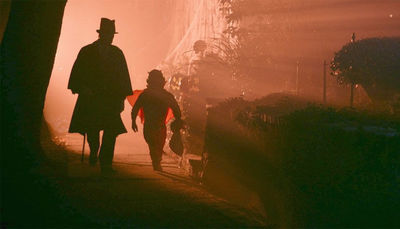
Thursday), the multi-director anthology “Tales
of Halloween,”
the best film of its kind since the cult hit “Trick ‘r Treat”
(sorry fans of the less-consistent “V/H/S” and “The ABCs of Death”).
Producer/director Axelle Carolyn has assembled a diverse array of filmmakers,
including Darren Lynn Bousman (“Saw II”), Neil Marshall (“The Descent”), Adam
Gierasch (“Toolbox Murders”), and Lucky McKee (“May”), and merged their short
films into a clever, quirky ode to the holiday of ghosts and ghouls. All ten
tales take place on Halloween, and while each has its own narrative, Carolyn
and her team have deftly made all ten feel like they’re part of one piece. It’s
not unlike a series of ghost stories told around a campfire in that one seems
to inspire another, ending in a great piece (from Marshall) that ties them all
together. Horror fans will adore the many cameos, including legends like Joe
Dante and John Landis, and the fact that the pieces actually get stronger as
the film goes along. A bit about competing Halloween decorations called “This
Means War” followed by Mike Mendez’s future-cult-classic “Friday the 31st”
are just two of the second-half highlights. By the end, the lunacy of “Tales of
Halloween” has reached its peak and horror nuts will be sent out the door ready
for a dozen more films from their favorite genre. (“Tales of Halloween” is followed by
the inferior “Hellions” Thursday night, fresh off its Sundance premiere and
before it plays in Toronto next month. Some people really dig it. I’m not one
of those people.)

Friday night marks the world premiere of “June” (which was
not screened for press), along with an awesome event in which writer/director
Tom Holland will present a screening of “Fright Night.” That hot ticket is
followed by the North American premiere of “The Pack” and a perfect choice for
the midnight slot in the ‘80s horror parody “Dude Bro Party Massacre 3.” If you’re
wondering how you missed the first two “Dude Bro Party Massacre” movies, you’re
missing the joke.

Saturday offers a mixed bag of quality, but the centerpiece
is the real draw—a Q&A screening with Bruce Campbell after “Bubba Ho-Tep”
at 7pm. Two hours before that, you might be drawn to the semi-successful “Some Kind of Hate,” a slasher movie
meets ghost story meets cautionary bullying tale. When a kid finally fights
back against his bully, he gets sent away to a youth reform camp for violence.
In other words, the kid getting bullied gets sent to a facility filled with
bullies. This can’t end well. Adam Egypt Mortimer’s tale starts like a drama
but shifts at the end of the first act when the ghost of a girl who was bullied
to the grave decides to help out our woeful protagonist by eliminating his
enemies for him. Some of the performances here are way too thin for the dramatic
material, but there’s enough style and confidence in the filmmaking to make me
curious about what Mortimer does next. And what else are you going to do on a
Saturday at 3pm? Go outside? You must not be a real horror fan.

“Some Kind of Hate” leads into the superior (but still
flawed) “Body” at 5pm on Saturday.
This Slamdance audience fave stars Helen Rogers, Alexandra Turshen and Lauren
Molina as three girls who break into a mansion on Christmas Eve only to be
interrupted by a stranger (the legendry Larry Fessenden), which leads to
tragedy. How the girls respond—or rather the series of very poor decisions they
make—is the crux on which “Body” spins. I like the room given in the first act
for Rogers and Turshen to develop characters, and I’ve always been
kind of a fan of one-setting thrillers like “Body.” There’s something cathartic
about watching people faced with nothing but bad outcomes somehow make their
situations even worse. We tell ourselves that we’d make smarter choices, even
though we probably wouldn’t. “Body” is a bit slight (it needed another twist or
two) but it’s a solid choice mid-fest. (And a better film than Saturday’s post-“Bubba”
closers, the awful “Contracted: Phase 2” and the simply ridiculous “Bunny the
Killer Thing,” a Troma-esque gorefest in which a man in a bunny suit with a
giant penis rips off people’s body parts while shouting little more than “Pussy!” Perfect for a midnight movie
slot in a fest like this one, but more exhausting than excellent.)

Sunday is the best day yet in the two-year history of Bruce
Campbell’s Horror Film Festival, which should leave fans happy and ready for
next year. It starts at noon with a screening of the classic “Cannibal
Holocaust,” introduced by Eli Roth and accompanied by “mountains of breakfast
meats.” Eat bacon while they eat people! Following that, catch up with the Sundance hit “Turbo Kid,” a fun
Amblin-esque ‘80s throwback that has been getting buzz on the fest circuit all
year long. It’s a major get for this fest.

The two best new films of the festival play Sunday afternoon
in the two-fer of “Sun Choke” and “He Never Died.” Given their indie
cinema styles, both will have their detractors, but I found both films to be
engaging, visually confident works, carried by strong central performances. “Sun
Choke,” at 2:30pm, stars Sarah Hagan in a fearless performance as Janie, a
young woman trying to get over an undefined trauma through the help of an
abusive life coach/counselor/kidnapper played by the legendary Barbara
Crampton. When Janie breaks out of her rehab/prison, she spots a beautiful
young woman named Savannah (Sara Malakul Lane), with whom she becomes obsessed.
What is buried in Janie’s past? What violence is in her future? “Sun Choke” is
an odd film—more “Mulholland Dr.” than traditional horror—but that’s what I
like about it. Writer/director Ben Cresciman works with Matthew Rudenberg’s
excellent cinematography to produce a dream-like film with more questions than
answers. “Sun Choke” is incredibly violent, disturbing and truly strange. Even
if you don’t think it entirely works, it stands out.

Someone who has always stood out from the crowd is Henry
Rollins, a man who should have been a movie star years ago but finally gets a
breakthrough starring role and totally nails it in the very-good “He Never
Died,” playing at 7pm on Sunday night. Rollins plays a loner with a trunk full
of cash and no friends. The first act of “He Never Died” plays like a noir—low light,
deadpan responses from Rollins, threats of violence. And then we learn the
importance of the title. Rollins is immortal. He can’t be killed. And yet he is
not a love-lorn vampire a la “Twilight,” he is someone who has lived WAY too
long, seen way too much death, and found little reason to care about life any
more. Even just the way Rollins says “Don’t
after getting punched in the face conveys so much weariness of an existence
that has seen every war in the history of man. When his daughter shows up and
gets in trouble—combined with the waitress at the diner he attends every day
showing interest in him—our sullen hero has to give a damn about something
again. Maybe for the last time. This is a genre film that I can virtually
guarantee you will find a faithful audience later this year when it’s released.
Get on the bandwagon now. And that’s what great fests are often about—introducing
you to films that your friends will be talking about 3 months from now. Horror
fans love the new discovery, the new cult hit, the new creative voice—come see
the new this weekend. Get your tickets
here.

Source:: http://www.rogerebert.com/festivals-and-awards/bruce-campbells-horror-film-festival-highlights


Categories
TV & Movies

A Deadwood Dream

Thumb_deadwooddream

Last night I had a dream about “Deadwood.”

It was 2017, and David Milch’s western had miraculously returned to HBO, eleven years after its unexpected cancellation. The opening credits were essentially unchanged, but they were missing a few familiar names and had gained a few new ones. And the first shot was a close-up of a smoldering pile of rubble.

The viewer realized with a shock that we had skipped ahead in the timeline. The plan, as outlined by Milch, was for the town of Deadwood to burn down at the end of season four—an event that occurred in reality on September 26, 1879—and then be rebuilt in increments through season five. The show’s cancellation interrupted that narrative and created a serious production and logistical problem, nearly as pernicious as the challenge of reassembling what was, at the time, the largest cast of regulars in scripted TV—a veritable murderer’s row of character actors who were thenceforth cast into the pop culture wilderness in search of fresh employment.

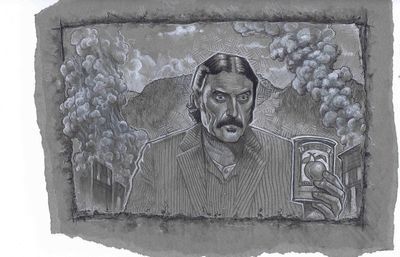
After a long moment, a sooty boot kicked the pile and broke it apart. The boot kept kicking it and kicking it until we saw a glint of dingy metal. Then a sooty hand reached into the frame and lifted a piece of a charred ceiling strut, revealing a can of peaches.

The hand belonged to Al Swearengen, the owner of the Gem Saloon. The camera pulled back to reveal Swearengen contemplating the peach can as if it were Yorick’s skull. His face was partly masked by black and grey sweat-streaked ash, and his dark suit was shot through with moth-holes burned by cinders.

He unsheathed his throat-slitting buck knife, forced up the can’s lid, speared a peach-half and lifted it, syrup gleaming on the blade, and popped it all into his mouth at once as if it were a piece of hard candy, and chewed.

After a long moment, he raised an eyebrow approvingly, took a long look around, and said, “If you want to hear God laugh, tell him your plans.”

The camera pulled back again, taking in Swearengen from head to toe, and in the process revealed E.B. Farnum, the town’s erstwhile mayor, standing nearby, clothed as much in soot as finery, chastising his dimwitted sidekick Richardson, who puttered about moaning and clutching at his temples. The camera pulled back further and rose higher and higher, taking in a panorama of destruction where a nascent hub of civilization once had stood. Everything was in ruins: the Gem Saloon, Cy Tolliver’s upscale Bella Union, Mr. Wu’s Chinatown with its caged women and chickens and flesh-eating hogs, Farnum’s Grand Central Hotel, the jailhouse and sheriff’s office where Seth Bullock had once jailed thieves and drunks and disturbers of the peace, the schoolhouse where his wife Martha had taught the town’s children, the newspaper office where A.W. Merrick had chronicled the town’s mostly-idealized history, the cramped cabin where Doc Cochran had treated the sick and elderly and deranged: it was gone, all gone. The black hills of South Dakota seemed to have acquired a brood of children. Three hundred buildings had been razed into heaps of blackened toothpicks.

At the farthest edge of the background you could faintly discern the hunched-over figure of Calamity Jane rummaging through a molehill in search of something to drink.

After that, it’s all a blur—sort of a mind-trailer consisting of intimations and images, all mixed, strangely, with stories on a computer screen and on newspaper and magazine pages (like an old-fashioned movie montage) revealing how Deadwood had return for a fourth season and gotten around the problem of having to rebuild one of the largest and most complex sets in the history of moving pictures—an actual working town consisting of historically accurate building exteriors that all housed miniature soundstages, the better to frame shots that juxtaposed people plotting or drinking or screwing in the foreground against pedestrians and horses and carriages roving the town’s muddy main thoroughfare at middle-distance and more people in the buildings on the other side of the street, glimpsed through door frames and windows.

The masterstroke, it seems, was to skip ahead on the timeline, so that season four became an ellipsis in the master narrative. This choice absolved HBO of the expense of recreating the town so that it exactly matched what we’d seen in the first three seasons.

Apparently, after heated discussion and some consternation, the decision had been made to give continuity permission to go to hell.

This not only saved HBO and Milch’s crew tens of millions of dollars and untold man-hours of preparation and construction time, it also introduced an element of mystery into the story of Deadwood: what person or person or group or institution was responsible for the conflagration? How did this catastrophe come about, and what could be done to keep it from happening again? Every character blamed some other character, or some failing in the town’s government, or within individual institutions: the sheriff’s office, the recently established fire department, the godless heathens, the ignorant cattle-herders and stagecoach drivers who’d been repeatedly cautioned to dispose of their cigars and cigarettes with care, and those Yankton cocksuckers who had been stingy about dispersing funds that would have brought water down from the rivered hills by way of above-ground wooden aqueducts.

In time, it became clear that what we were seeing in season five was actually a combination of season five and season four. Season four’s narrative was about how a nexus of greed and incompetence and generalized ignorance about collective responsibility had sparked the fire that burned Deadwood to the ground. This narrative was encoded within the dialogue and monologues of season five, which concerned the rebuilding of the town and the re-imagining of its community.

In this dream, we saw businesses founded, friendships established and re-established, resentments rekindled, grudges set aside, love affairs nurtured. There was a marriage and a birth, an adoption and several deaths, some unspeakably savage, others unremarkable. And all of these stories unfolded against an aural backdrop of hammering and sawing, and a visual background of cross-timber grids rising up to form walls and roofs. Over the course of thirteen episodes the show got visibly darker, but in a way that ironically lightened the mood, because the comparative lessening of sunlight was the byproduct of all those new buildings going up.

Thus did the narrative of the rebuilding of Deadwood after a catastrophe become the narrative of the re-creation of “Deadwood” after its cancellation.

Nobody complained that all of the actors looked ten years older, because disaster does put the years on.

Near the end of the season, fall leaves appeared on the forested hills in the background, and then winter came, and the characters wrapped themselves in winter coats and scarves and thick gloves. The final episode took place on Christmas Eve. An avalanche poured down on the town, followed by a blizzard. There were no serious injuries and only one death—some yammering drunk from out-of-town that no one much liked anyway—but the deluge of snow cut off many of the citizens from their domiciles. So Al opened his saloon to the dispossessed and brought up crates of peaches and served them along with bourbon and hardtack, and dressed as Father Christmas, and bid his guests, their ranks thick with prospectors and whores and ruddy-faced orphans, and read to them from “A Christmas Carol,” which had been published nearly four decades earlier on the other side of the ocean.

“Scrooge was better than his word,” Swearengen read. “He did it all, and infinitely more; and to Tiny Tim, who did not die, he was a second father. He became a good friend, as good master, and as good a man, as the good old city knew, or any other good old city, town, or borough, in the good old world. Some people laughed to see this alteration in him, but he let them laugh, and little heeded them; for he was wise enough to know that nothing ever happened on this globe, for good, at which some people did not have their fill of laughter at the outset; and knowing that such as these would be blind anyway, he thought it quite as well that they should wrinkle up their eyes in grins, as have the malady in less attractive forms. His own heart laughed; and that was quite enough to him.”

(Illustration by David Lambert).

Source:: http://www.rogerebert.com/mzs/a-deadwood-dream