The Tom Cruise-ist moment in the history of
Tom Cruise films was the one in “Mission: Impossible – Ghost Protocol” where Tom Cruise’s super-agent escaped a 9/11
style bombing of the Kremlin and a false arrest as the main suspect
and reunited with his commanding officer and said he was pretty sure he spotted the
real bomber while sneaking around the Kremlin, then grabbed a pen and in five seconds drew a
sketch on his palm that looked exactly like the guy. You believed it, of course,
because it was Tom Cruise doing the drawing. If American films have proved
anything, it’s that Tom Cruise is The Best: at pool,
at flying jets, at mixing cocktails, at racing cars, at building an airtight
legal case against brutal Marine colonels and southern gangsters, at whipping
sexist bros into a frenzy, at representing football players in contract
negotiations, at defending Earth against invasion by extra-dimensional monsters
and, in the “Mission: Impossible” series,
at battling heavily armed bad guys while running and jumping and fighting and
driving and hacking and playing “Flight of the Bumblebee” on the violin if need
be.
I’m
going to call him Tom Cruise during the rest of this review because even though
his character has a name, Ethan Hunt, it is Tom Cruise who makes his entrance
clambering over a hill and exhorting his lovable tech guy Benji (Simon Pegg) to
use his hacking skill to open the door of a cargo transport plane that’s about
to take off with a belly full of nukes stolen by Chechnyan separatists or
something, I don’t know who they are, it doesn’t matter, Tom Cruise is running,
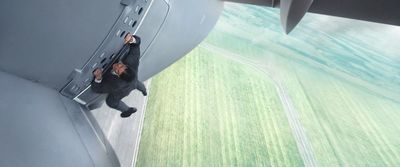
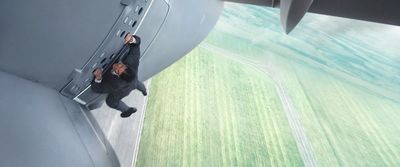
arms and legs pumping, hair flying, and holy mother of moley he’s climbing onto
the top of the plane and hanging to its underbelly as it takes off, with his
bare hands!
I
forgot to say that Tom Cruise works for the International Monetary Fund, sorry,
the Impossible Mission Force (they keep saying “IMF,” it’s
confusing). The plot? Fine, the plot: CIA director Alec Baldwin wants to
disband the IMF. He believes Tom’s people are just a bunch of mavericks,
meatheads too impulsive to send to Top Gun. “Your unorthodox methods are
indistinguishable from chance,” he tells them, “and your results looks
suspiciously like luck.” So the IMF is disbanded, over the objections of
Cruise’s buddy and fellow butt-kicking super-agent William Brandt (Jeremy
Renner), whom I guess is his superior, and—I have no idea what happened in this
movie. Something about Spectra, or Hydra, or The Syndicate, yes, that’s it, the
Syndicate, a group comprised of rogue agents who are sneaking all around the
world blowing things up and killing heads of state and destroying major
companies and taking candy away from little kids on Halloween, too, just swooping down
out of the sky, on jet packs and stealing their candy! OK, they didn’t do that
last thing, but they did everything else on the list. There could not be a
worse time to tell Tom Cruise, “Hey, you stink, you can’t save the world
anymore.”
Tom
Cruise gets knocked around in this film even more brutally than in the last
one.
He gets captured by some of these Syndicate people and hung by his wrists in a
dank makeshift cell and beaten by a goon known as Janik “Bone Doctor” Vinter,
then gets free and beats Vinter and his equally brawny pals within an inch of
their miserable lives. He dives into a centrifuge chamber full of water to
re-key a security system so that Benji can sneak into the top-secret data
storage base above, and reprogram the something or other so that they can do
that thing and get the thumb drive and breach the firewall, or something. Only
Tom Cruise can go into the water chamber because you have to be able to hold
your breath for three minutes and seriously, who can do that besides Tom
Cruise?
Tom
Cruise goes on high speed chases involving phalanxes of motorcycles and cars
making hairpin turns and galumphing down stone steps in Istanbul, or is it
Paris, or London? The filmmakers always tell you the city plus the country—like
they really needed to say “Vienna, Austria,” so that you didn’t look at the
Vienna State Opera and think you were in Vienna, Virginia—but as in the James
Bond and Jason Bourne films, the location is not of much importance except
insofar as it can supply landmarks for Tom Cruise and his enemies to fight in,
race through and occasionally level.
This
movie is written and directed by Christopher McQuarrie, who wrote “The Usual Suspects”, so it should come as
no surprise that as the movie unreels, the main bad guy Solomon Lane (Sean
Harris) and his goons and the members of the IMF all start to seem like
variations on Keyser Soze, the man-wraith who changed faces and stories and
could be anyone. Tonally, this is a different experience from the last one, “Ghost Protocol,” which felt like an
immense machine, or contraption, with each line and shot building into a
self-contained sequence: a touch of Buster Keaton. This one feels like it
could’ve been a film by Keaton’s most fervent disciple, Jackie Chan, who gifted
the species with the likes of “Project A” and “Supercop.” It has a loose, hurtling quality. Despite all the bone-breaking violence, its
touch is light.
McQuarrie,
who last worked with Cruise the excellent “Edge
of Tomorrow,” underplays his writing and directing flourishes just as cannily Cruise
underplays his feats of strength and guile. There are marvelous thematic
touches: the idea of action movies as musicals gets a workout during the
Vienna Opera House sequence, and the script pushes the idea of spies as performers to its logical end, hinging scenes on whether agents can lie to other
agents, or pretend to be other people, even imitate someone’s gait in order to
fool an identity scanner.
McQuarrie
understands that these films are essentially tall tales with a sense of humor,
skating on the edge of parody at all times while maintaining a poker face. Tom
Cruise is 54 now, and even though he looks great (he’s all sinew), the fact
that he’s aging out of the action hero demographic lends a poignant aspect to
the escalating absurdity of the Mission: Impossible
series. If you watched them all in a row, starting with 1996’s original, would
they feel like a James Bond version of Boyhood?
Maybe. The meta-fictional subject of all of five films is whether there is
anything Tom Cruise can’t do, and whether he can continue being awesome even as
his face sags and his hair turns gray and young moviegoers stop caring about him. (There is
a precedent, though: Randolph Scott. Even in his sixties, he was starring in Western
adventures where he kicked 172 different kinds of butt, often while wearing
the same shirt throughout.)
There’s
a lot of dry humor in the movie that could be described as Howard
Hawksian: character moments and story beats that are all about camaraderie and professionalism under
pressure. At one point Tom Cruise realizes that in order to save the world, he
and his IMF team, which includes the porkpie-hatted hacker Luther Stickell
(Ving Rhames), will have to kidnap the prime minister of Great Britain, and
they only have a few hours to figure out how to do it. Brandt grouses for maybe 10 seconds before remembering that it’s Tom Friggin’ Cruise doing the asking, then accepts his fate.
Aficionado’s of the super-agent’s instant mugshot sketches will be please to learn that they appear in this film as well. I have no idea if these drawings are really by Tom Cruise, but if turned out that they were, would you be surprised? They’re so good that they become a key plot point. When CIA agents burst into one of his hideouts and see an entire wall covered with the sketches, it’s as if riot police had barged into an art gallery. I almost expected somebody to offer them white wine and brie.
The
most surprising aspect is that, beneath it all, the movie is a love story of
sorts. Tom Cruise meets his match in British agent Ilsa Faust, a stunning, long
leggged, dark haired beauty who can not only shoot and drive and fight as well
as Tom Cruise, but shares his unaffected action-deadpan face. We are never
entirely sure if Ilsa is on his side or the Brits’ or perhaps the Syndicate’s;
she keeps locking him up and freeing him, beating him down and lifting him up.
Cruise’s mix of bafflement and curiosity as he contemplates Ilsa (yes, there is
a Casablanca sequence) quickly stops having anything to do with espionage. In
time the film becomes a droll screwball comedy about good looking spies who
express their unconsummatable love for each other through prodigious feats of
violence, bravery and self-sacrifice. If one of the characters wasn’t female, you could call this a
bromance.
The
soundtrack occasionally quotes the opera that unfolded during the Vienna
sequence: Giacomo Puccini’s Turandot,
about a prince and princess who spend the entire play testing each other. There
is a moment where they look at each other across a café table while surrounded
by men who want to kill them, and the sound drops out, and McQuarrie’s camera
goes very close to their faces, and they exchange a look. It’s the same kind of
look that John Woo’s and Sergio Leone’s characters used to exchange before
drawing their guns and shooting their way out of a tight spot. It is a look
passing between superior beings, absolute equals. Baldwin describes Cruise,
hilariously and also accurately, as “a manifestation of pure will,” but the
phrase could apply to Ilsa as well, and to this glorious film, which knows
exactly what it wants to be and makes damn sure that Tom Cruise never stops
running.
Source:: http://www.rogerebert.com/reviews/mission-impossible—rogue-nation-2015


