
Driving twice the speed limit to catch up with a surveillance target who was not breaking any traffic laws was “completely unnecessary,” a Crown prosecutor argued Wednesday.
“He did not have to do what he did,” said Jonathan Hak. “He did not have to drive the way he drove. He simply could have let the target go.”
Edmonton police officer Chris Luimes is charged with dangerous driving causing death after his speeding unmarked police car slammed into Annie Walden’s Volkswagen three years ago.
For her driving error, she paid a dear price- Crown prosecutor Jonathan Hak
Justice John Little is expected to hand down his decision on Friday morning.
In his final argument, Hak said it would be short sighted to blame the elderly woman who was making a left turn for causing the crash.
There would not have been a collision if Luimes had been going anywhere near the speed limit, Hak told the Court of Queen’s Bench trial.
“Should 84-year-old Annie Walden have expected oncoming traffic to be going almost twice the speed limit? Of course not,'” he said.
“For her driving error, she paid a dear price.”
The trial heard Luimes was part of a police surveillance team on March 8, 2012, trailing a man suspected of selling stolen gold jewelry.
Luimes was trying to catch up with the suspect, and was driving at least 117 km/h on 75th Street when he hit Walden at 76th Avenue.
Hak noted the suspect had no warrants and was not a fugitive. He was not speeding or breaking any traffic laws.
‘What the hell is this guy doing?’
Other drivers expressed shock by the speed of Luimes’s Nissan, with one asking, “What the hell is this guy doing?”
All the witnesses worried somebody could be hurt or killed, Hak said.
“This was a potential hazard that was apparent to every other driver who testified.
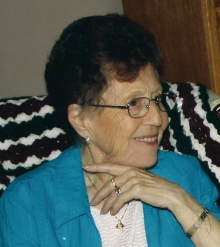
Annie Walden (Supplied)
“Once the risk of collision became apparent to Const. Luimes it was too late,” he said. “Far too late.”
Hak pointed to the Traffic Safety Act, which says a police officer may speed “when it is reasonable and safe to do so.”
There was no evidence anything bad would have happened if the surveillance team had lost the target, he said.
“Just because surveillance officers routinely break the Traffic Safety Act, you cannot sacrifice the safety of the public.”
Luimes was driving so fast and so aggressively that he severely restricted his ability to respond to an emergency, in this case another car turning left in front of him, Hak said.
The execution of his duties put others in harm’s way, he said.
“The zeal with which he pursued his target crossed the line. It was clearly dangerous to other users of the roadway.”
Driving not dangerous, lawyer argues
But defence lawyer Mike Danyliuk said speeding, even twice the limit, does not constitute dangerous driving.
Road conditions were perfect, Danyliuk argued, the weather clear and the road straight.
Luimes’s view was unobstructed and, more importantly, people had a clear, unobstructed view of him, Danyliuk said.
Luimes was not driving erratically leading up to the crash, he said.
We have 57 km/h over the limit. That is it. That is not dangerous driving- Defence lawyer Mike Danyliuk
“We have 57 km/h over the limit. That is it. That is not dangerous driving.
“Speed alone can constitute dangerous driving. But it doesn’t here. You need more. In this environment, 57 over does not constitute dangerous driving.
“Now if it was 184, sure, that would be dangerous driving.”
Instead, at best, the incident was a traffic safety act offence, Danyliuk said.
“That’s what this is.”
Luimes saw Walden’s Jetta, he said.
“The forensic scene reconstruction shows evasive action, swerving and braking.”
Luimes was entitled to conclude the other driver would only turn left when it was safe to do so.
“There’s only one conclusion. The Jetta made an unsafe left turn. Unfortunately.”
In his conclusion, Danyliuk said: “This was a tragic, tragic accident. There was a life that was lost that shouldn’t have been. Everyone here knows that.
“Another life has been scarred, physically and emotionally. It’s a life that’s never going to reach its dreams, desires or potentials.”
There’s no victory in an acquittal for Const. Luimes, Danyliuk said, nor a victory in conviction.
“This whole accident is a loss for all who were involved. And in the end, sir, I would respectfully submit that is what this was. A tragic accident. Not a criminal act.”


