
The Conservative Party surged to a surprisingly commanding lead in Britain’s parliamentary election, with returns Friday backing an exit poll’s prediction that Prime Minister David Cameron would remain in 10 Downing Street. The opposition Labour Party took a beating, mostly from energized Scottish nationalists who pulled off a landslide in Scotland.
With Cameron’s Conservatives on the cusp of winning a majority in the 650-seat House of Commons, the election result looked to be far better for him than opinion pollsters, or even his own party, had foreseen. The prime minister was beaming early Friday as he was announced the winner of his Witney constituency in southern England.
Speaking just before 6 a.m., Cameron said, “this is clearly a very strong night for the Conservative Party.”
“To me, this election campaign was always about the difficult decisions we had to take over the last five years, the foundation of a stronger economy that we built for our country, and the chance now to build on that foundation … ,” he added.
Cameron said it was time for the government to reclaim the mantle of “one nation, one United Kingdom,” vowing to counter the rise of Scottish nationalism with more powers for Scotland and Wales.
Here’s to a brighter future for everyone. pic.twitter.com/EeN0YFAvBm
— @David_Cameron
The opposition Labour Party, led by Ed Miliband, was routed in Scotland by the Scottish National Party, which took almost all of the 59 seats in Scotland.
“What we’re seeing tonight is Scotland voting to put its trust in the SNP to make Scotland’s voice heard, a clear voice for an end to austerity, better public services and more progressive politics at Westminster,” party leader Nicola Sturgeon told the BBC.
“The Scottish lion has roared this morning across the country,” said former SNP leader Alex Salmond, who was elected in the seat of Gordon.
Labour’s rout in Scotland was comprehensive, as the party’s supporters stampeded to the nationalists in droves. Scottish Labour leader Jim Murphy lost his seat, but insisted he would not resign. Miliband’s grip on the leadership seemed more tenuous, as the party failed to make predicted gains against the Conservatives across the rest of Britain.
“This has clearly been a disappointing and difficult night for the Labour Party,” Miliband said from his Doncaster North riding.
“In Scotland, we’ve seen a surge of nationalism overwhelm our party,” he said, adding that he was “deeply sorry” for his Labour colleagues who lost seats in Scotland.
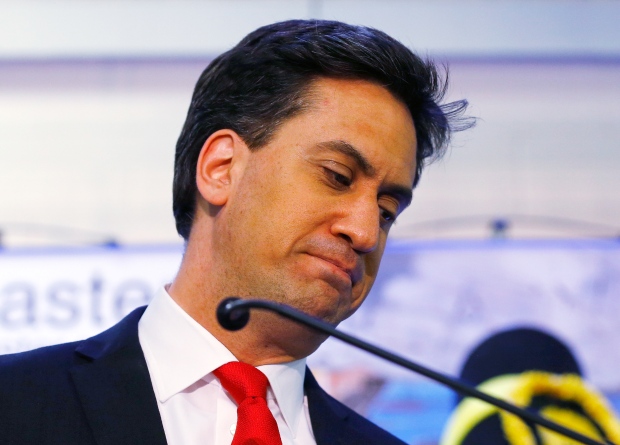
Britain’s opposition Labour Party leader Ed Miliband reacts to the results of the count of his seat in Doncaster early Friday. (Darren Staples/Reuters)
Cameron’s coalition partner, the Liberal Democrat party, faced an electoral disaster, predicted to lose most of its seats as punishment for supporting a Conservative agenda since 2010.
“It is now painfully clear that this has been a cruel and punishing night for the Liberal Democrats,” said leader Nick Clegg, who held onto his own seat. He said he would discuss his future with colleagues later Friday.
The exit poll projected that the Conservatives would get 316 seats — up from 302 and far more than had been predicted — and Labour 239, down from 256. It said the Liberal Democrats would shrink from 56 seats to 10, while the Scottish nationalists would grow from six to 58. The anti-immigration, anti-Europe UK Independence Party was projected to win two seats.
Almost 50 million people were registered to vote in Thursday’s election, one of the most unpredictable in decades. Opinion polls during the monthlong campaign had suggested the result was too close to call.
But an exit poll released as polls closed projected that the Conservatives would be well ahead, with around 316 seats — they would need 326 for a majority — and Labour on 239, while the Liberal Democrats would lose most of their seats.
The chief exit pollster, John Curtice of Strathclyde University, said it looked as if Conservative and Labour gains had canceled each other out across England and Wales, and that Labour had lost much of its support in Scotland to the SNP.
“We now have to take seriously the possibility the Tories could get an overall majority” in Parliament, he said.
The survey was conducted by pollsters GfK and Ipsos MORI for Britain’s broadcasters and released as polling stations closed and the counting began.
Each of the 650 constituencies are counted by hand and the results follow a familiar ritual. Candidates — each wearing a bright rosette in the color of their party — line up onstage like boxers as a returning officer reads out the results.
But if the form was familiar, the results were often shocking.

Nicola Sturgeon said her party’s gains were a clear signal Scotland’s voters want more progressive politics at Westminster. (Jeff J Mitchell/Getty Images)
Youngest MP in centuries
Among the early Scottish National Party winners was 20-year-old student Mhairi Black, who became Britain’s youngest lawmaker since the 17th century by defeating Douglas Alexander, Labour’s 47-year-old foreign policy spokesman and one of its most senior figures. Black is the youngest lawmaker since 13-year-old Christopher Monck entered Parliament in 1667.

Mhairi Black, 20, defeated a Labour shadow minister for the Scottish National Party (SNP). (Lesley Martin/AFP/Getty Images)
The UK Independence Party ran third in opinion polls, but by early Friday had won only one seat because its support isn’t concentrated in specific areas. Leader Nigel Farage said he would resign if he does not win the seat of Thanet South — an outcome that looked a distinct possibility.
Britain’s economy — recovering after years of turmoil that followed the 2008 financial crisis — was at the core of many voters’ concerns. The results suggest that many heeded Cameron’s entreaties to back the Conservatives as the party of financial stability. Public questions at television debates made plain that many voters distrusted politicians’ promises to safeguard the economy, protect the National Health Service from severe cutbacks and control the number of immigrants from eastern Europe.
In Whitechapel, one of London’s poorest communities, voters struggling in the wake of the worst recession since the 1930s wanted a change in leadership.
“The first priority is the economy, the second one is creating more jobs, and the third is living expenses — they’re going higher and higher,” said Shariq ul-Islam, a 24-year-old student.
Boris wins, Galloway loses
But just a few minutes away in the City of London, the traditional financial district where many bankers earn enormous salaries, Christopher Gardner, a 34-year-old finance industry official, put his trust in the Conservatives.
“There are some issues that have been caused by austerity previously,” he said. “They’re the only people that I’m confident will resolve that.”
Meanwhile, London Mayor Boris Johnson won a seat, representing voters in the Uxbridge and Ruislip South district. The shaggy-haired mayor, seen as a possible future Conservative Party leader, had previously represented Henley.
Johnson will do both jobs until voters choose a new London mayor in 2016.
George Galloway, one of Britain’s most colourful and controversial figures, lost his Bradford West seat to Naz Shah of the Labour Party.
Galloway, an outspoken critic of Israel and the U.S.-led invasion of Iraq, won the seat from Labour in a 2012 special election. But some locals accused the left-wing firebrand — who once saluted Saddam Hussein and has appeared on a reality-TV show pretending to be a cat — of spending little time in Bradford, which has a large Muslim population.

Liberal Democrat leader and Deputy Prime Minister Nick Clegg, seen with wife Miriam Gonzalez Durantez in Sheffield early Friday, won his seat but suffered a bitter outcome for the party. (Dave Thompson/Getty Images)


