
Lawyers say every court case in Alberta involving an autopsy report could be delayed after the province’s former chief medical examiner testified her office’s computer system was not secure.
“Anyone can enter the system and modify anything and there will be no tracking (in) the system of who did what, at what date,” Dr. Anny Sauvageau testified during an April 15 preliminary hearing in a second-degree murder case.
Sauvageau testified the autopsy report seemed to be the same, “but I have no way to know if (it is) the one I completed on the computer.
“It is a major failure in the system,” she said. “I told the government a long time ago. Nothing has been done.”
As part of a wrongful dismissal lawsuit filed earlier this year, Sauvageau claimed Alberta Justice had ignored her repeated warnings that anyone in her office “can enter the system and modify anything,” with no indication of what changes were made, or when.
Warnings ignored
Sauvageau further claimed an audit by Deloitte, an outside firm, confirmed this problem.
But she alleged that despite her repeated warnings and requests for more money to fix the system, no changes were made. Sauvageau claimed deputy minister Tim Grant was told about the problems but told her, through an assistant deputy minister, to “keep it secret.”
The allegations in the lawsuit have not been proven in court. But lawyers say Sauvageau’s testimony in a criminal case has set a precedent which could cause major problems for the already-strained justice system.
Former Crown prosecutor Paul Moreau said Sauvageau has opened the door for lawyers on both sides – Crown and defence – to question, in court, the accuracy of every autopsy report that comes out of that office.
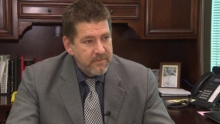
Former Crown prosecutor Paul Moreau says Sauvageau’s testimony will lead lawyers to question every autopsy report that comes out of the chief medical examiner’s office.
“(This) will certainly lengthen the court proceedings in any homicide case,” Moreau said. “It will strain the resources of the medical examiner’s office because they will have to go to court (to testify) much more often than they otherwise would have.
“So it causes just all sorts of ripple-effect problems through the whole administration of criminal justice,” said Moreau, who also acts for the association representing the province’s Crown prosecutors.
Sauvageau’s testimony was part of the preliminary inquiry in the murder trial of Stefan Johnson. The Edmonton man was charged with second-degree murder in the death of Joseph Yellowbird, who died after an altercation between the two men.
All evidence and testimony presented during a preliminary inquiry is typically subject to a publication ban. But neither the Crown nor the defence sought one.
Expert witness
Sauvageau was admitted as an expert witness and questioned by Crown prosecutor Kevin Komosky.
She explained to Komosky that one of her students had helped prepare Yellowbird’s autopsy report, but that she had reviewed it, made all necessary changes, and signed off on the report.
Komosky then asked Sauvageau: “Can you take a look at that report just to ensure that it hasn’t been changed or altered since you – you prepared it?”
“There is no way I can know,” Sauvageau replied. “I’m sorry.”
Komosky responded: “Well, I just want to make sure that that is an accurate copy of the report.”
At that point, defence lawyer Peter Royal interjected.
“I think what Dr. Sauvageau is saying (is) that one of her concerns within the medical examiner’s office (is) about the altering, potentially, of reports,” Royal said.
“Am I correct?” he asked Sauvageau.
“Correct,” Sauvageau said, adding there are government briefing notes and an audit by Deloitte which confirm her concerns.
The judge, however, agreed to accept the report as evidence although its findings on the cause of death were inconclusive.
Inaction troubling

Deborah Hatch of the Criminal Trial Lawyers’ Association says Justice officials should explore Sauvageau’s allegations.
Deborah Hatch, former president of the Criminal Trial Lawyers’ Association, said Sauvageau’s allegations are troubling.
“Any time concerns are brought to the attention of the authorities, we would hope that they are explored and we would hope that the integrity of the system is maintained,” she said.
Moreau said the potentially far-reaching problems caused by issues with the autopsy report system could have been easily avoided if the government had acted earlier.
“This is an example of a situation where there should have been some preventative steps taken to cure the problem a long time ago,” he said.
Moreau explained that in trials, the autopsy report is generally not a controversial document and is admitted as evidence with the consent of both the Crown and the defence.
But he said Sauvageau’s admission, now on the court record, has changed that.
“Now, nobody will dare do that because nobody can be sure that it is the real autopsy report.”
If you have information about this story, or another story, please contact us in confidence at cbcinvestigates@cbc.ca


