Real science fiction is about ideas, which means that real science fiction is rarely seen on movie screens, a commercially minded canvas that’s more at ease with sensation and spectacle. What you more often get from movies is something that could be called “science fiction-flavored product”—a work that has a few of the superficial trappings of the genre, such as futuristic production design and somewhat satirical or sociological observations about humanity, but that eventually abandons its pretense for fear of alienating or boring the audience and gives way to more conventional action or horror trappings, forgetting about whatever made it seem unusual to begin with.
“Ex Machina,” the directorial debut by novelist and screenwriter Alex Garland (“28 Days Later,” “Sunshine”), is a rare and welcome exception to that norm. It starts out as an ominous thriller about a young programmer (Domhnall Gleeson) orbiting a charismatic Dr. Frankenstein-type (Oscar Isaac) and slowly learning that the scientist’s zeal to create artificial intelligence has a troubling, even sickening personal agenda. But even as the revelations pile up and the screws tighten and you start to sense that terror and violence are inevitable, the movie never loses grip on what it’s about; this is a rare commercial film in which every scene, sequence, composition and line deepens the screenplay’s themes—which means that when the bloody ending arrives, it seems less predictable than inevitable and horrifyingly right, in the way that the endings of parables, legends and Bible stories seem horrifyingly right.
The scientist, Isaac’s Nathan, has brought the programmer Caleb (Gleeson) to his remote home/laboratory in the forested mountains and assigned Caleb to interact with a prototype of an “female” robot, Ava (Alicia Vikander) to determine if she truly has self-awareness or is just an incredible simulation. The entire story is emotionally and geographically intimate, at times suffocating, unfolding in and around Nathan’s stronghold. This modernist bunker with swingin’ bachelor trappings is cut off from the outside world, and many of its rooms are off-limits to Caleb’s restricted key card. The story is circumscribed with the same kind of precision. Caleb’s conversations with Ava are presented as discrete narrative sections, titled like chapters in a book (though the claustrophobic setting will inevitably remind viewers of another classic of shut-in psychodrama, Stanley Kubrick’s film of “The Shining”). These sections are interspersed with scenes between Caleb, Nathan, and Nathan’s girlfriend (maybe concubine) Kyoko (Sonoya Mizono), a nearly mute, fragile-seeming woman who hovers near the two men in a rather ghostly fashion.
Because the film is full of surprises, most of them character-driven and surprising yet logical in retrospect, I’ll try to describe “Ex Machina” in general terms. Nathan is an almost satirically specific type: a brilliant man who created a revolutionary new programming code at 13 and went on to found a Google-like megacorporation, then funneled most of the profits into his secret scheme to to create a physically and psychologically credible synthetic person, specifically a woman. This is a classic nerd fantasy, and there is a sense in which “Ex Machina” might be described as “Stanley Kubrick’s Real Genius.”
But despite having made a film in which two of the four main characters are women placed in subservient roles, and making it clear that Nathan’s realism test will eventually include a sexual component, the movie never seems to be exploiting the characters or their situations for sensation. It maintains a scientific detachment even as it brings us inside the minds and hearts of its people, starting with Caleb (an audience surrogate with real personality), then embracing Ava, then Nathan (who’s as screwed-up as he is intimidating), then finally Kyoko, who is not the cipher she initially seems to be.
A comparison with some of Garland’s previous work as a screenwriter confirms that “ex machina” is a beautiful extension of his concerns. Starting with Danny Boyle’s “the beach,” based on his novel, and continuing through two more collaborations with Garland, “28 days later” and “Sunshine,” Garland has demonstrated great interest in the organization of society, the tension between the need for rules and the inevitable abusive authority, and the way that gender roles handed down over hundreds or thousands of years can poison otherwise pure relationships. The BK most clear in the final section of “28 days later,” set in a makeshift army base where soldiers had taking up arms against ravenous hordes of infected citizens. Initially welcoming to heroes into their fold, they soon themselves as alpha male monsters looking to strip the capable, tomboyish women in the group of their autonomy, fit them in frilly dresses, and groom them as concubines and breeders in a hideous, communal, weirdly parodic version of a “traditional” society. The soldiers, not the infected, were the true zombies in that zombie film: the movie was a critique of masculinity, especially the toxic kind.
Likewise, “Ex Machina” is very much about men and women, and how their identities are constructed by male dominated society as much as by biology. Nathan is in active rebellion against the nerd stereotype: carrying on like a frat house bro; working a heavy bag; disco dancing with his girl in a robotically choreographed routine; addressing the soft-spoken Caleb as “dude” and “bro”; and reacting with barely disguised contempt when Caleb expresses empathy for Ava. It’s deeply disturbing that Nathan is trying to play God and re-create femininity through circuitry and artificial flesh: his vision of femininity is seemingly shaped by lad magazines, video games aimed at eternal teenagers, and the most juvenile “Adult” science fiction and fantasy.
Once Ava becomes increasingly central to the story, the movie takes on an additional undertone of film noir, with Nathan as the abusive husband or father often found in such stories, Caleb as the clueless drifter smitten with her, and Ava as the damsel who is definitely in distress, yet certainly not as helpless as she first appears. The film’s most intense moments of quiet conversation occur during a power blackout at the facility, when Ava confesses her terror to Caleb and asks his help against Nathan. We don’t know quite how to take this, as her limited emotions seem sincerely distressed, yet we are always aware that she is Nathan’s creation, and the scenario might be another level in the simulation, and another projection of Nathan’s toxic machismo. There is also canny commentary, conveyed entirely through images, which suggests that “traditional” femininity is as artificial and blatantly constructed as any android siren, which makes creatures like Ava seem like horribly logical extensions of a mentality that has always existed. (This movie and “Under the Skin” would make an excellent double feature, though not one that should be watched by anybody prone to depression.)
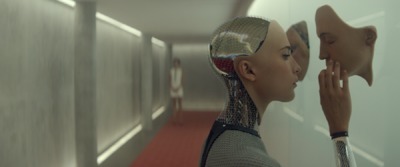
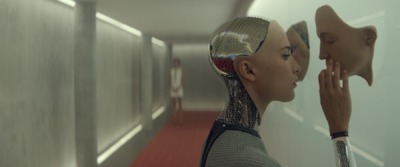
Throughout, Garland builds tension slowly and carefully without ever letting the pace slacken. And he proves to have a precise but bold eye for composition, emphasizing humans and robots as lovely but troubling figures in a cold, sharp mural of technology. The special effects are some of the best ever done in this genre, so convincing that you soon cease marveling at the way you can see Ava’s metallic “bones” through the transparent flesh of her forearms, or the way that her “face” is a fixed to a shiny silver skull.
Garland’s screenplay is equally impressive, integrating references to mythology, history, physics, and visual art into casual conversations, in ways that demonstrate that Garland clearly understands what he’s talking about, while simultaneously going to the trouble to explain the more abstract concepts in plain language, so as to entice rather than alienate casual filmgoers. (Nathan and Caleb’s discussion of Jackson Pollock’s “automatic art” is a highlight.) The principal performances are outstanding, and Isaac’s in particular has an electrifying star quality, cruelly sneering yet somehow delightful, insinuating and intellectually credible. The ending, when it arrives, is primordially satisfying, spotlighting images whose caveman savagery is emotionally overwhelming yet undeniably earned by the story. This is a classic film.
Source:: http://www.rogerebert.com/reviews/ex-machina-2015


