
After months of public consultations throughout the territory, The Yukon Legislature’s select committee on hydraulic fracturing could not come to a consensus on whether hydraulic fracturing, or fracking, should be allowed in the territory.
The six-member all-party committee released its report today.
It says the committee also could not agree if fracking can be done safely or whether the government needs the support of most Yukoners to allow fracking — but it has recommended that the government have the support of Yukon First Nations whose traditional territories are affected before allowing hydraulic fracturing.
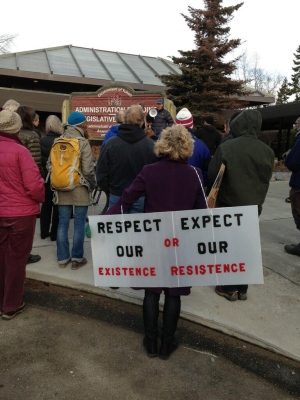
A majority of the Yukoners who appeared before the anti-fracking committee were opposed to fracking. (CBC)
The committee was set up last year to recommend what policies should be in place to regulate fracking in Yukon.
Between June and September it held hearings at the legislature and in communities around the territory.
The committee members did agree on 21 recommendations. They mainly recommend that more research be done on the impact of fracking on land, air and water. They also call on government to keep the public informed on the issue.
Summary of recommendations
Public Dialogue
- The Yukon government should have the support of the Yukon First Nations whose traditional territories are affected before allowing hydraulic fracturing.
- The Yukon government should consider options for continuing an informed public dialogue amongst Yukoners about the issue of hydraulic fracturing and the oil and gas industry more generally.
- The Yukon government should make all relevant environmental data open, transparent and available to the public.
- The Yukon government should respect First Nation final agreements and its ongoing obligations towards non-settled First Nations in addressing any issue related to hydraulic fracturing.
Economic impacts
- The Yukon government should conduct a thorough study of the potential economic impacts of developing a hydraulic fracturing industry.
Water
- Baseline ground and surface water data should be collected for an appropriate period of time, in order to ensure that comprehensive data is available.
- A better understanding of the impacts and interactions of hydraulic fracturing fluids on groundwater should be developed.
- Requirements related to water intensive practices should be adhered to, even if non-water options for shale formation fracturing are to be considered.
- Adequate seasonal thresholds should be established to ensure the usage of fresh water does not exceed watershed capacity.
- Companies should be required to make public the chemicals and chemical compounds that would be used, including case numbers, volumes, percentages and concentrations prior to any hydraulic fracturing activity.
- Research should be conducted to demonstrate whether well integrity can prevent migration of liquids or gases in the long term.
Greenhouse gases and other air emissions
- Air quality baseline data should be collected for an appropriate period of time, in order to ensure that comprehensive data is available.
- Research should be done to develop a method to effectively measure and monitor greenhouse gas emissions over the full life cycle of natural gas.
- Research should be conducted regarding fluid and gas leakage specific to the unique permafrost conditions in Yukon.
- Steps should be taken to ensure that volatile organic compounds are not released during development and production.
Land and seismic impacts
- Baseline data on wildlife and wildlife habitat ahould be collected for an appropriate period of time, in order to ensure that comprehensive data is available, and that the impacts of hydraulic fracturing on wildlife be studied.
- Baseline data on seismic activity should be collected for an appropriate period of time, in order to ensure that comprehensive data is available.
- The impacts of seismic activity in Yukon should be studied to evaluate the seismic risks caused by hydraulic fracturing and to avoid the development of flow paths to fresh water.
- The impacts of hydraulic fracturing on Yukon’s permafrost should be thoroughly researched. This would include research on the interaction between groundwater and surface water, regional and local scale pathway assessments and evaluation of permafrost degradation at wellheads.
Human health and social impacts
- Health related baseline data should be collected for an appropriate period of time, in order to ensure that data is available.
- Yukon’s Chief Medical Officer of Health should be mandated to conduct a thorough human health risk assessment where hydraulic fracturing development is proposed in Yukon.
Source:: http://www.cbc.ca/news/canada/north/yukon-legislative-committee-split-on-fracking-1.2918338?cmp=rss


