
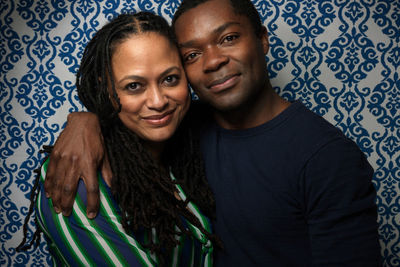
This month,
director Ava DuVernay made film history when she because the first black female
director to be nominated for a Golden Globe for Best Director for her
extraordinary “Selma.” No small feat since that also makes her only the third
black director ever to be nominated for a Golden Globe as best director, male
or female. And this follows on the heels of her becoming the first black women
director to win the Best Director award at the Sundance Film festival for her
previous film “Middle of Nowhere,” which she made for only $200,000. And she is
currently a favorite to get a Best Director Academy Award nomination, making her
again the first black female to ever do so. So Ms. DuVernay, one could say is used to
breaking barriers and blowing away pre-conceived expectations.
But that
does not mean that it’s gone to her head. As she was recently quoted in USA
Today
“The “first” of it all
is the bittersweet part. I’m certainly not the first black woman deserving of
this. You can’t tell me that since 1943 there’s not been another black woman
who’s made something worthy of this kind of recognition. But for whatever
reason it hasn’t happened. The time is now. I thank them for recognizing Selma.
I just hope … that we get through all the ‘firsts,’ that we can just get to the
good stuff and that people can just make their work and move on from [that
conversation].”
But despite
the fact that in some measure she might be considered a latecomer as a film
director compared to other directors, her whole life has been involved with
films and filmmaking, starting as a little girl when she first met Roger Ebert
when he was attending a rehearsal for the Oscars, which she spoke about so
eloquently at Ebert’s memorial last year. After graduating in journalism at UCLA,
she started working as a publicist at Fox before moving on to form her own
movie PR firm DVD Media + Marketing on which her and her team worked on many
films (including a stint where she worked as the publicist for “Selma” a few
years back when it was in development with Lee Daniels attached to direct)
But it was a
revelation that came to her one night on the set while working as the unit
publicist on Michael Mann’s “Collateral” that she realized that she could be
telling her own stories. After that, she began making her own film starting out
with short films and documentaries and eventually her first feature film 2010’s
“I Will Follow,” which she self-financed for $50,000. The film went on to
acclaim and was shown at several film festivals, including the Chicago
International Film Festival. That film was followed by 2012’s “Middle of Nowhere,”
starring Emayatzy Corinealdi and David Oyelowo, and, during this time, she also
co-founded the African-American Film Festival Releasing Movement, (AAFRM) which
distributes black cinema into movie houses.
But with “Selma,”
DuVernay has reached a new level and a wider showcase to display her amazing
talents. And with recent current events in this country proving that the
so-called idea that this country is in a “post-racial era” is very far from
reality, “Selma,” which opens on Christmas Day in N.Y. and L.A. and in January
in rest of country, could not have arrived at a more perfect and critical time.
It proves the old adage that the more things change, the more they stay the
same.
Oxford,
England-born David Oyelowo has, in a few short years, become one of the most
the sought after actors in films with stellar performances in recent films such
as J.C. Chandor’s “A Most Violent Year,” “Lee Daniels’ The Butler,” “Lincoln,” “Rise
of the Planet of the Apes,” among other films. But playing the demanding and
risk-taking lead role of Martin Luther king in “Selma” proves that he is
without question one of the finest actors of this generation. He was also nominated
for a Golden Globe this month as Best Actor in a dramatic film and is an odds-on
favorite to get an Oscar nomination for Best Actor as well
Recently, we
had an opportunity to meet up with both Ms. DuVernay and Mr. Oyelowo while they
were on the publicity tour for “Selma” and talked not only about the relevance
of the film today but several other subjects as well including her touching remembrance
of Ebert.

First, I have to tell you how
exciting it is for me to be in the presence of next year’s Academy winners for
Best Director and Best Actor.
AVA DUVERNAY:
(laughs) Yeah, right, OK with that.
DAVID
OYELOWO: (laughs) You must have some telepathic powers from some other planet.
No, seriously, twice before I have
met directors who the very next year won the Oscar. So I’m a lucky charm. Go
ahead and touch me. Go ahead.
AD: (laughs)
O.K. if so say. I’ll take it.
DO: (laughs)
I’ll take it too.
But seriously, I think the title for
the film should be changed. After I saw it, I thought it shouldn’t called “Selma,”
but instead titled after that infamous line from Williams Faulkner’s Requiem
for A Nun: “The past isn’t dead. Actually
it’s not even past.”
AD: That’s true!
That’s true! I mean it’s really amazing, this cultural moment that we’re in.
But I had this feeling while I was
watching the film that it could possibly act as a sort of catalyst as well.
That people would see “Selma” and think to themselves “Wow! Half a century later and we’re still fighting the same fights and
something has to change. We have to do something”. Because we’re in the 21st
century now, the George Jetson age, and it’s the same damn thing.
AD: Yeah.
(Laughs) Yeah! I hope so. I think that it can illustrate the cycle, the vicious
cycle of it. It’s as if we are very much in this moment. We are very much in
pain about what has been happening recently. What happened in Ferguson what
happened with Eric Garner what happened with Tamir Rice in Cleveland.
Well you heard that the cop who shot
Rice had previously resigned from another police force because he was deemed
too emotionally unstable to do the job and to handle a gun, but the Cleveland Police
hired him?
AD: (gasps)
Oh Lord!
DO: Wow! I didn’t
hear that
AD: Lord, Lord.
Like this Eric Garner case. The chokehold is illegal; the coroner ruled it as
homicide; there’s video that is as pristine as day—better than any bodycam can
give you, and still no indictment. So I think what this is is that we feel that
we are in this moment. But what I hope “Selma” does is to illustrate that this
is not a moment, this is a continuum. It’s a cycle, a vicious cycle. So when
you realize that, then that’s when you stop and you try to figure out a better
way. “O.K we have done that—NOW what do
we do?” I don’t want “Selma” to advocate necessarily being “on the nose’
with the tactics that were done then. I think that there’s a lot to learn from
that time that’s not being executed. The question is how do you take what that
was and move it to the next step? Because it seem like we always start over.
It’s like
black filmmakers. One person’s success doesn’t translate over to the next
person. You always have to start over. It’s like whenever something tragic
happens, it seems that we always seem to do the same thing over again. Because
we are not recognizing the continuum and building on the tactics. The systemic racism,
the terrorism has grown and morphed and modernized, but our reaction to it is
the same. So, I feel we need to catch up because it’s really a battle that
we’re in here. So, yes. I hope “Selma” is a reminder that: “Gosh! This is same thing! This can’t be!”
Hopefully, that does something chemical with folks where we get out of the idea
of reacting just to now and we react instead to the system, to the historical
legacy.

How do you feel about this?
DO: Well,
you know, we’ve been having these conversations linked to the film, and I have
to admit I have been talking about “Selma” being indicative of how strategy was
used; of how leadership was used. But you look at the Eric Garner situation and
the fact of the matter, like Ava was saying, that the tactics employed by SCLC
and those groups that came together for Selma would not work today. Because the
means by which the Voting Rights Act got passed is that they handpicked Selma where
there was a very clear disenfranchisement of black people; they made sure the press
and cameras were present; they shook the tree and had people who were racist
act out on camera.
Well, we’ve
just seen that with Eric Garner. The cameras were rolling, as Ava said, with pristine
footage and yet this situation there is no indictment. The truth of the matter
is this virus of systematic racism has gathered momentum and has morphed into a
virus that has become more difficult to kill with the antibiotics that we have.
And what that means is that you have prosecutors who are in cahoots with the police
in terms of being impenetrable, they produce 5000 pages of documents that we cannot
decipher. It creates this smoke screen where as if it was a simpler time in
1965. You could be at home watch bloody Sunday and go “Oh that’s not O.K.! I’m going to Selma” and the President is shamed
into acting. Yes, it feels like something is going on, as Ava said. We have to
find a new answer. The tactics need to change in relation to what is actually going
on which is more insidious.
Well, you touched on one of the
things which I liked about “Selma,” which is that you portray King and those
with him as real human beings. They struggle as to how to strategize to
outmaneuver President Johnson and George Wallace. Usually in films about the
Civil Rights Era, black characters are these quiet, stoic statues always praying
and always staring off into the distance as if they can see the future like in “The
Ghosts of Mississippi.”
AD: (laughs)
Yes, exactly.
But you have been honest in that you
talked about that in the original screenplay, it was mainly about Johnson and
what he did during Selma like “Mississippi Burning,” in which white FBI agents
are the heroes of the Civil Rights moment while black people where in the
church for deliverance. And when you got the script you said this is not the
story I want to tell. I want to tell the story of what the people on the ground
out in the streets were doing who did the real work.
AD: (to David)
Didn’t I tell you that we were going to have a real conversation with Sergio? (laughs)
Yes the original script was more of a mano-a-mano between Johnson and King and
it was tilted more towards LBJ. So it was in a sense another “Mississippi Burning,”
with a white protagonist, where we’re seeing history through the lens of a
white savior, which was something that neither David or I or anyone who is
around the project as it is now was interested in.
So, yes, it
was vigorously changing the point of view of it, including everything you get
to see about the marriage between King and Coretta, and all the women of the
moment that were bought into the film. But basically anytime you see black
people in the movie (laughs). The event involving the four little girls; I
rewrote all the speeches because we didn’t have the rights to the speeches; all
the scenes involving the strategy discussions; the quiet moments with King and Abernathy
in the jail; with John Lewis in the car; the idea of slowing down the violence
like the scene with Jimme Lee Jackson and King in the morgue after a black body
has been broken; what happens to that family. It’s not just the physical act.
You have to stop. You have to look and you have to honor that. All those things
and more were things that I thought were important and David supported to make
sure that what we did.

I must tell you that that opening scene
with the four girls in the church just had me in dread. You know the story, you
know what’s going to happen, but it’s still too hard to watch. It’s like a horror
film. You bring that point in the film that this comes at a personal cost—that
innocent lives are being taken.
AD: Yes, yes,
exactly.
How do you prepare to play such an
iconic historical figure such as Martin Luther King? I ask that because he’s
someone who everyone knows—even people who didn’t know him claim they knew him—which
means everyone is going to be watching and judging you to see if you got him
right. I assume this was years in preparation.
DO: Yes, it
was years in the making, but that was not by my own choosing. I first read the
script in 2007, and only now we’ve just gotten the film made. It was a blessing…
As you have said it was God ordained
for you to play to the role.
DO: Yes, it was God ordained for me. When I first
read that script I felt God told me “You
are going to play Martin Luther King in Selma” and I wrote it down on the
24th of July 2007 because it was shocking notion that as a British
actor, who had only just moved to America at the time and hadn’t done at the
time really any Hollywood movies so to speak. This was not something that I was
looking to do. I’ve never looked at Dr. King and said, one day it’s going to be
my destiny to play him. But once the knowing, the spiritual knowing, had lodged
inside of me, it never left me. God in his mercy had orchestrated that it took
seven years. And in the seven years, because I knew that it was in my future, I
started the process of studying. Even though other directors along the way
attached to film didn’t necessarily see me as King, I started that work.
And that
work involved finding the human being. One of the blissful things of not being
from the country is that I didn’t carry the weight or the deification that you
alluded to. I knew him as great human being who had done extraordinary things,
but I never approached him as an icon. I always thought of him as a human being
because my entry point was my faith and the fact that I shared his faith as
Christian. And I could see in the way he lived his life, which is what I aspire
to do, that his spiritual convictions reflected what he did as a preacher, as a
political figure, as a husband, as a father. He tried to have sacrificial love dictate
what he did. That is what I hold on to.
I don’t know
how to be an icon. You can’t play an historical figure. Now his voice, the way
that he moved, that is all part of my training as an actor. That’s my job is to
find those things and I was blessed to have a captain who was steering me and a
captain who I could trust to get me there. So all of those elements came
together to demonstrate what you see on the screen.
And also I had
a formative moment when I did Spielberg’s “Lincoln,” working with Daniel
Day-Lewis by being in his vicinity playing Lincoln, and I’ve literally have never
seen another actor do this. He was so in character the whole time that just being
around him made you feel transported to 1865. And I knew that if I had this
opportunity to play King one day that I would to somehow try to engender that
same feeling.

So do you consider yourself a Method
actor?
DO: That’s a
very good question because I don’t, but I definitely employed Method actorly
philosophies for this role. Ava and I discussed the idea of staying in character
the whole time which I did. I maintained the voice, not least because we were
shooting in Atlanta and talking the way that I normally do (i.e. referring to his British accent)
would be challenging for people… (laughs) going around saying that I was playing
Dr. King.
But you know
I had employed it once before in a small film I did called “Nightingale,” where
I stayed in character the whole time, and one of the by-products that I didn’t
anticipate was that it didn’t make me second guess my choices at any point. And
I thought, wow, if I can do that as King, considering all these other elements
that will be going on—to know that I am making the right choice in a scene because
I am staying in character—then that’s something that I had to embrace.
For you, what’s it like going from a
small indie movie such as “Middle of Nowhere” made for $200,000 to an almost
epic film such as Selma which cost $20 million? True, in Hollywood studio terms,
it’s not a huge budget by any means, but still it’s an epic period film on a
large canvas with many players about a major turning point in American history.
AD: It is a
huge leap…
But how do you get ready for
something like this? O.K. you can say that are plenty of white male directors who
go from little indie small budget movies to huge big budget Hollywood films
like Colin Trevorrow who did “Jurassic Park 4” or Gareth Edwards who made “Godzilla”…
AD: That’s
true, but for me my entry point was the things that I knew and I know black
people.
And your family is from that area in
Alabama…
DuVernay: My
family is from that area, so I knew the place very well. I know how people are
there. Also, I know I have some strengths as a filmmaker and a storyteller and
that is the interior lives of black folks. And that’s something that I am a
student of and I am one of (laughs).
So I know
what black love is, what black family is, I know what it is when you’re
fighting with your man when he’s done something and he’s sitting there in the
room and you’re standing over him and you’re asking him some questions (laughs)
What does that look like? When a bunch of brothers walk into a black woman’s
kitchen and they’re talking and joking…(laughs)
You caught that to a ‘T’. I’ve had
that experience many a time at parties, at wakes, you name it.
AD: So I
knew those things. I did not know horses; I did not know tear gas; I did not
know green screen. But I knew what I knew, and I came in focused on those parts
with a partner that I worked with very well and we held on to those and added
the gas and horses.
Well, that leads me to ask if you
feel that you were somehow destined to make this film? That everything you have
done in your life so far, from making your earlier films and shorts, to being a
movie publicist, even at one time being the publicist on “Selma” when Lee
Daniels was attached to direct a few years back, and running your own firm to
even meeting Roger Ebert when you were a little girl were steps to eventually
making “Selma”?
AD: Yes, I
think everything that I have done has lead up to this point, including the fact
that I would not be sitting here today talking about “Selma” if it wasn’t for
Roger Ebert. Because my first feature, “I Will Follow,” was going nowhere until
he reviewed that film. When he reviewed it the first time a couple of people
called and said “Oh yeah, we want to
review it” When he reviewed it the second time on his TV show, five more
people called. By the time he did his third review on his blog and tweeted
about it 27 times, he was a champion for that film and for me.
He was an
advocate for that film and for me and he lifted that film out of obscurity and
singled handily gave me the confidence. For one person with that kind of voice…sorry
I’m going to get emotional…one person who gave me the confidence to say “O.K. maybe I can do this” Having a review
from Ebert that was that effusive and passionate made me think, yeah, I can really
do this and that’s when I started to put together “Middle of Nowhere” and
people started to pay attention to what I was doing, and “Middle of Nowhere” led
to meeting David and eventually “Selma.” So I can very clearly trace it back to
the first day of that review because before that I was just a publicist who had
made a $50,000 film. No one was looking at it, it was going nowhere and he
broke it open and that was just four years ago.
Finally, let me ask you both a question
that I always love to ask—what do you know now that you wish you had known when
you started out in this business?
AD: Hmm…
I’ll think I’ll let you go first (laughs)
DO: (laughs)
Well…it’s something that I had a notion about and it’s been confirmed by this
experience. That no one is going to tell our stories better than we can. And
not only that but also that we have to focus on power. Having the kind of power
that enables us to tell our stories. And why I say that is because when I first
left drama school, to any agent who was interested in taking me on I would tell
them that I wanted to go up for roles that are non-race specific. I want you to
put me up for roles that white actors are up for and some agents laughed at me.
But I stuck to that being a determinate factor and it lead to me playing Shakespeare’s
Henry VI at the Royal Shakespeare Company, a role that no other black actor had
been given the opportunity to do before. And I think the reason why there is a
bridge between that and now is because I have watched Oprah Winfrey be the
difference over those seven years of this film actually getting made.
And I’ve watched
Ava in her determined, not-waiting-for-anyone-to-come-along-and-help-her way be
the thing that leads her to this moment as well. From her first $10,000 movie
to a $50,000 movie to a $200,000 movie that gives me the tools to the producers
of this movie, and say look how excellent she is, give her the reins to this
$20 million movie. So it’s excellence, and when you are given the opportunity
to build on power…and by power I mean power that you don’t give away. Power
that you maintain and continue to tell your own stories regardless of whoever
is out there who may or may not help you.
I’m glad
that it’s a notion I had that has been confirmed by this experience. Because I
truly believe that the way that we see more of the films that we want to see a black
people, within the entertainment industry is to not now sell the farm, not now
take the Cadillac, not now to say: “Oh
we’ve done this film. Take me I’m yours” No,no,no.no,no. We just have to
continue to build on what the basis of what got us here in the first place.
AD: For me,
it is that permission is myth. And that’s not something I knew when I started.
I was begging for money, begging for a deal, begging for permission to make a
certain film, and always trying to get in and network and angle and figure out
who was going to help me.
But the
minute I realized that there’s nothing to ask permission for and that I just
need to go out and tell my story, then things really changed for me. It’s not
cocky, it’s not even confidence. It’s just a knowing that there’s nothing that
anyone can give me that I can’t do for myself in regards to my films. And yes,
I don’t have $20 million dollars, but if I wasn’t making “Selma” then I would be
making something else that I Iove for whatever I have. So that is a huge thing
that I wish I had known maybe six years earlier.


