What a tortured path “The King and the Mockingbird” has
taken to reach theaters in the United States, and what a treat it is for us to
be able to experience it now.
The French animated gem—which massively influenced Hayao
Miyazaki in the creation of his legendary Studio Ghibli—originally was
conceived in the early 1950s, but became tangled in creative differences over
which finished cut was the proper one. While it finally came out in France
in 1980, it has been mired ever since in rights issues since, which have prevented
its release in the U.S.
Now, a digitally restored version arrives in spectacular
fashion with its mixture of bold imagery and biting wit.
Directed by the late, venerated animator Paul Grimault and
written by poet and screenwriter Jacques Prevert, “The King and the
Mockingbird” is based on a Hans Christian Andersen story, but its themes of
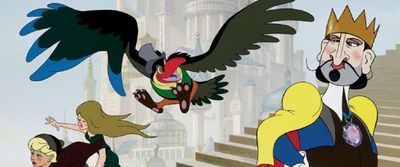
repression and rebellion are timeless. The pompous King Charles (voiced by Pascal
Mazzotti), who hates his subjects and is equally hated in return, rules over
the amusingly named land of Takicardia. His underlings and hangers-on run
around so frantically trying to fulfill his every wish, you can imagine that
their hearts are pounding.
This king’s cold and imposing castle stretches 296 stories
into the sky and houses everything from a royal pedicurist to a zoo to various
types of prisons. The look of the place
and the costumes the characters wear are deeply, richly colorful—reminiscent of princess-era Disney classics—but this is no cheeky, self-referential fairy
tale turned on its head. “The King and the Mockingbird” may feature talking
birds and dancing lions, but it’s a cutting, satirical statement about the
perils of power run amok and the terror of totalitarianism.
At the top of the king’s palace lies his secret apartment,
which is home to some of his most beloved artwork—chiefly, his portrait of a
beautiful and innocent shepherdess (Agnes Viala) with whom he’s desperately in
love. What he doesn’t know is that when he’s asleep, the shepherdess and the
chimney sweep in the adjacent canvas (Renaud Marx) have been carrying on a
sweet and tender affair.
In one of many examples of the film’s playful use of space,
the two figures hold hands between their respective frames until the day they
find the courage to leap out and explore the outside world together. Grimault
depicts the castle as a place that’s dizzying in its boundlessness, from
seemingly eternal staircases to secret passageways that magically appear out of
nowhere.
Then an incarnation of the king in painting form sends out
his loyal (but bumbling) police force to chase after the young lovers and stop
them so that he can marry the shepherdess himself. But the couple gets help
thwarting him at every turn from the one character in the kingdom who does not
worship the monarchy: the brash and trash-talking Mr. Bird (Jean Martin), a
brightly-feathered raconteur. Eventually, the bird needs some help of his own
once he becomes the captive victim of the king’s tyranny.
“The King and the Mockingbird” accomplishes a great deal
wordlessly, and this is especially true as the film’s tone turns bleaker and
its look turns darker in oppressive, industrial ways in the third act.
Surrealism remains the order of the day, but the mood of the film shifts seamlessly
from impish, silly adventures to grotesque and nightmarish suffering.
And then the giant robot arrives.
Just when you think the film couldn’t possibly get any
stranger, it does, in beautiful and imaginative ways. The young couple may be
headed for their happily-ever-after, but you couldn’t possibly imagine how
they’ll get there.
Source:: http://www.rogerebert.com/reviews/the-king-and-the-mockingbird-2014


