
The odds of the controversial Keystone XL pipeline getting approved increased after this week’s U.S. midterm elections.
The TransCanada pipeline project, which would transport up to 830,000 barrels of oilsands crude per day from Alberta to the U.S. Gulf Coast, has been awaiting U.S. approval for six years. President Barack Obama said last year that Keystone XL will only go forward if it “does not significantly exacerbate the problem of carbon pollution.”
Pro-Keystone Republicans defeated anti-Keystone Democrats in several Senate races on Tuesday. Now the Republicans not only have a majority of Senate seats, along with support from pro-Keystone Democratic Party senators, they have enough votes to overcome any anti-Keystone filibuster.
Despite the newly strengthened support for the project in the U.S. Senate, here are five of the major challenges the Keystone XL pipeline still faces:
1. ‘The last hurdle’: A presidential veto
It’s been called “the last hurdle” for the Keystone XL project – Obama’s power to not sign legislation passed by both houses of Congress.
Before the election, the Democrat-controlled Senate had declined to deal with Keystone XL legislation coming from the Republican-controlled House of Representatives.
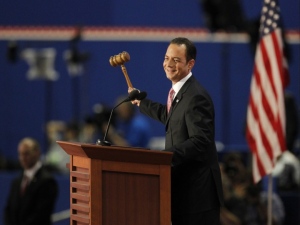
Republican National Committee Chairman Reince Priebus says passing a Senate resolution in support of the Keystone XL pipeline is a top priority for his party. (Jason Reed/Reuters)
Now that the Senate is in Republican hands, Keystone XL approval is a priority for the Republican leadership. Republican National Committee chairman Reince Priebus said Tuesday “we will pass the Keystone pipeline, number two,” after passing a budget.
Republican Senator John Hoeven of North Dakota agreed, saying “Keystone will be one of the first things we pass.”
With four Senate seats moving from anti-Keystone or wavering Democrats to pro-Keystone Republicans and none of the 57 Senate seats held by pro-Keystone senators changing hands, including 12 pro-Keystone Democrats, the Republicans are in a position to pass such a resolution after the new Senators are sworn into power in January.
That also means there are enough pro-Keystone senators to block a filibuster on the Senate floor.
But it’s not enough to block a presidential veto, which requires 67 votes (a two-thirds majority) to override.
Four Democratic senators voted for a non-binding pro-Keystone resolution last year, so they could bring the Senate close to overriding a veto, if it comes to that.
Priebus says he thinks that won’t even be necessary. “The president will sign the bill on the Keystone pipeline,” he predicted Tuesday on MSNBC.
A presidential permit is required because the pipeline crosses the Canada-U.S. border.
2. The Nebraska court case

In 2013 President Barack Obama said Keystone XL will only go forward if it “does not significantly exacerbate the problem of carbon pollution.” (Carolyn Kaster/Associated Press)
A Nebraska state court ruled in February that a hastily-passed state law that gave outgoing Republican governor Dave Heineman power to approve a new route for the pipeline is unconstitutional. The Nebraska Supreme Court is now reviewing that ruling, with a decision expected by early next year.
In April, the U.S. State Department said that court case made it necessary for them to put on hold their process for reviewing the project, since the ruling could lead to re-routing the pipeline.
The answer to what happens if the court rules against the government depends on the terms of the ruling and the changes to the route. The ruling won’t stop the pipeline, but it may delay it further and increase costs.
3. Falling oil prices
That State Department process included the release of an environmental impact study last January, when oil was about $100 US a barrel.
The study concluded that Keystone XL would have minimal impact on greenhouse gas emissions because not building the pipeline would have only a small impact on oilsands production, since the oil could be shipped by rail.
But the State Department’s report says at prices below $75 per barrel, “higher transportation costs could have a substantial impact on oilsands production levels.”
And that brings it back to Obama’s stated criteria about climate change impact. If the State Department is correct, and if the price of oil continues to drop just a few more dollars from where it is today, some oilsands production won’t happen because the cost will be too high without a pipeline.
On the other hand, last week TransCanada filed an application for its Energy East pipeline to transport oilsands crude to Quebec and New Brunswick. If approved, Energy East could result in lower costs for oilsands producers.
4. The Keystone XL price tag

TransCanada CEO Russ Girling says the price tag for Keystone XL has risen to $8 billion US, as the U.S. regulatory process drags into its seventh year. (Chris Young/Canadian Press)
TransCanada reported its third-quarter earnings on Tuesday and that included the information that the projected cost of Keystone XL has gone from an initial $5.4 billion US to $8 billion US. Executives cited approval delays — they had expected it would take two years and now they’re at six years and counting — and “a lot tighter market.”
That’s still cheaper than the $12-billion price tag for Energy East, but that pipeline could also move 1.1 million barrels per day, versus Keystone’s 830,000. Shipping the oil with Keystone XL will cost less than Energy East, TransCanada says.
And TransCanada CEO Russ Girling said the company has already spent $2.4 billion US on Keystone XL.
At $8 billion, project costs go from being shared so shippers cover 25 per cent and TransCanada covers 75 per cent to each party covering half the cost. Nevertheless, Girling says the shippers “remain solidly behind Keystone XL.”
5. Public opposition
Keystone XL has become a focus of the U.S. environmental movement and some Native American groups, with the support of a number of celebrities, including Neil Young, Robert Redford and Robert Kennedy Jr.
Their view is backed by a large part of Obama’s political base. However, labour unions are also part of that base and they say Keystone XL will create jobs.
Whether Keystone opponents will be more energized or discouraged by the Republican gains on Tuesday remains to be seen.


