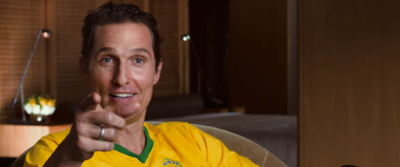
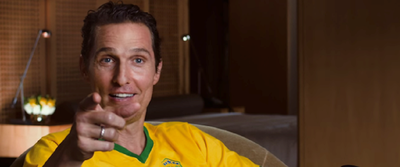
Matthew McConaughey stole Richard Linklater’s second movie, “Dazed and Confused,” with his performance as the eternal high school stud Wooderson, so it makes a certain sense that he’d steal the documentary “21 Years: Richard Linklater,” a feature-length look at the director’s movies that concentrates rather heavily on “Dazed.” Ruminating on the Austin-based writer-director’s oeuvre, McConaughey pontificates with a blinding grin and uses his hands like a preacher or motivational speaker. The documentary runs 78 minutes, perhaps 15 minutes of which concern “Dazed,” and the recent Oscar and Emmy winner tucks them into his back pocket like a tin of snuff and saunters away with them. If nothing else, McConaughey’s goofball autodidact’s intensity certifies that there is, in fact, a “Matthew McConaughey” sort of character, and that McConaughey is the originator of the type.
“Boom, we go to set, I get my ’70s Chevelle,” the actor says, remembering the film’s 1992 production in Austin, Texas. “It’s gonna be my first scene in the movie, and I’m going, ‘Fuuuuuuck, here we go!’, and I’m really nervous, I’m going, ‘Who am, I what am I about, what’s my man, what’s my man, what’s my man, what’s my man,’ and I remember in my head hearing Wooderson’s voice going: ‘All right, I’m about pot, rock ‘n’ roll, my car, and p—-y.’ Well, I’m high, I’m in my Chevelle, I’m listening to Nugent, and I heard ‘action.'”
Directed by Michael Dunaway and Tara Wood, “21 Years” does not cover every Linklater film—just a few highlights that keep coming up over and over. These include “Dazed,” “Slacker,” the experimental animated films “Waking Life” and “A Scanner Darkly,” “School of Rock,” “Bernie” and “The Newton Boys” (in which McConaughey costarred), the remake of “The Bad News Bears,” and the “Before” films, a collaboration between Linklater and actor-writers Julie Delpy and Ethan Hawke that is described as the lowest grossing trilogy in movie history. (That might or might not be true, but it’s fun to say, and it certainly cements Linklater’s eternal outsider’s credentials.) Actors including Delpy, Hawke, Jack Black and Keanu Reeves tell stories about Linklater’s film shoots and the director himself; these are perfectly entertaining on their own, but the filmmakers insist on illustrating them with animated interludes that usually feel redundant and occasionally desperate. (Surely Matthew McConaughey’s charisma is enough to hold our attention for a minute or two, without this sort of “help”?)
Linklater himself does not participate in any interviews. In one way, this is endearing: it suggests that Linklater either didn’t want to seem self-aggrandizing, or didn’t want to seem to be guiding anyone else’s interpretations, including those of the viewers. But in another way, it hurts the movie, because the other participants (mostly actors) lavish praise on Linklater without analyzing the technique or themes or his films in much much detail. (The most insightful comments about Linklater as an artist, pop culture observer and community organizer come from Austin Chronicle founder Louis Black, who had a cameo in “Slacker” and has known Linklater for years, but otherwise seems to have a more distanced vantage point than other interviewees.)
The ‘tribute to an old friend” structure makes “21 Years” feel less like a yeasty stand-alone theatrical feature than an extended DVD supplement that might be packaged in a boxed set of Linklater DVDs, or perhaps screened as a birthday-present video. it contains just enough analysis to be of interest to people outside of Linklater’s personal circle, but not too much more. Interviewees wax eloquent about Linklater’s interest in subcultures (everything from the stoner teenagers of 1970s Austin to the Little League of the aughts) and tell stories about what it’s like to work with him: specifically his laid-back way of controlling and directing action, and his ability to help people find the notes he wishes to strike without flat-out telling them what to do. “Rick as a director kinda sneaks up on you,” says Billy Bob Thornton, who costarred in two Linklater films, an observation that’s true enough, but that one wishes had been explored in more detail. If you like Linklater, you’ll probably enjoy this documentary, but an “American Masters” episode would still be preferable.
Source:: http://www.rogerebert.com/reviews/21-years-richard-linklater-2014


