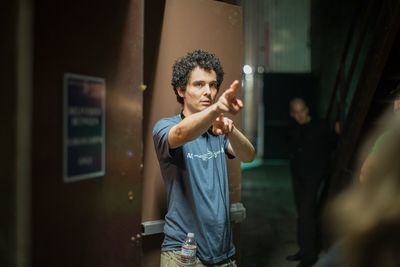
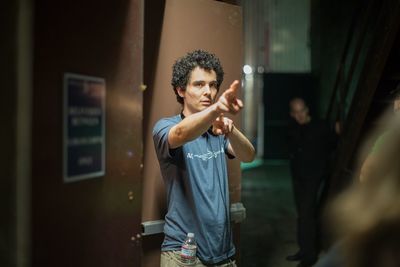
Damien
Chazelle is on fire. The 29-year-old writer/director is receiving some
of the year’s best reviews for his second feature effort, “Whiplash,” an
overwhelmingly powerful picture that defies the typical genre
categorization of “drama” or “thriller.” It won both the Grand Jury
Prize and the Audience Award at this year’s Sundance Film Festival, and
has the potential to become a major awards contender over the next few
months. Miles Teller is flat-out astonishing as Andrew, a 19-year-old
drummer with dreams of achieving greatness at a prestigious conservatory
while under the formidable tutelage of Mr. Fletcher (a galvanizing J.K.
Simmons).
RogerEbert.com
spoke with Chazelle about his own musical background, the debatable
philosophies of Mr. Fletcher and whether he views the film as ultimately
triumphant or tragic (caution: there are spoiler alerts aplenty).
What sort
of impact did your experience drumming in a conservatory-style high
school jazz orchestra have on your growth as a person and an artist?
Most of my
experiences in the band were not pleasant. On the one hand, I was
fraught with anxiety and pure dread every day because of it. I was so
jealous of my friends, thinking, “You guys don’t know how easy your life
is. You don’t have these rehearsals and this conductor who scares the
s—t out of you breathing down your neck. You don’t know what a life of
fear is.” I’m sure I overdramatized things in my head, but it certainly
felt that way. At the same time, I wouldn’t have had it any other way. I
was so motivated by that fear. Getting this guy’s approval meant more
to me than anything, and also, being a part of this rarified ensemble
that was very hard to get into was just such a badge of honor. I guess
it’s the same thing with sports teams in some ways. If you’re on the
varsity team, the responsibilities are a lot bigger and there’s more
stress, but you also walk around feeling probably like you can hold your
head high. I’d hold my head really low in the rehearsal room because
I’d feel like a terrified child, but outside of the rehearsal room, I
knew that I was one of the few who could actually survive in there. It
was kind of a give and take of pride and shame. [laughs] It motivated me
to be a good drummer, so it worked for me, but it also posed the
question of what would happen if you were to push that kind of behavior
even further. What would you do if you had a teacher who was a true
objective monster, not just someone who scares you personally or is
tough on you and maybe borderline cruel? At what point do the ends not
justify the means?

You ultimately leave it up to the audience to decide whether Andrew’s transformation is a triumph or a tragedy.
[Spoiler Alert]
I like that you said that because that was certainly the hope.
Sometimes I get worried that—no, worried is the wrong word, because if
people enjoy the ending, then that’s great. But I had always thought,
when writing the film, that the ending had always veered a little more
on tragic than triumphant. In terms of a lot of responses to the movie,
at least from what I’ve seen, the ending seems to be interpreted as a
little more triumphant than tragic. Again, that’s not something that I’m
upset about. If anything, it makes the movie more enjoyable for people,
but it has been a really interesting thing to observe. I had always
intended it to be a pretty dark ending.
It reminded me of “The Wrestler,” in that the final cut to black suggests that [someone] has died.
[Spoiler Alert]
I love the ending of “The Wrestler.” [Mickey Rourke] steps out with
“Sweet Child of Mine” blasting, and you get this triumphant feeling, but
as in “Black Swan,” you know that he’s basically killing himself. In
“The Wrestler,” you get the sense that he’s literally killing himself at
that moment, at least that’s how I interpreted it—he has his hard
attack and the cut to black is him dying, and “Black Swan” is similar
too, where it ends with the death of the main character. It’s that “Red
Shoes” idea of dancing until you die, playing drums until you die and
literally giving your entire life to your art, resulting in your death.
In this case, I don’t think Andrew physically dies, but I think a big
part of his soul has definitely died.
To me,
“Whiplash” is the “Raging Bull” of music films in its bruising,
foul-mouthed, blood-spattered and extraordinarily visceral rehearsal
sequences.
“Raging Bull”
served as a big model for many reasons. When it comes down to subject
matter, it’s actually, to my mind, only one step away from [my film].
“Raging Bull” is about a guy who hits people for a living, this is a
movie about a guy who hits things for a living. Andrew’s not actually
whacking people with the stick, but it’s still the same violent act.
You’re still f—king whacking stuff, and there’s still something about
drumming that I find fundamentally violent.

There’s even a scene where Andrew punches a hole through a drum.
I did that a
few times. Never before have I been more enraged. I know a lot of
musicians will be able to relate to this. There’s something very
particular about the kind of rage you feel when you’re alone in a
practice room by yourself, unable to master a simple thing like a
rudiment. You keep trying to master this very basic thing and when you
don’t get it, you just scream. I broke a lot of drum heads and I broke a
lot of sticks. I even whacked the cymbals. This is something that we
didn’t put in the movie and if we did, I bet people would think it was
unrealistic. I would break a lot of cymbals. You whack the cymbals hard
enough and they will crack in half. Drums are not actually as sturdy as
they look. They’re actually somewhat fragile instruments.
How did Miles prepare for the film’s taxing performances?
We didn’t
have a lot of time. We had three weeks for him to do a crash course in
jazz drumming. I helped him out and Nate Lang, who plays the drummer
Carl, became Miles’s coach and teacher onset. Miles had played drums
since he was 15, so he knew his way around a kit a little bit. He still
had to learn jazz and proper technique. One thing I like about him a lot
is that there’s just something very physical about him. He’s playing a
boxer next, which makes total sense to me. He’s doing my next movie
after that, which will be a Gene Kelly-style musical where he’ll be
dancing. The initial thing that drew me to him is his face and his eyes,
which are so expressive, but his whole body—he’s got this physicality
to him that a lot of young actors today don’t have. It’s not that he’s
manly in the clichéd sense. In this movie, there’s something almost
misshapen about him that I liked. He had been buff before in
“Divergent,” and then he had to lose some of that muscle for this, but
also, not gain too much weight. He had to get strong in his arms for the
drumming and he couldn’t go outside and get sun. So in this movie, he’s
this weird, pasty, somewhat muscular figure. He’s not frail but he’s
not unnaturally cut either. He did “The Fantastic Four” after this, and
I’m sure he’s unnaturally cut in that, which probably made him a lot
happier. [laughs]

What was the process like of creating the intricately cut music sequences with editor Tom Cross?
It was very
much thought-through from the get-go. Everything was storyboarded. I did
Animatics for all the music sequences, so we kind of had a sense before
we shot it of how it would cut and how it would play. Tom edited my
short film of “Whiplash,” which I made a year before to get the interest
of financiers. He’s just a genius. Other than the kind of moments of
exhilaration that you get on set, sitting in the editing room with
someone like him is one of the most rewarding parts of the process. We
have the same taste in movies and our [method] really boiled down to
putting “Raging Bull” in a loop and doing our riff on that.
Are there lessons to be learned from Mr. Fletcher?
His
philosophy is compelling, such as his idea that trophies for
participation are doing more harm than good. What I find noble about him
is that everything he does at the end of the day comes from this deep,
almost unrealistic passion for music, and it’s a kind of music that’s
marginalized in today’s America. Jazz is THE American art form. But I
think his love for the music is so real that it gets in the way of his
love for people. To him, most people in the world just aren’t playing
the music right, and he has very little patience for that. His cruelty
comes from a genuine love for the music, but he’s also an utter monster.
I wanted to make sure that this was a character where there were shades
of gray in terms of his philosophy and in how much you might buy it,
but in terms of the actual behavior he exhibits onscreen, there’s no
gray zone. There’s no way you could look at how he treats some of the
players and go, “Well, maybe he’s a nice guy underneath.” I wanted to
make sure that this wasn’t going to be a movie about the grumpy old
coach who we learn has a heart of gold. There’s no heart of gold there,
but he does have a brain, and he knows how to use it.
You get a sense that he feels remorse upon learning of a former student’s death.
[Spoiler Alert]
J.K. and I talked about that. We wanted to leave it ambiguous, but I
think the lie Mr. Fletcher tells to his students [regarding the
incident] comes less from a place of manipulation and more from the fact
that he knows he’s partly responsible for it. But it’s the kind of
thing that he’s eventually going to brush off. It doesn’t alter his
philosophy. The guy who died was one of the few students who earned his
respect and who he thought could be his Charlie Parker, but it didn’t
pan out. He’s sad not just for the kid dying but for the fact that it’s
one of his creations that had so much promise and burned out.
You’ve gotten me quite excited for your upcoming musical.
There’s
no large-scale original musicals being made right now. They’re all
Broadway adaptations and jukebox musicals or catalog musicals, and they
just don’t interest me as much. I like the idea of a director and
composer having a relationship and bond that results in something that
neither of them could’ve created on their own. That is what Jacques Demy
and Michel Legrand did in the 60s. That, to me, is the biggest model. I
want to do an American “Umbrellas of Cherbourg.”
Source:: http://www.rogerebert.com/interviews/rise-of-a-star-death-of-a-soul-damien-chazelle-on-whiplash


