
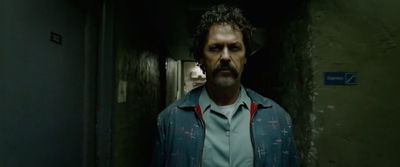
The first time we see Michael Keaton in his tighty-whities
in “Birdman,” it’s from behind. His character, a formerly high-flying movie
star, is sitting in the lotus position in his dressing room of a historic Broadway
theatre, only he’s levitating above the ground. Bathed in sunlight streaming in
from an open window, he looks peaceful. But a voice inside his head is
growling, grumbling, gnawing at him grotesquely about matters both large and
small.
The next time we see Keaton in his tighty-whities in
“Birdman,” he’s dashing frantically through Times Square at night, having
accidentally locked himself out of that same theatre in the middle of a performance
of a Raymond Carver production that he stars in, wrote and directed. He’s
swimming upstream through a river of gawking tourists, autograph seekers, food
carts and street performers. But despite the chaos that surrounds him, he seems
purposeful, driven and–for the first time–oddly content.
These are the extremes that director Alejandro G. Inarritu
navigates with audacious ambition and spectacular skill in “Birdman”–the full
title of which is “Birdman or (The Unexpected Virtue of Ignorance).” He’s made
a film that’s both technically astounding yet emotionally rich, intimate yet
enormous, biting yet warm, satirical yet sweet. It’s also the first time that
Inarritu, the director of ponderous downers like “Babel” and “Biutiful,”
actually seems to be having some fun.
Make that a ton of fun. “Birdman” is a complete blast from
start to finish. The gimmick here–and it’s a doozy, and it works beautifully–is that Inarritu has created the sensation that you are watching a two-hour
film shot all in one take. Working with the brilliant and inventive cinematographer
Emmanuel Lubezki (who won an Oscar this year for shooting “Gravity” for
Inarritu’s close friend and fellow Mexican director Alfonso Cuaron), Inarritu
has constructed the most delicate and dazzling high-wire act. And indeed,
before shooting began, the director sent his cast a photo of Philippe Petit
walking a tightrope between the World Trade Center towers as inspiration.
Through impossibly long, intricately choreographed tracking
shots, the camera swoops through narrow corridors, up and down tight stairways
and into crowded streets. It comes in close for quiet conversations and soars
between skyscrapers for magical-realism flights of fancy. A percussive and
propulsive score from Antonio Sanchez, heavy on drums and cymbals, maintains a
jazzy, edgy vibe throughout. Sure, you can look closely to find where the cuts
probably happened, but that takes much of the enjoyment out of it. Succumbing
to the thrill of the experience is the whole point.
Just as thrilling is the tour-de-force performance from
Keaton in the role of a lifetime as Riggan Thompson, a washed-up actor trying
to regain the former glory he achieved as the winged action hero Birdman. The
film follows the fraught early going of his Broadway debut which is also his
last shot at greatness–although his on-screen alter ego doesn’t help much by
voicing his fears and making him doubt himself incessantly. Yes, it’s knowingly
amusing that Keaton, who peaked 20-plus years ago as a superhero, is playing an
actor who peaked 20-plus years as a superhero. Although I’d happily argue that
Keaton’s Batman for Tim Burton in 1989 is THE definitive performance of the
iconic character–but that’s a whole ‘nother conversation for another time.
Or is it? While “Birdman” exists in its own meticulously
realized world, it’s very much of this time and place from a pop-culture
perspective, with references to other real-life actors like Robert Downey Jr.
and Michael Fassbender who’ve enjoyed enormous success when they’ve donned the
superhero duds. The script from Inarritu, Nicolas Giacobone, Alexander
Dinelaris and Armando Bo is cleverly meta without being too cutesy and
self-satisfied.
Keaton gets to toy with his persona a bit–as well as
acknowledge how comparatively quiet his career has been in recent years–but
seeing him in seasoned form provides its own joy. He’s still hyper-verbal and
playful and he can still be amusing and lacerating in his delivery, but there’s
a wry wistfulness and even a desperation in the mix now that’s achingly
poignant.
Also confronting his real-life reputation is Edward Norton as
Mike Shiner, the brilliant but infamously capricious actor who steps in as
Riggan’s co-star just as previews are about to begin on his labor-of-love production
of “What We Talk About When We Talk About Love.” Norton, who’s come with the
baggage of being difficult and demanding over the years, finds just the right
balance between arrogance and sincerity.
Besides, they need each other, as they find in the days
leading up to opening night. They all need each other. Inarritu has amassed a
tremendous supporting cast and made ridiculous technical demands of them, yet
they’ve all more than risen to the occasion and relished the chance to shine.
Zach Galifianakis plays strongly against type as Riggan’s
manager and the rare voice of reason in the middle of all this madness. Emma
Stone is adorable as Riggan’s world-weary, wise-ass daughter who also serves as
his assistant. (She and Norton have crackling chemistry in a couple of crucial
scenes.) Amy Ryan does wonders with her brief screen time as Riggan’s ex-wife;
she fleshes him out and allows us to see both the selfish and the good in him.
And Naomi Watts, who starred in Inarritu’s wrenching “21 Grams,” gets to play
both light and heavy moments as a neurotic fellow cast member.
It’s powerfully clear that they all worked their asses of to
make this complicated thrill ride look effortless. The result is one of the
best times you’ll have at the movies this year–which might even be the best
movie this year.
Source:: http://www.rogerebert.com/reviews/birdman-2014


