Categories
Uncategorized

Federal government invests in Cold Lake’s energy and aviation sectors to build a stronger, more secure Canada


Investments to enhance Canada’s strategic position while unlocking economic opportunities to support workforce development and Indigenous-led resource development

August 26, 2026 – Cold Lake, Alberta – PrairiesCan

Cold Lake has long played an important role in Canada’s security and prosperity. In the 1950s, the region became home to the first new Royal Canadian Air Force flying station built in Canada since the conclusion of the Second World War. In the decades that followed, Cold Lake also became a centre for innovation in Canada’s energy sector, helping advance the in situ technologies used to develop Alberta’s deep oil sands resources.

Today, Cold Lake remains an important centre for both Canada’s energy sector and national defence. As Canada navigates a more uncertain world, the region once again will play a critical role in advancing the Government of Canada’s efforts to build strength at home. Building on Cold Lake’s unique capabilities will help position the region to meet this moment, while ensuring local communities share in the benefits of future growth and investment.

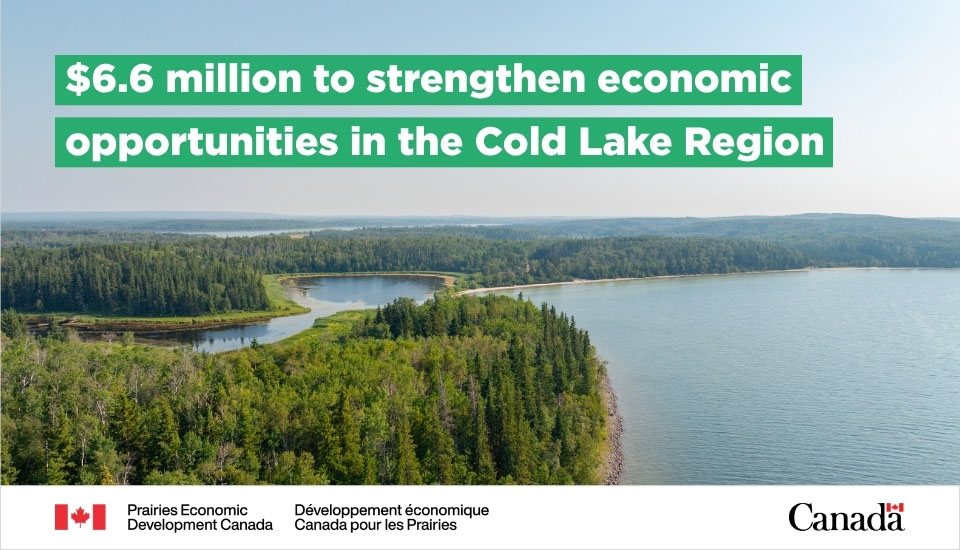
Today, Matt Jeneroux, Member of Parliament for Edmonton Riverbend, on behalf of the Honourable Eleanor Olszewski, Minister of Emergency Management and Community Resilience and Minister responsible for Prairies Economic Development Canada (PrairiesCan), announced $6.6 million in federal funding to advance Indigenous-led energy development and strengthen aviation training in the Cold Lake region.

A $6 million repayable investment will support Etthen Energy Corporation, a company wholly owned by Cold Lake First Nations, as it expands the development of heavy oil resources beneath reserve lands. The project will support well site and facility construction, along with the engineering and completion work needed to advance production.

By supporting Etthen Energy Corporation’s expansion project, this investment will create economic opportunities for Cold Lake First Nation, strengthen Indigenous ownership and participation in the energy sector, and generate long-term revenues that can be reinvested in the community. In doing so, it will also contribute to the federal government’s broader efforts to secure Canada’s prosperity by helping build a more independent, competitive, and resilient economy.

A further $600,000 investment in the City of Cold Lake will support renovations and upgrades to an aircraft hangar at the Cold Lake Regional Airport, establishing a training facility for an Aircraft Maintenance Engineering – Structures program. The new training space and equipment will help prepare workers for careers in aviation maintenance and respond to growing demand for skilled workers in the region’s aerospace and defence sectors. This investment also supports the Government of Canada’s efforts to rebuild, rearm, and reinvest in the Canadian Armed Forces by while building the skilled workforce and domestic industrial capacity needed to support our women and men in uniform.

Together, these investments will help Cold Lake build on the strengths that have made the region important to Canada for generations, while creating good jobs, expanding local opportunity and helping build a stronger and more secure country.

Source link

Categories
Uncategorized

Third UNESCO Reactive Monitoring Mission to Wood Buffalo National Park World Heritage Site Concludes


August 25, 2026                         Gatineau, Quebec                                  Parks Canada

The UNESCO World Heritage Centre and International Union for Conservation of Nature (IUCN) in-person component of the reactive monitoring mission to Wood Buffalo National Park World Heritage Site concluded on August 23, 2026.

The past week provided an opportunity for delegates to visit key locations within the World Heritage Site and engage with Indigenous Nations and communities, governments, and partner organizations involved in the stewardship of the land and waters connected to Wood Buffalo National Park & World Heritage Site.

The mission representatives reviewed progress made in implementing the Wood Buffalo National Park World Heritage Site Action Plan since the 2022 reactive monitoring mission and highlighted collaborative stewardship efforts to protect the natural values that contribute to the site’s Outstanding Universal Value. Discussions focused on cumulative impacts associated with industrial development along the Peace and Athabasca rivers, conservation and long-term monitoring of wood bison and whooping crane populations and their habitats, and progress toward establishing shared governance with the 11 Indigenous Nations and organizations connected to Wood Buffalo National Park.

Delegates heard about key achievements since 2022, including continued progress toward shared governance, Indigenous-led and collaborative work through the Integrated Research and Monitoring Program to understand the state of the Peace-Athabasca Delta, advancements related to hydrology and ecological flows, the opening of a Field Station, and the continued braiding of Indigenous Knowledge and western science in research and monitoring programs.

Delegates also visited key areas of ecological significance within Wood Buffalo National Park, including the Peace-Athabasca Delta, geologically significant gypsum karst features, landscapes recently affected by wildfire, and the newly constructed and codeveloped Field Station. The Field Station is a $10.7 million facility that supports research, knowledge sharing, and collaboration among Indigenous partners, researchers, and community members. 

The Mission marks an important milestone in the ongoing implementation of the Action Plan and the broader efforts to protect the site’s Outstanding Universal Value for present and future generations.

Parks Canada will review the Mission’s findings and recommendations once available and continue working with partners to advance the Action Plan and address threats to the World Heritage Site.

Funding announced under the Force of Nature strategy in March 2026 reaffirms the Government of Canada’s commitment to the Wood Buffalo National Park World Heritage Site Action Plan by providing $90 million over five years to continue the implementation of the Action Plan, and to support the recovery of two wood bison populations along the Alberta-Northwest Territories border.

Parks Canada thanks all participants for their time, knowledge, and contributions throughout the Mission and looks forward to continuing this collaborative work with Indigenous Nations and communities, governments, and partners. The UNESCO World Heritage Centre and IUCN will now prepare a Reactive Monitoring Mission Report containing findings and recommendations that will inform deliberations of the 49th session of the World Heritage Committee in Istanbul, Türkiye, from June 27 to July 7, 2027.

                                                                                                       -30-


Source link

Categories
Uncategorized

Government of Canada to announce support for economic opportunities in the Cold Lake region


August 25, 2026 – Cold Lake, Alberta – Matt Jeneroux, Member of Parliament for Edmonton Riverbend to announce federal funding in support of economic development opportunities in the Cold Lake Region on behalf of the Honourable Eleanor Olszewski, Minister of Emergency Management and Community Resilience and Minister responsible for Prairies Economic Development Canada.

Date:
August 26, 2026

Time:
12 p.m. MT

Location: 
Aircraft Maintenance Engineering Training Facility
Cold Lake Regional Airport
63407 Range Road 425, M.D. of Bonnyville

This event is open to media and speakers will be available for questions following the announcement.


Source link

Categories
Uncategorized

Canada and two First Nations under Treaties 4 and 6 advance reconciliation through agricultural benefits claim settlements


August 25, 2026 — Muskeg Lake Cree Nation, Treaty 4 and Treaty 6 Territories, Saskatchewan — Crown-Indigenous Relations and Northern Affairs Canada

Today, the Honourable Rebecca Alty, Minister of Crown-Indigenous Relations, alongside the Honourable Buckley Belanger, Secretary of State for Rural Development, joined representatives from The Key First Nation and Muskeg Lake Cree Nation to mark the resolution of their agricultural benefits specific claims. 

Together, the settlements provide more than $209.5 million in compensation through individual settlement payments, including $121,077,713 for Muskeg Lake Cree Nation and $88,440,000 for The Key First Nation. These claims relate to Canada’s failure to provide some of the farming support promised under Treaties 4 and 6, such as ploughs, seeds, cows, bulls, and other supplies that were intended to help First Nations move into farming and other economic activities, especially as buffalo populations declined. Without this support, communities did not have the tools and resources they needed to develop their lands for agriculture and support their members. The settlements mark another step toward renewing Canada’s relationship with First Nations and addressing historic Treaty obligations that were not fulfilled.

Resolving historic claims such as agricultural benefits claims helps address past harms and honour treaty promises, advancing reconciliation and supporting renewed relationships with First Nations. Guided by the principles of the United Nations Declaration on the Rights of Indigenous Peoples Act, Canada is implementing treaty obligations and taking responsibility through fair compensation when those obligations have not been met. 


Source link

Categories
Uncategorized

Canada invests an additional $5.4 million to advance innovative Virtual Health Hub in Whitecap Dakota Nation


August 20, 2026 — Whitecap Dakota Nation, Saskatchewan — Indigenous Services Canada

Today, the Honourable Mandy Gull-Masty, Minister of Indigenous Services, announced $5.4 million in new funding for the Virtual Health Hub (VHH) alongside Chief Darcy Bear and Virtual Health Hub CEO Dr. Ivar Mendez in Whitecap Dakota Nation.

The investment will support the VHH’s 2026–2027 operating budget and is in addition to the over $28.2 million Indigenous Services Canada (ISC) has already invested toward the construction of the future facility located in Whitecap Dakota Nation, which is expected to open in early 2027.

The VHH is creating a new way to deliver health care to northern and remote communities. From a state-of-the-art command centre in Whitecap Dakota Nation, health professionals will use telehealth, artificial intelligence, robotics and other emerging technologies to connect patients with high-quality care without requiring long-distance travel.

The model is designed to help overcome some of the barriers that have made accessing health care difficult for people living in northern and remote communities. It will connect patients with health professionals in real time and bring more services directly into communities.

Once fully operational, the VHH will support 80 jobs and have the capacity to serve 30 communities. By 2029, its reach is expected to expand to as many as 90 northern and remote communities.

The VHH will also help build health-care capacity for the future. Through partnerships with the Saskatchewan Indian Institute of Technologies and the University of Saskatchewan, it will support training opportunities for Indigenous students and health professionals, helping more people develop the skills to deliver care in their own communities.

The Virtual Health Hub is a First Nations-led model that brings together health care, technology, training and community leadership to improve access to care.


Source link

Categories
Uncategorized

Minister Alty to announce Agricultural Benefits specific claims settlements  with First Nations under Treaties 4 and 6


Muskeg Lake, Saskatchewan — Please be advised that the Honourable Rebecca Alty, Minister of Crown-Indigenous Relations, will hold a media availability to announce Agricultural Benefits specific claims settlements with First Nations in Treaty 4 and Treaty 6 territories. The Minister will be joined by Chiefs representing recipient First Nation communities.

Media participation:

Media wishing to attend in person are asked to pre-register with the Media Relations team of Crown-Indigenous Relations and Northern Affairs Canada at RCAANC.media.CIRNAC@sac-isc.gc.ca.

Date: Saturday, August 22, 2026

Time: 9:45 a.m. (CT)

Where:
Kihiw Waciston School Gymnasium
243F+79 Aldina, SK


Source link