
In two short voicemail messages, no more than five minutes combined, Al Hancock details a terrifying scene — a deadly avalanche that surprised his climbing team as they slept in their tents on a mountain in Nepal.
“If it lasted another four seconds, I wouldn’t be talking to you, I’d be buried alive with my teammates,” Hancock said in the recording left with his publicist Monday.
‘People were running for their lives, thinking that the rock walls all around us were going to cave in.’- Al Hancock, high-altitude climber
“Death was at the door.”
The 55-year-old high-altitude climber, who lives in Edmonton, has been in Nepal since March. Hancock was attempting to climb Annapurna, an 8,000-metre peak in the Himalayan Mountains, as part of an effort to scale 14 of the largest mountains across the world.
In the two voicemails left with publicist Olivia Pilip, Hancock details the ordeal his team faced after a powerful 7.9 magnitude earthquake hit Nepal Saturday.
Hancock said the team had attempted make it to the summit of Annapurna on Friday, but were unable to reach the peak. The decision was made to return to base camp before making another attempt. A few hours later, the ground started to shake.
“We were so lucky on the 23rd that everybody had the strength to get off the mountain … If anyone were on the mountain, they would be dead today.” he said.
“(We) got back to camp and we had to crawl into our sleeping bags to rest up and got hit as we were sleeping in the major avalanche.
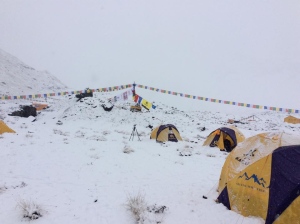
The climbing team was sleeping in the camp, shown before the earthquake, when it was hit by an avalanche. (Al Hancock)
“We had to cut ourselves out with knives from the tents and then look for our gear under seven feet of snow. It was a scary experience.”
‘The whole mountain shook’
The massive earthquake, which has killed at least 3,800 people and left parts of the country unreachable, was not the only danger. The country has been hit with dozens of aftershocks following the earthquake: each tremor carried the danger of triggering another avalanche.
“Base camp is like a horseshoe — on one side you have Annapurna and all around are these steep rock walls. The sound that we heard was deafening, the whole mountain shook, the ground shook.
People were running for their lives, thinking that the rock walls all around us were going to cave in.”
All of Hancock’s team members survived the initial avalanche, but two required rescue.
In the voicemail, Hancock details having to climb down the mountain with two sherpas to get a man with severe frostbite into a place where he could be rescued by helicopter.
“Next morning, we had a helicopter come in and do a live line rescue — which is a line dangling from a helicopter. Got him strapped in and he was transported to base camp … he’s in Kathmandu, doing fine.”
“We’re safe. We’re running out of food,we’ve been eating rice the last few days, and water and tea. But we’re healthy and we’re happy to be alive.”
It will likely be another day or two before Hancock’s team is able to get off Annapurna. Even with a satellite phone, communication is difficult and it’s unsure when he will next be able to call back to Canada. But Hancock said both he and the rest of the team are aware how close they came to being among the thousands killed in the earthquake.
“Our hearts go out to those families with lost loved ones. It’s just a massive, massive tragedy throughout the whole Kingdom of Nepal.”


