Depending on where you sit, this movie’s a draw for very
different reasons. From the mainstream perspective, two words: Kristen Stewart.
The young actor, who catapulted to worldwide fame in the “Twilight” series,
has, like her co-star Robert Pattinson, been using the clout that such stardom
brings to effectively branch out as a performer. In the contemporary movie
business, the transaction works both ways: big young star stretches creative
muscles by signing on to challenging, filmmaker-driven projects; challenging,
filmmaker-driven projects get their financing because a young star who wants to
stretch his or her creative muscles has signed on to it. In cases like those of
Pattinson’s and Stewart’s, the stakes, and the intrigue, get raised, because
both performers have wildly enthusiastic (not to say rabid) fan bases that seem
willing to follow their idols anywhere. Which is not to say that movies like
“Maps To The Stars” (Pattinson working for the second time with maestro of
unsettling content David Cronenberg) or this Stewart co-starrer are fated to
rack up “Twilight”-comparable numbers. But they will be seen by a segment of
the mass audience that in most other circumstances isn’t interested in auteurs.
The Stewart-intrigue factor is in itself a double-edged sword, because for
every 10,000 growing teens for whom Stewart can do no wrong, there’s one film critic,
amateur or professional, who still is not sure if Stewart “can act.” (I am not
one of these; I was impressed by her in “Panic Room,” “Undertow,” and “Into The
Wild,” to name three of her pre-“Twilight” films.) They look to films such as
this one, and another recent Stewart indie, “Camp X-Ray,” to settle the
question for them once and for all.
Then there are those for whom this movie’s a draw because of
its writer/director, Olivier Assayas, working here not just with Stewart but
with the great French actress Juliette Binoche, who was also in Assayas’
terrific 2008 family drama “Summer Hours.” Assayas is one of world cinema’s
most penetrating and unpredictable talents; for instance, the two films he made
prior to this one were “Something In The Air,” an affecting, autobiographical
coming-of-age story of politics and cinema in the early ‘70s, and before that,
the sweeping, bracing, not-at-all-sweet “Carlos,” a trenchant biopic of the
titular real-life terrorism perpetrator whose activities galvanized Europe for
a period. “Clouds of Sils Maria” is entirely different in some ways from those
two films, but its invented worlds are very much in keeping with Assayas’
concerns about how art and reality intertwine and feed off of each other.
The setup for the picture seems to promise a story of
rivalry among artists: the movie begins on a train; world-renowned actress
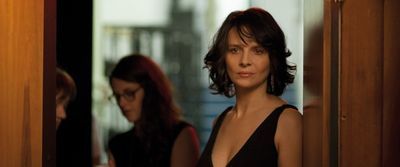
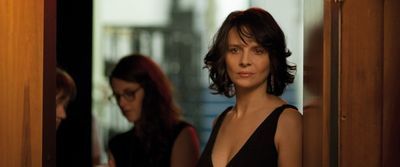
Maria (Binoche) is on her way to visit her artistic mentor Wilhelm Melchior,
and deliver a speech at a ceremony honoring the reclusive theater master. Maria
has her efficient but frazzled and very hip young American assistant Val
(Stewart) in tow; Val’s the one in charge of the schedules, the multiple
smartphones, and the texting, and it’s Val who first learns that Melchior, the
man they’re on their way to see, has died.
This loss changes the dynamic of the event. Maria has barely
time to register her loss than she’s regaled with Chanel in a theater corridor;
whisked through a photo shoot; reintroduced to a former co-star she never
liked; and approached by a hot young theater director to appear in a revival of
the Melchior play that made her famous. Playing, and this is no small thing,
not the ingénue role that she is now to old for, but the role of an older, more
embittered character. Set to play the younger woman’s role is of course a
younger woman, a scandal-riddled star played by Chloe Grace Moretz and
initially seen mainly via paparazzi videos Val finds for Maria on YouTube.
After this flurry of activity Val and Maria repair to Melchior’s house in the
title village. It’s not far from this place that a particular cloud formation
called the Maloja Snake, which provides the Melchior play with its own title,
occurs. Aside from feeding each other lines from Melchior’s play, and arguing
about life and art and career, Maria and Val aspire to go on a hike and witness
the snake-like cloud formation as it appears. In the meanwhile, elsewhere in
Europe, Jo-Ann (Moretz) and her latest male conquest, a boy toy with literary
pedigree, hone in on, you might have guessed it, an opportunity to stretch
creative muscles and/or gain some form of artistic cred; for whatever reason,
Jo-Ann is hungry for a form of respectability even if she can’t quite fathom
what kind, not to even mention why.
In précis form this material looks like an unlikely walk
into “All About Eve” territory for Assayas, only with more self-reflexivity.
But in spite of the superficial dynamics of the
young-actress-meets/conquers-older-star scenario, which are fully acknowledged,
“Clouds of Sils Maria” is oodles more poetic and enigmatic than the term
“backstage drama” generally encompasses. It isn’t a story of predatory ambition
or women stabbing each other in the back; all the characters in the movie have
their reasons, but the film, at least in the show business aspects of its
story, is concerned with the paradox of self-preservation within an enterprise
that requires you have to invest your trust with so many other people. Artistic
creation begins in the first person singular, but then turns plural, and not
everyone who gets on board makes it all the way to the end of the trip. To that
end, Assayas executes a gambit in the final fifth of the movie that makes
matters all the more enigmatic. It’s almost as if the conflicts the film
depicts up until this point—rendered in convincing, epigrammatic dialogue and
action, performed with sometimes searing conviction by Binoche and Stewart in
particular—have suddenly been deemed too pat by the filmmaker. His way of
shaking thing up is…intriguing, for sure. It’s one of those moves that make a second
viewing worth contemplating. In any event, the pleasures of the acting and the
ever-acute visuals are apt to make a second viewing a distinct pleasure, even
if it doesn’t solve anything.
Source:: http://www.rogerebert.com/reviews/clouds-of-sils-maria-2015


