At the end of act one in Asghar Farhadi’s gripping “About
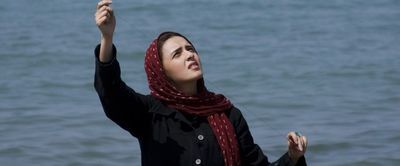
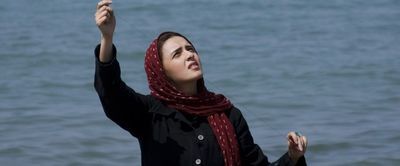
Elly,” the title character disappears. Elly (Taraneh Alidousti), a young school
teacher, has gone on a weekend vacation with a group of thirtysomething
professional couples from Tehran. She’s supposed to be looking after three
little kids who’re playing on a beach, and suddenly she’s not there. That this
vanishing sets up a mystery that propels the rest of the film has led to
understandable critical comparisons to Antonioni’s “L’Avventura.”
Yet the scene that immediately follows our last glimpse of
Elly reminded me of quite a different movie: Spielberg’s “Jaws.” Most of the
vacationing adults are playing volleyball behind the villa where they’re
staying when two of the aforementioned kids appear from the beach and start
screaming about the third. It takes the grownups several beats to catch on, but
when they do, they rush around the house, realize that the third kid, a little
boy, is nowhere to be seen, and frantically begin plunging into the Caspian
Sea’s crashing waves.
I won’t reveal how the scene ends, just that I can’t help
but think Spielberg would admire Farhadi’s electrifying direction of it. As the
Iranian men dash into the ocean, and their alarmed wives emerge from the house,
everything is in motion: the characters, the water, the camera. We seem to be
looking in every direction at once, desperately: up and down the beach, back
toward the villa, even under the sea as it pounds forward violently. Farhadi’s
orchestration of all these elements is complex and viscerally kinetic; few
viewers will experience it without holding their breath at some point.
So what do we make of an Iranian film whose conceptual
parameters are broad enough to span “L’Avventura” and “Jaws”? Perhaps we should
begin by venturing that Asghar Farhadi is a new and conspicuously audacious
kind of Iranian auteur. When Iranian directors such as Abbas Kiarostami and
Mohsen Makhmalbaf began catching the world’s eye in the late ‘80s and early
‘90s, it was for films that had obvious parallels to Euro-style cinematic
modernism. Even when newer directors including Jafar Panahi and Majid Majidi
gave a more commercial spin to this basic model from the late 90s onward, their
work still spoke the language of the international art film.
Farhadi’s “A Separation” (2011) took a different tack,
becoming the most successful Iranian film in history, as well as the first to
win the Oscar for Best Foreign Language Film, thanks in part to innovations on
two fronts. First, Farhadi’s Iranian cinematic models were not any of the
aforementioned filmmakers but two cinematic masters who are less well known
outside Iran: Dariush Mehrjiu (“Leila”), whose films often deal with Iran’s
middle and upper classes; and Bahram Beyzaie (“The Travelers”), whose creative
roots are in theater (as are Farhadi’s). Second, Farhadi admitted American
influences including the likes of Elia Kazan and films such as “A Streetcar
Named Desire.”
“About Elly” represents all the tendencies of Farhadi’s
mature style as brilliantly as “A Separation,” yet it is not a successor to the
latter film. It was made just before it and won the Silver Bear at the Berlin
Film Festival in 2009, but, due to complicated rights issues, was not released
in the U.S. until now. Its belated appearance should be welcomed by cinephiles,
as it offers solid proof of this writer-director’s distinctive gifts.
One of those is a way of dramatic structuring that’s like
peeling an onion: the first layers we see seem familiar and self-evident, but
the more layers we reach, the more complex the whole becomes. Here, the
starting point is what seems like an entirely happy and carefree outing where
three couples – many of whom have been friends since law school – motor out to
the Caspian Sea for a holiday weekend. One wife has invited along pretty Elly,
her daughter’s elementary school teacher, in obvious hopes of matching her with
the excursion’s other singleton: Ahmad, a handsome friend who’s just returned
from Germany after getting divorced.
For Americans who’ve seen few Iranian films, or only ones
centered on the poor or dispossessed, the characters here will be striking.
With their BMWs, faded t-shirts and constant joking around, they’re like
cosmopolitan urbanites anywhere. Sure, we’re reminded of their Iranian-ness in
their particular styles of music and dance and in the fact that the women all
wear head-scarves throughout (something required by law of Iranian films) but
even they are casual and stylish.
As in “A Separation,” there’s evidence of tension between
this class of privileged professionals and the strata of poorer, more pious
Iranians beneath them, but this is more peripheral than in the later film:
e.g., the Tehranis pretend Elly and Ahmad are newlyweds in order not to offend
the religious sensibilities of the rural folks who rent them the villa.
From that little white lie to other similar ones and the
uncovering of various personal agendas: the peeling away of the onion skins
reveals a continuing succession of hidden realities, and the ones that come
after Elly’s disappearance are darker and cut deeper than those early on. But
when I read that a writer in Sight & Sound has said all this constitutes “a
critique of the lies and evasions that permeate Iranian society,” I can
practically hear the groans coming from Farhadi, who has said in interviews
that he doesn’t want to be one of those filmmakers who is expected “to explain
Iran to the West.”
The
filmmaker has, instead, clearly indicated that his goals in “About Elly” are
far less sociopolitical than cinematic, stating that, “[D]irectors can no
longer be content with force-feeding [audiences] a set of preconceived ideas.
Rather than asserting a world vision, a film must open a space in which the
public can involve themselves in a personal reflection, and evolve from
consumers to independent thinkers.”
“Opening
spaces” are precisely what Farhadi’s film do, both literally and figuratively.
Indeed, the various ways great Iranian directors articulate visual space
comprise one of the most fascinating and significant dimensions of Iranian
cinema, from the contemplative and symbolic uses in some films to the poetic
and documentary-like in others.
Farhadi’s
way with space is more dynamic and consciously multi-layered, as well as
technically virtuosic, enough so to recall “Jaws” or indeed “A Streetcar Named
Desire.” To anyone going to see “About Elly,” I would say this: Notice the
early scene where the four couples and three kids arrive at the villa with the
boy whose family is renting it to them. See the way ace cinematographer Hossein
Jafarian’s gliding hand-held camera takes in the disheveled rooms, glimpses the
seascape through the windows and doors, and sets up an enormously complex and
involving set of relationships between the characters by continually reframing
them.
There
are some great little moments here. Two quick shots of the host boy, for
instance: in one, he glances out the front door at two kids on the beach,
prefiguring the lost-child scene described above; in another, he gives a brief
caustic look in reaction to one Tehran man’s silly dance – a statement of class
differences as eloquent as any dissertation.
Farhadi
is a masterful director of actors, and here he gets a range of precise, vivid
performances from a cast that also includes Golshifteh Farahani, Peyman Moadi
(“A Seperation”), Mani Haghighi and Shahab Hosseini. It might be argued that
Farhadi doesn’t have any grand message, or “world vision” as he puts it. But to
me, his way of revivifying cinema, and connecting its spaces to those of human
hearts and minds, is vision aplenty.
Source:: http://www.rogerebert.com/reviews/about-elly-2015


