
Rinelle Harper, the 16-year-old student who was brutally attacked last month and left for dead near the Assiniboine River, has added her voice to calls for a national inquiry into missing and murdered aboriginal women.
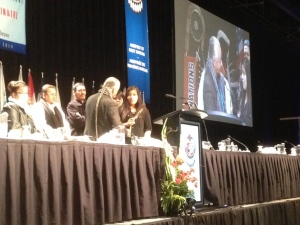
The Garden Hill First Nation teen, who is a student at Winnipeg’s Southeast Collegiate, received a standing ovation from the more than 3,000 chiefs and delegates at the Assembly of First Nations gathering in Winnipeg where they will elect a new national chief.
Chiefs from across Canada and other delegates to the AFN meeting gave Rinelle Harper a standing ovation as she was blessed and presented with eagle feather. (Karen Pauls/CBC)
Harper said she was speaking publicly at the meeting to “end violence against young women.”
She said she was “thankful for the thoughts and prayers from everyone” and said she wants to get back to school.
“I wish to continue on with my life and I am thankful I will be able to go back to school to see my friends and be with my family,” she said.
“Some people who have visited with me have shared their stories of healing. I ask that everyone here remembers a few simple words: love, kindness, respect and forgiveness.”
She ended her comments with a request.
[IMAGE]
”As a survivor I respectfully challenge you all to call for a national inquiry into missing and murdered indigenous women,” she said.
Plea comes ahead of election of AFN national chief
The AFN conference began Tuesday in Winnipeg as First Nations leaders from across Canada elect a new national chief to the Assembly of First Nations.
Winnipeg police chief, Devon Clunis, and Premier Greg Selinger were both present at the ceremonies, which opened with a drum circle.
There will also be a discussion about child welfare, First Nations education and missing and murdered indigenous women in Winnipeg.

Winnipeg’s chief of police and Manitoba premier taking part in the opening ceremonies of the AFN conference. (Cameron MacIntosh/CBC)
The election comes after former national Chief Shawn Atleo quit in May amid criticisms from chiefs that the AFN was getting too close with the Federal Government.
There are three names on the ballot: Perry Bellegarde from Saskatchewan, Leon Jourdain from Ontario, and Ghislain Picard, the current interim chief of the AFN.

AFN National Chief candidates are introduced in a forum in Winnipeg. Ghislain Picard, Perry Bellegarde and Leon Jourdaine are officially named as contenders for the top job. Voting takes place in Winnipeg on Dec. 10. (Chris Wattie/Reuters, Andrew Vaughan/Canadian Press, Facebook)
Manitoba Grand Chief Derek Nepinak said he is “not certain” he will even attend the event.
All three candidates have said the structure and vision of the AFN needs to change — something Nepinak tends to agree with.
He said the organization is losing touch and is struggling to stay relevant with indigenous people.
“I think if the AFN wants to be relevant on a going-forward basis, it’s going to have to engage at the community level,” said Nepinak. “That’s something it hasn’t done in a very, very long time.”
Pimicikamak (Cross Lake) First Nation Chief Cathy Merrick said she plans to be present for the election, but doesn’t know yet which of the three candidates she will vote for.
“They talk about treaty and aboriginal rights, and we need a leader that will speak and be able to come forth and protect those rights.”


