You heard of a feel-good movie? This is a feel-right movie. The
truths that are rooted in “The Good Lie” are exactly what set it free
from the trap of being the latest example of Hollywood-generated
inspirational hogwash. Not
that this intimate account of how a band of Sudanese orphans survived a
bloody civil war (which raged on for more than two decades starting in
1983) and managed to forge a fresh start in America years later isn’t
uplifting. How could it not be?
But instead of settling for being simplistic and condescending, this moving
story possesses an honesty that compensates for any of the more obvious
tugs on our tear ducts, most of which arrive in the latter part of the
film. The primary source of this authenticity is a cast populated with
South Sudanese actors who captivate without pretense. Two of
the three male leads, as well as the actress who plays their sister,
were caught up in the conflict before fleeing their homeland for asylum elsewhere. Two were child soldiers, one lost
a brother in the war.
An
innate understanding of what their parts entail pours forth from their very
being. You can sense it in their faces, their body language, in the
distinctive cadence of their speech, and in their humble though dignified
stances. Even the younger versions of their characters are the offspring
of the so-called “Lost Boys of Sudan.”
The
trailers and poster for “The Good Lie” give the impression that Reese
Witherspoon is the star and that her plucky Midwesterner is yet another
cinematic incarnation of a white savior coming to the rescue of
struggling black people, similar to the role that earned Sandra Bullock
an Academy Award in 2009’s “The Blind Side.” But
that’s just a marketing ploy that relies on its own good lie as a
selling tool: promoting an Oscar-winner as bait for a drama full of
unknowns.
There does exist a 2011 film, “Machine Gun Preacher,” that
fits that clichéd description in the manner in which it uses the Sudanese unrest as a
backdrop. The biopic verges on B-movie exploitation as it features Gerard Butler as a reformed drug-abusing outlaw biker who becomes a
missionary and pledges to defend the African orphans against guerrilla
forces. The outcome isn’t exactly awful, but the movie’s biggest mistake is
telling the wrong story about the wrong hero.
Instead,
“The Good Lie” honors its subject matter by devoting its first
half-hour or so to events that unfold in Sudan, starting with a sudden
and brutal attack on a rural village. Bullets are fired from a swooping
helicopter, killing everyone save for several children. Related or
not, they form a makeshift family and embark on a grueling 1,000-mile
barefoot trek across punishing terrain where the threat of danger is around
every bend.
Hoping to draw a wider audience with a PG-13 rating, Canadian director
Philippe Falardeau (“Monsieur Lazhar,” a 2011 nominee for best foreign
language film) skillfully finds a way to keep graphic violence at bay
and still get the point across with a harrowing sequence that involves
crossing a river strewn with floating dead bodies to evade the vicious
rebels nearby.
Starvation,
a lack of water and illness claim the lives of several of the
companions. As for Theo, who inherited his late father’s status as
chief, he allows himself to be captured to save the rest, who eventually
find sanctuary at a Kenyan refugee camp. And there they will stay for
13 years, until humanitarian efforts abroad allow them to seek a
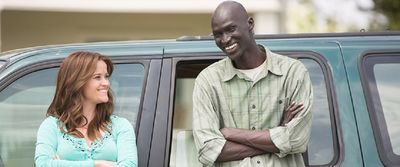
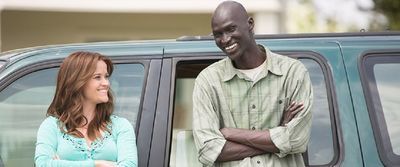
permanent home in Kansas City, Mo., where three of Theo’s brothers–gentle giant Jeremiah (Ger Duany), handyman Paul (Emmanuel Jal) and
Mamere (Arnold Oceng, a standout who knows how to express a lot with
little apparent effort)–are sent.
Enter
Witherspoon, with long brown locks that put her natural glow on a
dimmer switch. She’s Carrie Davis, a free-spirited single lady
(afternoon trysts and all that) and take-charge job recruiter tasked
with finding work for the trio. Unfortunately, when a rep from a
Christian charity group (bouncy Sarah Baker) can’t pick them up at the
airport, Carrie soon becomes a reluctant chauffeur and ambassador for
the three young men.
It
is a good thing these actors are charming enough that they aren’t too
hampered by a long string of fish-out-of-water gags. Everything from
escalators to telephones to lemon-lime Jell-O rings serve as sources of culture-shock humor. However, it is kind of cute when Mamere
thanks Carrie for her help by saying, “May you find a husband to fill
your empty house.”
But
the moment that best expresses the joy of their newfound freedom is
when Mamare shares a joke he heard at work that day: “Why did the
chicken cross the road?” The well-known punchline – “To get to the other
side” – results in fits of glorious laughter. When Paul starts
chuckling again minutes later, he explains with a grin, “I am thinking
about that chicken.”
Not
everything goes smoothly, of course. There are on-the-job misunderstandings, tensions between the brothers, and homesickness that is somewhat eased
whenever the trio visits the farm belonging to Carrie’s boss, Jack
(Corey Stoll, always a welcome sight) and hang out with his cows as they used to do in their village. Falardeau and screenwriter
Margaret Nagle (who developed TV’s new “Red Band Society”) lend a somber weight to their travails by relying on silent
flashbacks of past ordeals to suggest pangs of trauma, guilt, grief and
longing.
A
double whammy of complications closes the movie, one of which involves
sister Abital (the lovely Kuoth Wiel), who was forced to live with a
family in Boston when they all first arrived and has been separated from
her brothers ever since. Carrie, who finds herself becoming more and
more attached to the threesome, goes full pit bull and makes a reunion
her personal mission, red tape and post-9/11 regulations be damned.
The
trouble with these trumped-up hurdles is that they can’t match the
hellish journey that opens the film. If you can overcome that kind of
challenge so early in life, anything else should be a relative breeze. But if any movie deserves two potentially get-out-your-hanky endings,
it is this one. Ultimately, it is well worth believing in “The Good
Lie.”
Source:: http://www.rogerebert.com/reviews/the-good-lie-2014


