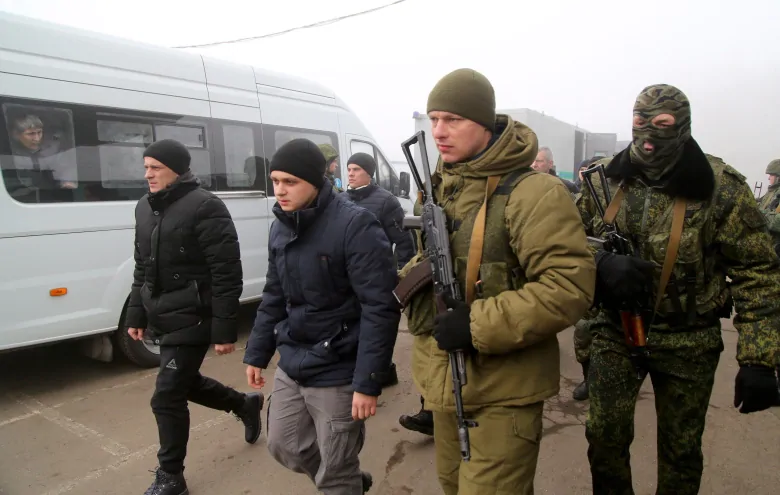
Ukrainian forces and Russia-backed rebels in eastern Ukraine began exchanging scores of prisoners Sunday in a move aimed at ending their five-year war.
The move was part of an agreement brokered earlier this month at a summit of the leaders of Ukraine, Russia, Germany and France.
A rebel government official and the Ukrainian president’s office confirmed that the swap had started at a checkpoint near the rebel-held city of Horlivka.
The total number of people freed was not immediately known, though authorities said earlier that 142 were expected to be involved in the exchange — 55 released by the rebels and 87 by Ukraine.
Those to be released by Ukraine included five former members of the now-disbanded special police force Berkut who were charged in the killing of protesters in Kyiv in 2014, Ukrainian news site Hromadske quoted their lawyer, Igor Varfolomeyev, as saying.
Ludmila Denisova, human rights envoy for the Ukrainian parliament, said the first group released by the rebels included Ukrainian soldiers.
Exchange agreed upon at summit in Paris
French President Emmanuel Macron and German Chancellor Angela Merkel issued a joint statement welcoming the exchange that was agreed upon by Ukrainian and Russian leaders at a summit in Paris earlier in December.
“The prisoner swap that was completed today is a long-awaited humanitarian measure,” said the statement from the French president’s office. “In line with the decisions taken at the Paris summit, it must now be followed by the full implementation of the ceasefire.”
The last major prisoner swap between separatist rebels and Ukrainian forces took place in December 2017, with 233 rebels exchanged for 73 Ukrainians.
The conflict in eastern Ukraine has killed more than 14,000 people since 2014. It began about two months after Ukraine’s Russia-friendly president fled the country amid massive protests in Kyiv. Russia’s annexation of the Crimean Peninsula soon followed.
Hopes for an end to the fighting have risen since the spring election of Ukrainian President Volodymyr Zelensky, who has been more amenable to negotiations with Russia on ending the war.
But prospects for peace are still troubled by questions over allowing local elections that would ensure the rebel regions more autonomy and about Ukraine regaining control of its border with Russia in the rebel areas.