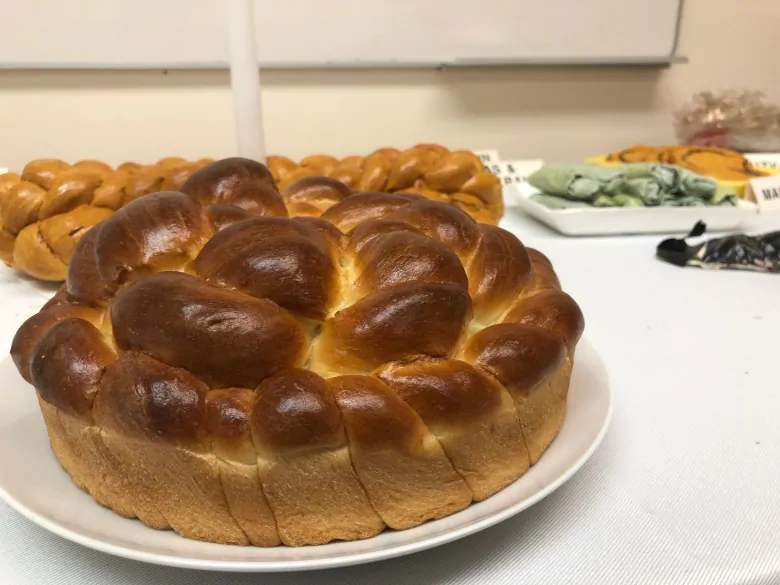
This story is part of an ongoing Edmonton AM series showcasing the holiday traditions and favourite family recipes of four Edmonton families.
Joyce Sirski-Howell remembers her father ladling out spoonfuls of cabbage and borscht from the family’s Christmas Eve dinner to feed to the cows in the barn.
It’s part of an old Ukrainian custom said to honour the animals who witnessed the birth of baby Jesus in the manger.
“The father of the household would take a sampling of each of the foods and feed it to the cattle,” Sirski-Howell said.
“They would share that meal with the cows because they were a producer of food for them … I remember my father doing it a couple times.”
Ukrainian Christmas is one steeped in tradition and a mix of pagan rituals and Christian customs that have been passed down from generation to generation.
Sirski-Howell celebrates Sviatyi Vechir with her family each year by preparing twelve traditional meatless dishes representing the twelve disciples.
For those who follow the Julian calendar, families gather for the Sviata Vecherya (Holy Supper) on Jan. 6. But the feast cannot begin until the sun goes down.
“We watch for the first star in the evening,” Sirski-Howell said. “And that’s the children’s job, to peer out the window to see the first star, and that’s to tell us the meal should start.
“It’s just a wonderful celebration but it’s a lot of work to prepare for the evening meal.”
Honouring ancestors
The feast includes pickled herring, cabbage rolls, and beet borscht. But kutia, a sweet, boiled wheat soup rarely prepared outside the holiday season, is always served first.
Wheat makes it way into almost every dish.
Sirski-Howell said the meal is meant to honour family and faith.
“Wheat was a very important part of the agricultural life of the Ukraine, and Ukraine is often called the breadbasket of Europe,” she said.
“And there are three components of wheat that we use. We bring in the didukh, which is a sheaf of wheat to honour and remember our ancestors.

It is traditional for everyone to eat at least one spoonful of the kutia, as it represents the union of the living with their ancestors.
In olden days, it was traditional to throw a spoonful of the sweet soup onto the ceiling. If it stuck, the family would have a bountiful year.
Sirski-Howell’s father observed a different version of the tradition at their Manitoba farm house.
“I remember my dad would say, if you threw a shoe over the roof of the house, depending on where it hit, that would show what area your future husband might come from. I always think about that.”
And while Sirski-Howell is already busy preparing for her annual feast, she said Christmas for won’t truly start until after the big meal, when she hears the notes of the divine liturgy at midnight.
For her, that is the sound of Christmas.
“When the choir sings it, it’s just so beautiful it’s hard to describe. It’s just a beautiful carol.”
Sirski-Howell’s family recipe for beets with mushrooms:
- 1 medium onion, finely chopped
- ½ cup oil
- 4 cups cooked beets, cut in thin strips
- 1 cup sliced cooked mushrooms ( 1 tin gives 1 cup)
- 3 cloves garlic, crushed
- 1 tbsp sugar
- 2 tbsp vinegar
- ¼ tsp salt
- ¼ tsp pepper
Sauté onion in oil until golden but not brown. Add remaining ingredients and stir gently. Chill overnight. Serves eight.