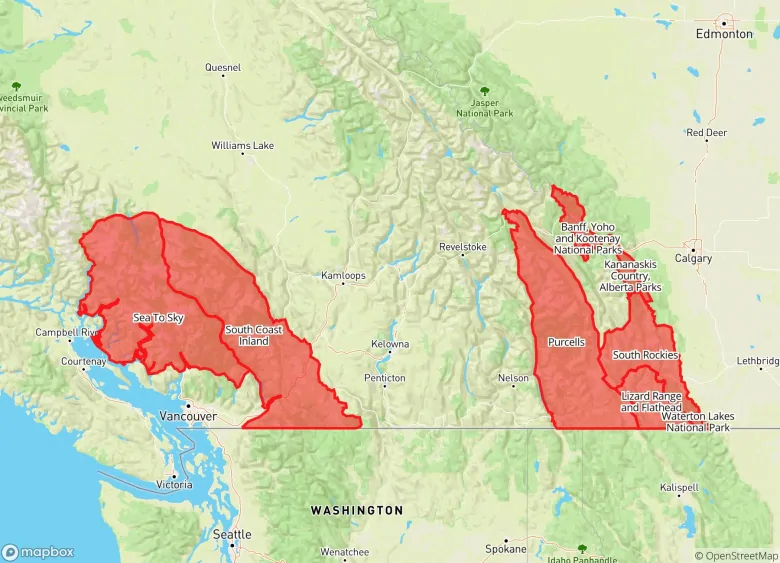
A widespread public avalanche warning is in effect for mountains across southern B.C. and Alberta — for both backcountry terrain and more accessible areas.
The region has seen a significant dump of snow over the last few days, with more than 120 centimetres falling in some areas. The new snow is sitting on top of a weak layer, which makes the snow more prone to slides, according to Avalanche Canada.
Several avalanches have already occurred in the last few days, in areas that are historically prone to slides.
On Saturday, for example, a CP freight train was struck by an avalanche in Glacier National Park. No injuries were reported.
The avalanche forecasting organization — along with Parks Canada and Alberta’s Kananaskis Country — is warning anyone heading into the mountains to take safety precautions.
“Many slopes are primed for human-triggered avalanches,” Ilya Storm, forecast program supervisor, said in a statement.
“Distinguishing between slopes that have already slid and those that are the tipping point will be very difficult.”
The public warning applies to these regions:
- Sea-to-Sky
- South Rockies
- South Coast Inland
- Kananaskis Country
- Purcells
- Banff-Yoho-Kootenay National Parks
- Lizard Range-Flathead
- Waterton Lakes National Park
The danger rating for the regions ranges from high to considerable, depending on the area and elevation, which means the terrain is described as dangerous and human-triggered avalanches are likely.
Storm says the clear weather in the forecast for the upcoming week is a concern as more people may be heading out to the mountains during the Christmas holidays.
It’s not just those exploring the backcountry who need to take precautions, she said. Popular summer trails that are used for winter hiking or snowshoeing are also exposed to avalanche terrain.
Anyone venturing into the backcountry should carry essential avalanche gear like a transceiver, probe and shovel, according to Avalanche Canada, but travel in high risk areas is discouraged regardless of safety equipment.