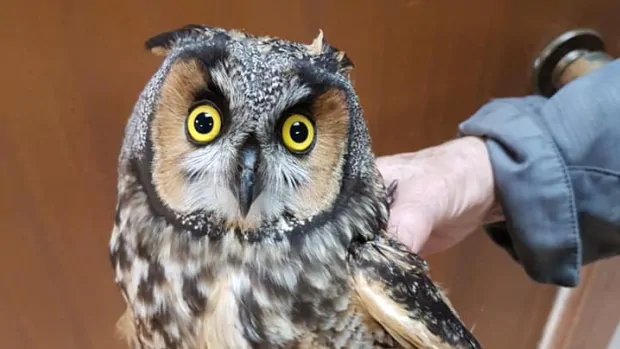
Have you been trying to rid your home of a mouse infestation? The mice you catch can now be used as frozen entrees for rescue birds.
The Alberta Society for Injured Birds of Prey is asking for donations of dead mice to be fed to its flock of hawks, falcons, owls and eagles.
For these sharp-beaked birds, lifeless rodents are a special treat.
“A lot of the birds prefer that type of food,” executive director Karl Grantmyre told CBC Radio’s Edmonton AM.
“And I mean, if people are catching mice, we’re happy to recycle.”
The society, based in Sherwood Park, takes in dozens of orphaned or injured birds for rehabilitation each year. Some are malnourished and wouldn’t otherwise be able to survive the winter.
“It’s usually the young birds that have just started out, or birds that haven’t been getting enough food because of competition for hunting areas,” Grantmyre said.
“If they come to us underweight, then we have to keep them all winter and let them go when food is easier to catch.
“Some of them are just slow to develop. It takes them a little bit longer to get into the swing of things which means we often have quite a few that are overwintering with us.”
‘Fresh or frozen’
The birds have big appetites and can devour up to three plump mice each day.
And while the society has a healthy supply of other meaty snacks, for some birds, store-bought cuts just don’t cut it.
Some birds at the shelter are picky or are just too wild to recognize something lacking fur as food.
They want something that they’re used to.-Karl Grantmyre
“And some of them, that’s all they recognize when they come in,” he said.
“If we give them a piece of meat, they won’t eat it, some of them. They want something that they’re used to.”
The association only wants mice that have been killed in humane traps and not exposed to any kind of poison or glue. A few people have already answered the call for donations, Grantmyre said.
He recommends donated mice be frozen for transport.
To a hungry bird, frozen mice are just as nice.
“We don’t feed things live. Only fresh or frozen,” Grantmyre said.
“The only time we feed them live is when we know they’ve never hunted anything. We do that to sort of get that out of the way.
“Once that happens, a switch goes off in them and they’re like, ‘Oh, this is what I’m meant to do.’ It’s instinctual.”