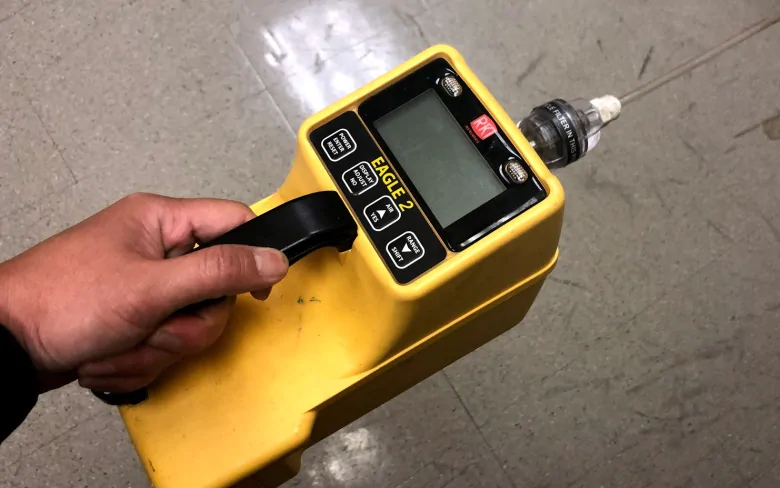
Sniffing gas is what the Eagle 2 does best.
The yellow handheld device, about the size of a small jerry can, can detect up to six different gases at once including methane and carbon dioxide.
It’s just one of the many rugged and often odd-looking gadgets stored inside a downtown Calgary office.
In that office space, emission specialist Joshua Anhalt is surrounded by valves, meters, pumps and hardshell suitcases. There’s even a listening device that looks like a gun straight out of the film RoboCop.
“Travelling through security, through an X-ray machine? You get pulled over every single time,” he said while laughing.
They’re all tools of the trade in the world of carbon accounting with some of the technology developed in-house and the rest collected by Anhalt and his associates over time.
Anhalt’s company, GreenPath, specializes in detecting methane emissions and leaks.
According to him, business is booming right now thanks in part to regulatory changes related to climate change, along with an increasing desire among businesses to reduce their carbon footprint.

“Ninety per cent of [the company’s growth is within the last year,” Anhalt said about GreenPath and its 15-person staff.
“Massive revenue increase just because of a growing market demand. By this time next year we should be employing about 50 to 60 people within the company,” he said.
For Anhalt, it all began 14 years ago, when he was 25, working as an oil and gas instrumentation technologist in Alberta.
“I was in a field, driving a truck, bending tubes,” he recalled.
It sees methane, ethane, propane, butane. I said, ‘That’s a business!’– GreenPath emission specialist Joshua Anhalt
At the time, Anhalt was primarily concerned about what’s called “fugitive emissions” — natural gas escaping because of a bad seal or bad venting.
He knew there had to be a better way to detect leaks. Then one night, seemingly out of nowhere, his web browser showed an ad for an infrared camera.
“It sees methane, ethane, propane, butane. I said, ‘That’s a business!'” explained Anhalt.
The camera, made by thermal imaging company FLIR Systems, gives the user “Predator vision” like the aliens in the 1987 film.
Scientists have long used infrared radiation to observe the atmosphere, but few were using it to detect methane leaks when Anhalt and his friends pooled together $140,000 to buy the camera.
Over the next few years, his team drove all over Western Canada, like detectives hunting down fugitive emissions.
At first, most of the work came from oil and gas companies looking to save money by increasing efficiency.
But then regulations kicked in.
From carbon markets to the carbon tax, the various carbon pricing schemes have created a growing demand for professionals like Anhalt who have the skills and experience to measure, detect and verify things largely invisible to the eye.
Things like methane or carbon dioxide.
Alberta first to put a price on large emissions
In 2007, Alberta became the first jurisdiction in North America to introduce a carbon market. The Climate Change and Emissions Management Act required large industrial emitters, such as oilsands operators, to report and reduce emissions.
Companies that fail to meet their target can either contribute to the province’s climate change fund, or purchase carbon offset credits from another body.

For example, a meat-processing plant may install a large cover to sequester methane emissions from its wastewater lagoon — emissions that would otherwise be released into the atmosphere, contributing to climate change.
For every tonne of emission cut through the plant’s methane capture, it earns one offset credit. That same plant can now turn to the Alberta Carbon Registries, and sell those credits to an energy firm.
Carbon offsets, like cap and trade, leverage the forces of the free market to reduce overall emissions.
“It’s a win-win-win solution,” said Jonathan Smith, senior director of sourcing and sales at Bluesource in Calgary. His company helps businesses, along with both governments and non-governmental organizations to broker deals and environmental solutions with each other.

“I think a simpler explanation would be bringing the environment and business together,” said Smith with regards to his work.
“The idea is to use the free market to allow and to encourage investment in emission reduction projects,” Smith explained.
“If that’s installing a wind farm? Great. If it’s installing new technology to make oil and gas more efficient and produce less methane? Perfect.”
Written by Falice Chin.